From Aggregations to Individuals: Exploring Migrating Deep-Sea Scattering Layers Through Multiscale-Multimode Technologies in the Gulf of Mexico

From Aggregations to Individuals: Exploring Migrating Deep-Sea Scattering Layers Through Multiscale-Multimode Technologies in the Gulf of Mexico

Past Expedition

Dates
July 26 to August 1, 2021
Location
Gulf of Mexico/Caribbean
Vessel
R/V Point Sur

Overview

From July 26 to August 1, 2021, a multi-institutional science team set sail aboard the R/V Point Sur from Gulfport, Mississippi and headed towards DeSoto Canyon. The objectives of this mission, funded by NOAA Ocean Exploration, were to deploy two different autonomous sensor platforms developed as part of this project: National Geographic Society’s Driftcam and the Teledyne Webb Research Slocum glider. During this cruise we focused on areas that have been studied extensively during the DEEPEND|RESTORE program  in the Gulf of Mexico (GoM).

Features

A one-week cruise aboard the R/V Point Sur was conducted to deploy two different autonomous sensor platforms developed as part of this project to explore the sound scattering layers of the Gulf of Mexico.
September 3, 2021
One of the goals of this expedition is to deploy an autonomous glider that transmits data via Iridium satellite during the course of a mission, while the glider is at the ocean’s surface.
August 4, 2021
Impactful science often comes from collaborative efforts, when experts from different disciplines assemble to provide unique perspectives and form new ideas.
August 4, 2021
View More View Less
Releasing tens of thousands of dollars of instrumentation into the ocean is tricky — you may not get it back once it’s in the water.
August 2, 2021
The increased use of ocean robots, such as autonomous underwater vehicles (AUVs), is expanding the resolution, range, and duration of physical and biological measurements collected throughout the water column in the world’s ocean.
July 30, 2021
The Second Star Robotics and National Geographic team working on the Driftcam.
The National Geographic Society Driftcam is an untethered mid-water imaging system, built to collect detailed information about ocean animals via high-resolution video, at depths as deep as 700 meters (2,297 feet).
July 28, 2021
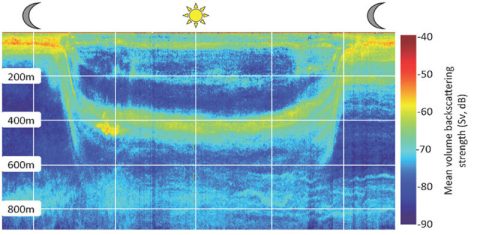
Echogram illustrating the ascending and descending phases of the diel migrations (warmer colors) through the water column. The downward and upward migration activity occurs during dawn and dusk periods. The color scale represents the strength of the sound that is reflected by the organisms in the water column from the ship-based sonar. Cooler colors show less sound reflected and warmer colors show more sound reflected, indicating the presence and density of animals.
The pelagic habitat contains a diverse and highly specialized fauna, with adaptations becoming more and more “bizarre” as one goes deeper into the water column.
July 28, 2021
Echosounders have been employed in fisheries and ocean research for decades to detect fish, plankton, and features both on the seabed and in the water column.
July 28, 2021
Figure 1. Acoustic backscatter data at 18kHz (top) and 38 kHz (bottom) shows the vertical and horizontal distribution of biological scatterers associated with the shelf break in the northern Gulf of Mexico. Color scale represents acoustic scattering intensity (in dB re 1 m-1).
The oceanic rim ecosystem, including waters of the outer continental shelf, is arguably the least-known marine habitat in the U.S. Exclusive Economic Zone (EEZ).
July 27, 2021

Multimedia

Featured multimedia assets associated with this project.

Meet the Exploration Team

Learn more about the team members and their contributions to this project.

Principal Investigator - Florida International University
Director of Operations, National Geographic Exploration Technology Lab
Co-founder, Second Star Robotics
Professor and Director, Cooperative Institute for Climate, Ocean, and Ecosystem Studies (CICOES) - University of Washington
Research Faculty - University of South Florida
Project Manager, DEEPEND Consortium - Nova Southeastern University

Resources & Contacts