


2026 Pacific Islands Mapping
Embarking a Polliwog, Disembarking a Shellback: Carrying On One of the Oldest Maritime Traditions
As a first-time sailor, there have been many milestones during this expedition. The first sunset at sea. The first time watching the horizon stretch so far in every direction that land became only a memory. Transitioning from feeling the ship’s motion as a constant annoyance to simply moving with the sway of the vessel without conscious effort. That first collective laugh in the mess hall or during a shared break where professional titles drop away, and the subsequent realization that these strangers are now my “expedition family” and primary support system.

One of many magical sunsets seen during the 2026 Pacific Islands Mapping Expedition. Image courtesy of NOAA Ocean Exploration, 2026 Pacific Islands Mapping. Download largest version (jpg, 1 MB).
The Equator Crossing(s)
Another unforgettable first arrived just after 3:35 am HST on June 23, when the ship crossed the equator at a longitude of -162.64°. It marked the beginning of an age-old maritime tradition celebrating the transformation of “polliwogs” into “shellbacks.” Conducting a line-crossing ceremony, most famously when crossing the equator, is a time-honored maritime tradition. A custom that dates back hundreds of years, military and civilian sailors around the globe carry on this tradition today. Sailors who have not yet crossed start as polliwogs and, after a trial, “King Neptune” initiates them into the “Ancient Order of the Deep.” This honor is then commemorated with a traditional naval certificate, marking them as a shellback for the rest of their sailing career.
On NOAA Ship Okeanos Explorer, operational duties remained the primary focus, a departure from the historical customs of shellback ceremonies which typically involved festivities leading up to and occurring on the day of the equator crossing. During the 2026 Pacific Islands Mapping Expedition, the celebration of that milestone came after weeks of around-the-clock mapping operations, conductivity, temperature, and depth (CTD) rosette deployments, and environmental DNA (eDNA) sampling that will help scientists better understand the Pacific seafloor and the biodiversity hidden in the depths of the ocean. Interestingly, due to the nature of this mapping expedition, the ship crossed the equator a total of five times!
For some aboard, like myself, this was not only our first time crossing the equator but also our maiden voyage at sea. Others had been on multiple expeditions and spent years at sea waiting to achieve this milestone, and a few arrived with shellback certificates earned during previous expeditions in other parts of the world. Experience varied widely, but the excitement was shared by everyone.

The mapping path for the 2026 Pacific Islands Mapping expedition shows Okeanos Explorer crossing the equator a total of five times during its voyage. Image courtesy of NOAA Ocean Exploration, 2026 Pacific Islands Mapping. Download largest version (jpg, 854 KB).
Traditions and Preparation
As the ship entered “King Neptune’s realm,” mysterious notices began appearing throughout the passageways. Crew members quietly whispered about “Royal Court business,” while secretive shellback meetings appeared on the daily schedule with little explanation offered to curious first-timers. The anticipation became part of the adventure.
As tradition dictates, every polliwog was assigned a nautical identity and a lighthearted charge to answer before King Neptune’s court. Some names reflected personalities, while others highlighted shipboard roles. Assigned as photographer and videographer for this voyage in addition to science support, I was dubbed “Paparazzi Polliwog,” accused of documenting Neptune’s realm and capturing the likenesses of honorable shellbacks. My sentence? Create a portrait worthy of presentation before the Royal Court. The piece was well received and has now been donated to the ship. In addition, polliwogs were given an egg to care for until the ceremony, housing their “shellback soul.”
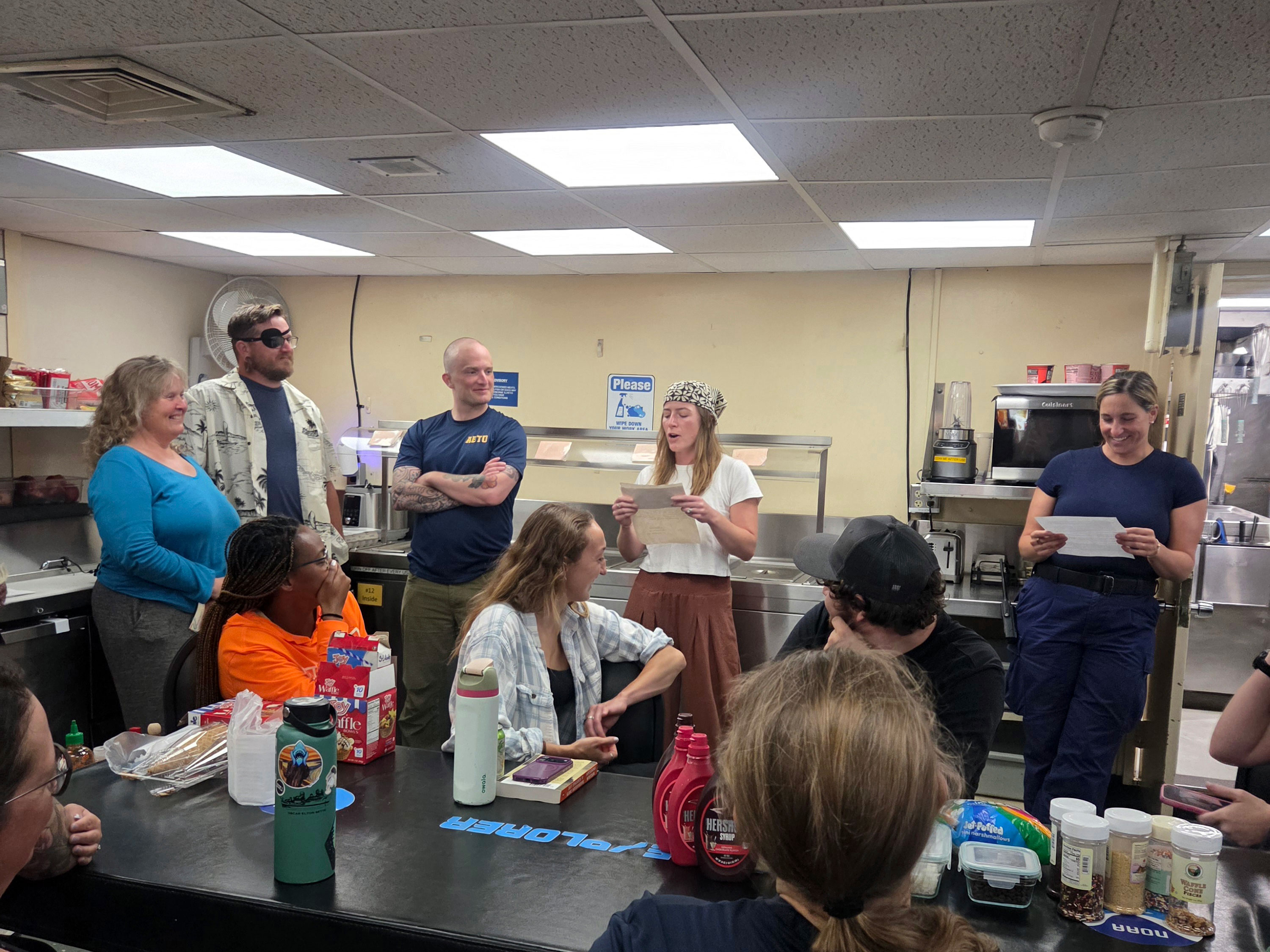
Shellbacks and polliwogs gather in the mess hall where the future shellbacks were given their Polliwog names, charges, and sentences. Image courtesy of NOAA Ocean Exploration, 2026 Pacific Islands Mapping. Download largest version (jpg, 1 MB).

The painting I created to present to the Royal Court. Our Knauss Fellow was sentenced to craft an elaborate crown (shown in background). Image courtesy of NOAA Ocean Exploration, 2026 Pacific Islands Mapping. Download largest version (jpg, 1 MB).
Outside of daily work routines, downtime preparations continued with equal parts curiosity and amusement. Polliwogs also received pledges and ship trivia to memorize, and just enough mysterious instructions to keep everyone guessing. Then came one of the expedition’s most entertaining evenings.
The Talent Show
For this particular voyage, polliwogs who chose to participate were to prove their worthiness of Neptune’s consideration by performing in a talent show before the Royal Court, filling the evening with merriment. Sea shanties filled the room, accompanied by an unforgettable rendition of “Knock, Knock, Knockin’ on Neptune’s Door.” The entertainment featured card tricks performed by Knauss Fellow Shari Rohret and me, shadow puppets, original poetry, creative storytelling, singing, and dancing, showcasing a wide variety of hidden talents among our colleagues. Adding a unique twist, the ship’s registered nurse used familiar tunes such as “Staying Alive,” “Pink Pony Club,” and “Baby Shark” to demonstrate proper cardiopulmonary resuscitation (CPR) chest compression timing.
While the performances were entertaining, the evening’s true significance was found in the camaraderie that filled the room. The science team, officers, engineers, technicians, and stewards stepped outside their daily duties to cheer one another on. The exciting evening was filled with applause, laughter, and shared memories.
The Ceremony
The next day marked the culmination of the preparations. In keeping with tradition, many participants arrived wearing their clothes inside out before the Royal Court convened for the long-awaited shellback ceremony.
While shellback ceremonies have historically included far more rigorous initiation rites, modern ceremonies aboard Okeanos Explorer emphasize participation, camaraderie, respect, and fun. All activities are optional and those who choose to participate do so knowing the event is meant to celebrate crossing one of Earth’s most significant geographic reference lines while honoring generations of sailors who have crossed before them.
Designed as a tribute to historical traditions, the “polliwogs” navigated a series of obstacles known as “the gauntlet,” where members of “King Neptune’s Royal Court” presented them with playful challenges and dramatic performances that reimagined classic maritime trials. All activities were good-natured and met with as much laughter from participants as from those cheering them on.
Before receiving our ornate shellback certificates, each polliwog relinquished their carefully guarded egg, the symbolic home of their “shellback soul,” to the sea as an offering to Neptune. One by one, participants shared something they were grateful for or appreciated about this journey before casting their egg overboard, taking a quiet moment to reflect before officially joining the ranks of the shellbacks.
By day’s end, first-time ocean voyagers were no longer polliwogs. We joined generations of shellbacks carrying not only a certificate, but also stories of secret meetings, mysterious proclamations, inside-out clothing, and an unforgettable equator crossing aboard a ship dedicated to exploring our ocean.

An ornate shellback certificate and card, awarded to participants who completed the equator crossing during the 2026 Pacific Islands Mapping Expedition, officially marking their transition from polliwog to shellback. Image courtesy of NOAA Ocean Exploration, 2026 Pacific Islands Mapping. Download largest version (jpg, 1 MB).
Reflection
Long after the expedition comes to an end and the shellback certificates are hung or tucked away, many aboard will likely remember something less tangible. We will remember the applause that followed every talent show performance, the perseverance and encouragement shared among shipmates, the laughter that carried through the passageways, and the friendships strengthened through weeks of living and working together at sea. Those memories, as much as the certificate itself, are what make the journey from polliwog to shellback worth celebrating.
By Michelle Whitman, NOAA Ocean Exploration