


Ocean Exploration Facts
The ocean exploration facts in this section provide short answers to common or intriguing ocean questions. The questions are organized in a series of categories; click on a category to learn more about these topics.
For many ocean exploration facts, content has been repurposed from essays posted elsewhere on the website; to access the original content, click on links available on individual ocean fact pages.

An Expendable Bathythermograph (XBT) is a probe used to measure temperature throughout the water column.

The average depth of the ocean is 3,682 meters, or 12,080 feet.

Sargassum is a genus of large brown seaweed (a type of algae) that floats in island-like masses and never attaches to the seafloor.

In geology, a hotspot is an area of the Earth’s mantle from which hot plumes rise upward, forming volcanoes on the overlying crust.

The mid-ocean ridge is the most extensive chain of mountains on Earth, stretching nearly 65,000 kilometers (40,390 miles) and with more than 90 percent of the mountain range lying in the deep ocean.

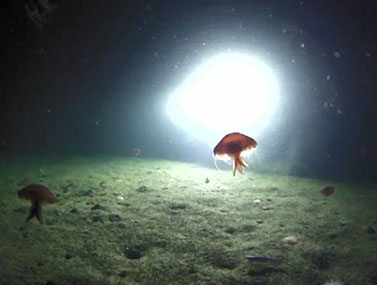
Red light does not reach ocean depths, so deep-sea animals that are red actually appear black and thus are less visible to predators and prey.

Isopods are an order of marine invertebrates (animals without backbones) that belong to the greater crustacean group of animals, which includes crabs and shrimp.

Deep ocean trenches, volcanoes, island arcs, submarine mountain ranges, and fault lines are examples of features that can form along plate tectonic boundaries.

“ROV” stands for remotely operated vehicle; ROVs are unoccupied, highly maneuverable underwater machines operated by someone at the water surface.

A marine protected area is a defined region designated and managed for the long-term conservation of marine resources, ecosystems services, or cultural heritage.

CTD stands for conductivity, temperature, and depth, and refers to a package of electronic instruments that measure these properties.
Exploration is key to increasing our understanding of the ocean, so we can more effectively manage, conserve, regulate, and use ocean resources that are vital to our economy and to all of our lives.