


Ocean Exploration Facts
The ocean exploration facts in this section provide short answers to common or intriguing ocean questions. The questions are organized in a series of categories; click on a category to learn more about these topics.
For many ocean exploration facts, content has been repurposed from essays posted elsewhere on the website; to access the original content, click on links available on individual ocean fact pages.

Oxygen minimum zones are persistent layers in the water column that have low oxygen concentration due to biological, chemical, and physical processes.

A shakedown is an expedition that tests a ship’s mission systems and equipment before a field season.

Cold seeps are relatively stable, long-lived places in the ocean where hydrocarbon-rich fluid that is of a similar temperature to surrounding water seeps up from cracks in the seafloor while hydrothermal vents are volatile, short-lived openings in the seafloor created through volcanism where magma-heated, high-temperature water emerges.

The deep scattering layer (or DSL) is a region in the water column where there is a high density of marine organisms that reflect sound.

Marine meiofauna are a group of animals small enough to live in between the grains of sand and mud on the seafloor.

Sponges are ancient animals that may appear simplistic, but the more we study them, the more we realize how complex they are. They are bizarre and beautiful – nothing like the yellow, plastic rectangle next to your kitchen sink.

A "natural product" is a chemical compound or substance made by a living organism.
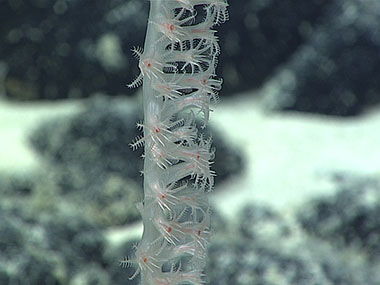
Sclerites are tiny, microskeletal structures embedded in an octocoral's soft tissue that provide the animal support and protection.
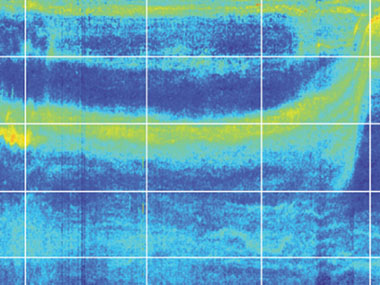
The Earth’s greatest migration and a major influencer on ocean and planetary systems.

Habitat connectivity refers to how and to what degree distinct patches of habitat are connected, which can influence the distribution, genetic diversity, and health of animal and plant populations.

An “exclusive economic zone,” or “EEZ” is an area of the ocean, generally extending 200 nautical miles (230 miles) beyond a nation's territorial sea, within which a coastal nation has jurisdiction over both living and nonliving resources.

Animals living only in marine caves have adapted to environments with low light and often low levels of oxygen.