


2026 Mapping Shakedown (EX2602)
Exploration Team

Logan Kline is an operations support analyst with NOAA Ocean Exploration. She supports the Expeditions and Exploration division and also serves as the executive secretary of the Interagency Working Group on Ocean Exploration and Characterization. Logan holds a Master of Science in ecology and environmental science from the University of Maine and a Bachelor of Science in environmental science and policy from the University of Maryland, College Park. For her graduate work, Logan investigated the efficacy of an artificial intelligence algorithm designed to detect and identify seabirds in plane-based imagery of Maine’s coastal islands. She has been involved with NOAA in multiple capacities, including as an Ernest F. Hollings scholar interning at the NOAA Northeast Fisheries Science Center and as a Sea Grant Knauss Fellow in NOAA Ocean Exploration. Logan is very interested in the intersection of emerging technologies and wildlife monitoring; she has experience in remote sensing, geographic information systems, computer vision, uncrewed aerial vehicles, and passive acoustics.

Gretchen Spencer is a management analyst for NOAA Ocean Exploration, where she works on office-wide initiatives that focus on programmatic and policy issues that cross the spectrum of the office. She was a 2023 John A. Knauss marine policy fellow at the NOAA Research front office, where she supported the NOAA Research chief of staff and the executive leadership team and also worked as an executive secretary for the Subcommittee on Ocean Science and Technology and the National Ocean Mapping, Exploration and Characterization Council. Gretchen earned a master’s degree in marine science from Nova Southeastern University in Florida, where her thesis focused on the biogeochemical cycles occurring in mangrove ecosystems. While pursuing her master’s degree, she worked as the education and outreach specialist for the Marine Environmental Education Center, educating the public about marine conservation and caring for the two resident sea turtles. Gretchen received her bachelor’s degree in marine biology from the University of Maine.

Neah Baechler is a member of the NOAA Ocean Exploration Technical Operations Team with a multidisciplinary background in seafloor mapping, GIS, and marine geology on crewed and uncrewed platforms and a career focus in ocean exploration and sustainability. She graduated from the College of Charleston Benthic Acoustic Mapping and Survey (BEAMS) program with a degree in geology in 2015 and launched her hydrographic career as an explorer-in-training aboard NOAA Ship Okeanos Explorer shortly after. She was a contractor predominantly on Okeanos Explorer and Exploration Vessel Nautilus, working with Kongsberg mapping systems and navigating for remotely operated vehicle dives until she joined Saildrone in 2022 as the lead surveyor for bathymetric data collection on uncrewed surface vessels (USVs). Neah was most recently the bathymetry operations manager at Saildrone, shaping drone capabilities and bathymetric procedures and pushing the envelope on USV capability. When she’s not mapping the seafloor, you can find Neah in her garden, playing outside around her hometown of Portland, Oregon, and painting moody water colors.

Adrienne Copeland, Ph.D., is the acting program manager for NOAA’s Deep Sea Coral Research and Technology Program and a physical scientist with NOAA Ocean Exploration where she oversees the office’s biological acoustic priorities. She specializes in the use of active and passive acoustic collection methods to understand pelagic predator-prey dynamics. Adrienne received her bachelor’s degree in biology and a certificate in mathematical biology from Washington State University, and her doctorate in zoology with a marine biology specialization from the University of Hawaiʻi at Mānoa. Her undergraduate and graduate research ranged from single-celled parasite genetics to mammalian behavior, but all of her diverse research projects employed mathematical tools to understand biological principles. Adrienne has designed and directed several at-sea research projects and has served as chief scientist on six expeditions. For this expedition, she will lead the calibration of the ship’s scientific echosounders — a tool used to explore the water column, which, by volume, is the largest unexplored biome on the planet.

Rachel Simon is a data and video engineer with the University of Rhode Island (URI) Graduate School of Oceanography’s Inner Space Center. She holds a bachelor’s degree in electrical engineering from URI. After working several years in broadcasting — operating an early-generation audio-over-IP infrastructure — she pivoted to ocean research. She began as a shoreside engineering watchstander supporting expeditions on NOAA Ship Okeanos Explorer. Her first at-sea expedition was in 2019, supporting video systems for BBC’s Blue Planet Live aboard Research Vessel Atlantis. Since then, Rachel has worked on nearly 15 different vessels. Rachel’s most recent at-sea experience was aboard Exploration Vessel Nautilus, which took her to Hawai‘i, American Samoa, Palau, Guam, the Solomon Islands, and the atoll of Majuro in the Marshall Islands. Rachel is excited to finally work on the “wet end” of Okeanos Explorer telepresence systems. While not at sea, she is living her best life in exciting downtown Providence, Rhode Island.

Treyson (Trey) Gillespie lives in Charleston, South Carolina, and holds a bachelor’s degree in geology and environmental geosciences and a master’s degree in environmental and sustainability studies from the College of Charleston. While there, Trey completed the BEnthic Acoustic Mapping & Survey (BEAMS) program, where he gained experience processing and analyzing multibeam bathymetric data for applied scientific research. As a result, Trey has worked with a variety of international and domestic organizations such as Seabed 2030, Geological Survey Ireland, the INFOMAR Project, the U.S. federal government (as a NOAA explorer-in-training and as an independent contractor), and aboard several University-National Oceanographic Laboratory System (UNOLS) vessels in support of oceanographic science and as a mentor to undergraduate students and interns. Since 2019, Trey has worked with academic, commercial, and governmental vessels to map our global ocean in support of the greater scientific community. Trey now works in a scientist III role with the University Corporation for Atmospheric Research, serving as a member of the technical operations team for NOAA Ocean Exploration.

Danielle Warren is a member of the NOAA Ocean Exploration Technical Operations Team. She has a bachelor’s degree in biological sciences/marine science and over eight years of sailing experience as a NOAA senior survey technician across NOAA’s fleet of oceanographic and fisheries research vessels. Her main areas of expertise include CTD (conductivity, temperature, depth) operations, scientific data collection and management, and seafloor mapping. In her time with NOAA, she sailed seven ships and supported upwards of 30 scientific research missions while also spearheading training initiatives, shipboard metadata updates, and work transition programs to provide better work/life balance and training opportunities to current and future survey technicians. When not at work, Danielle can be found curled up with a good book or one of her craft projects.

Melissa Gonsalves is currently pursuing a professional science master’s degree in cybersecurity at the University of Rhode Island and holds a bachelor’s degree in information technology from Southern New Hampshire University. She has experience in network and systems engineering across multiple industries, with a focus on maintaining secure, reliable infrastructure and communications in operational environments. Her additional professional experience includes serving as a lead information technologist aboard academic research fleet (ARF) vessels and contributing as a member of the University-National Oceanographic Laboratory System (UNOLS) Satellite and Network Advisory Group. She has previously sailed on several ARF research vessels and is excited for her first time aboard NOAA Ship Okeanos Explorer as a data/telepresence engineer, supporting the transmission and accessibility of scientific data at sea. An environmentalist with a love for the ocean and a passion for travel, she enjoys writing and performing original music and spending time in nature. Melissa currently resides with her family in lovely Charlestown, Rhode Island.

Ventsi Gotov is a data/telepresence engineer at the University of Rhode Island’s (URI) Inner Space Center, supporting network and computer systems for oceanographic research operations. With over 10 years of network engineering experience spanning internet service providers and enterprise environments, he has recently expanded into IP video engineering, working with SMPTE 2110 systems. Ventsi earned his bachelor’s degree in information systems from Bryant University and his master’s degree in computer science from URI, where he specialized in algorithms and data science. Originally from Bulgaria, Ventsi has called Rhode Island home for 20 years and lives there with his family. His career has also taken him to New Zealand, where he lived and worked for several years.

Margaret Hanley holds a bachelor’s degree in geology from the College of Charleston and is an alumna of the BEnthic Acoustic Mapping and Survey (BEAMS) program. She is pursuing a master’s degree in marine science with a concentration in hydrography at the University of South Florida and the Center for Ocean Mapping and Innovative Technologies. Her thesis research uses multibeam data and video imagery to characterize glacial seafloor morphology and habitats along the Sabrina Coast in East Antarctica. Her introduction to ocean exploration came as an explorer-in-training (EIT) aboard NOAA Ship Okeanos Explorer. She later served on the ship as a mapping watch lead, assisting with mapping operations and training other EITs. Her additional professional experience includes time with NOAA’s Office of Coast Survey External Source Data team; charting work with Woolpert in Nome, Alaska; and remote survey operations with Saildrone. Margaret is based in St. Petersburg, Florida, where she can often be found on the water or out with her dog.

Philip L. Hoffman is the NOAA Ocean Exploration Technology Portfolio lead and uncrewed maritime systems research and development coordinator. He also serves as the office’s primary research and development liaison to the NOAA Uncrewed Systems Operations Center and manages the NOAA/Navy CENOTE (Commercial Engagement Through Ocean Technology) working group. In these roles, he leverages the broad relationships that he developed in previous roles as the NOAA Research Evaluation Team lead and the NOAA Cooperative Institute Program director. Prior to NOAA Research, Philip served as the NOAA Fisheries Protected Species Program coordinator and was part of the writing team for the original NOAA autonomous underwater vehicle roadmap (2009). He started his federal career as a biological scientist and project coordinator for the U.S. Army Corps of Engineers, Seattle District, focusing on salmon habitat restoration, Dungeness crab dredging mortality mitigation, salmon fish passage construction, and military construction environmental compliance. In addition, he worked for the State of Florida, Pinellas County Florida, and a coastal nongovernmental organization on Tampa Bay. Philip holds a bachelor’s degree in marine science from Eckerd College and a master’s degree in oceanography and coastal science from Louisiana State University. Philip is married to a NOAA Satellites oceanographer and is the proud father of five kids. In addition to pursuing marine fish recreationally with a variety of gear, he serves as a scout leader, enjoys woodworking, and builds railroad models.
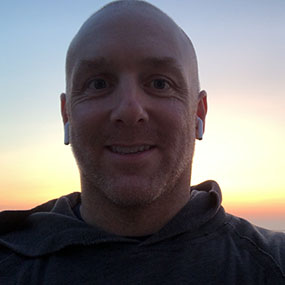
Christopher (Chris) Wright holds a Bachelor of Science in business administration from the University of Mary Washington and a Master of Business Administration from Rollins College. After graduation, he worked as a network and systems administrator and engineer in the hospitality industry in the Northeast and Mountain West for more than 15 years. He completed his first expedition aboard NOAA Ship Okeanos Explorer in 2019, and remains extremely excited about continuing the journey to explore ocean basins around the world. Chris and his family currently reside in Newport, Rhode Island.