


Ocean Exploration Facts
The ocean exploration facts in this section provide short answers to common or intriguing ocean questions. The questions are organized in a series of categories; click on a category to learn more about these topics.
For many ocean exploration facts, content has been repurposed from essays posted elsewhere on the website; to access the original content, click on links available on individual ocean fact pages.

Abyssal plains are wide, flat areas of the deep seafloor.

Marine critical minerals are minerals found on the ocean floor that are essential to the United States economy and security.

Backscatter is the sound energy that is reflected back to its source after hitting the seafloor or objects in the water column. The strength of this energy provides insight into the characteristics of the unseen underwater world.

The global seabed has a wide range of textures. Depending on where you are, the bottom of the ocean might be covered in muddy clay, sand, rocky boulders, or other features.

“Headless chicken monster” is a common name for deep ocean sea cucumbers in the genus Enypniastes. Their flowing movements have also earned them the more elegant nickname “Spanish dancers.”

Some deep-sea coral colonies can survive for thousands of years, which makes them the oldest known colonial organisms. Corals are unique animals, though, so answering the question of exactly how long they live depends on how you count!

When considering which deep-sea creature has the biggest teeth, the answer depends on what you mean by “biggest!” The fangtooth Anoplogaster cornuta has the biggest teeth of any ocean animal compared to its body size, but its maximum body size is only 7 inches (17 centimeters) long.

The deepest confirmed fish sighting is of a snailfish filmed at a depth of 8,336 meters (27,000 feet) below the ocean surface. Other fish may live at similar depths, but it’s likely that no fish lives deeper than about 8,400 meters (28,000 feet) because of the deep ocean’s extreme pressure.

Maritime heritage is the legacy of human interactions with Earth’s large water bodies and their coasts throughout time.
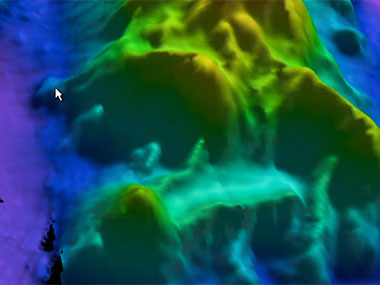
Bathymetry is the study of the ocean floor and the bottoms of rivers and lakes.

Microdebitage refers to small fragments, less than one millimeter in size, produced when stone tools are created. These fragments can help archaeologists identify areas where stone tools were made, which in turn can help to locate archaeological sites in areas that could not be excavated by traditional methods, including underwater sites.

Mapping watchstanders act as sentries and data keepers while collecting, processing, and documenting high-quality ocean and seafloor data captured by sonar and oceanographic instruments.