


New Pathways to Discovery: NOAA Ocean Exploration Publishes Data on Global Databases
NOAA Ocean Exploration is making annotations of biological occurrence data (observations and samples) from expeditions on NOAA Ship Okeanos Explorer available in global databases for the first time. By publishing these data on the Ocean Biodiversity Information System (OBIS) and the Global Biodiversity Information Facility (GBIF), NOAA Ocean Exploration aims to maximize the reach and scientific impact of our deep-sea data.

The ocean is important to all our lives, yet much of the life within it remains a mystery. Scientists estimate there may be between 700,000 and 1 million species in the ocean (mostly animals and excluding most microorganisms, of which there are millions). Roughly two-thirds of these species, possibly more, have yet to be discovered or officially described, with almost 2,000 new species accepted by the scientific community each year.
Annotations: From Exploration to Discovery

Video captured during NOAA Ocean Exploration’s remotely operated vehicle dives provides a glimpse into life in the deep sea. Annotations help us better understand that life. In this screenshot from a dive on Surveyor Seamount during the Seascape Alaska 5 expedition (Dive 05), annotators identified a variety of marine life, including a red rockfish (Sebastes melanostictus), two pink nudibranchs (Dendronotus sp.), an anemone (Actinostola sp.), some rare unknown demosponges, and more. Image courtesy of NOAA Ocean Exploration, Seascape Alaska. Download largest version (jpg, 7.6 MB).
Among NOAA Ocean Exploration’s most valuable assets are the data we collect. These data include the hours and hours of video collected during remotely operated vehicle (ROV) dives. On its own, the value of this video is limited. That’s why NOAA Ocean Exploration partnered with Ocean Networks Canada to use SeaTube, a web-based tool that allows scientists — both at sea and on shore — to annotate observations in real time. Since 2023, the Deep Sea Animal Research Center at the University of Hawai‘i at Manoa has reviewed, revised, and expanded upon our benthic annotations to ensure maximum accuracy and completeness. Archived along with other expedition-related data and already accessible through NOAA’s National Centers for Environmental Information, these annotations provide insights about species diversity, distribution, and abundance and inspire further research to advance marine science, management, policy, and education.

Among the marine species observed and identified during the 2023 Shakedown + EXPRESS West Coast Exploration were this squat lobster (Munidopsis depressa), branched tree coral (Parastenella ramosa), and shrimp (Lebbeus sp.), which were seen in Nitinat Canyon (Dive 08). Image courtesy of 2023 Shakedown + EXPRESS West Coast Exploration. Download largest version (jpg, 2.4 MB).

Chimaeras are always popular sightings. This spotted ratfish (Hydrolagus colliei) was seen and documented swimming over a Dover sole (Microstomus pacificus) and by some stylasterid corals in Cordova Bay during the Seascape Alaska 5 expedition (Dive 11). Image courtesy of NOAA Ocean Exploration, Seascape Alaska. Download largest version (jpg, 1.8 MB).
The Data
This data drop consists of datasets from three expeditions in 2023. Collectively, these datasets include over 60,000 biological observations and nearly 400 biological samples from 34 ROV dives in deep waters off the U.S. West Coast and Alaska. Each record includes taxonomic information (from the World Register of Marine Species) and date, location, and other scientific data (e.g., salinity, temperature, dissolved oxygen concentration); some include notable behaviors. The datasets also include 245 water samples (for environmental DNA analysis) collected during ROV dives and CTD (conductivity, temperature, and depth) rosette system deployments, links to additional data resources and information about accessing physical samples, as well as select images (GBIF only).

Fields of tubeworms (Lamellibranchia sp.) dominated Dive 04 of the Seascape Alaska 3 expedition. Given their abundance at the site — a newly discovered cold seep on the Aleutian Arc — a sample was collected to represent the site’s biological context. Image courtesy of NOAA Ocean Exploration, Seascape Alaska. Download largest version (jpg, 1.7 MB).

Farrea is a genus of rare, deep-ocean glass sponges. Given their rarity, a sample of this individual was taken for research purposes from Middleton Canyon during the Seascape Alaska 5 expedition (Dive 15). Image courtesy of NOAA Ocean Exploration, Seascape Alaska. Download largest version (jpg, 1.1 MB).
2023 Expedition Datasets
- 2023 Shakedown + EXPRESS: West Coast Exploration (ROV and Mapping) (EX2301): OBIS/GBIF (DOI: 10.15468/adse9x)
- Seascape Alaska 3: Aleutians Remotely Operated Vehicle Exploration and Mapping (EX2304): OBIS/GBIF (DOI: 10.15468/34x3ay)
- Seascape Alaska 5: Gulf of Alaska Remotely Operated Vehicle Exploration and Mapping (EX2306): OBIS/GBIF (DOI: 10.15468/gr46mr)
By sharing these data in global databases, NOAA Ocean Exploration is improving their visibility and accessibility, making them even more discoverable by scientists, managers, and policymakers around the world. And, by combining our data with data collected by others, we’re further enabling deep-ocean discoveries and understanding.
What Are OBIS and GBIF?
OBIS and GBIF are the world’s leading free, open-access biodiversity databases.
- OBIS focuses specifically on marine life.
- GBIF covers all life forms on Earth.
Under a joint strategy to improve the volume and quality of biodiversity information available, OBIS shares the marine life data it receives from contributors, like NOAA Ocean Exploration, with GBIF, making GBIF a comprehensive global database.
Moving Forward (and Looking Back)
Data are only useful if people can find them. NOAA Ocean Exploration is committed to making the scientific data and information we collect as accessible to the public as possible. Our recent data contributions to OBIS and GBIF demonstrate our commitment to making data more accessible to our varied user communities.

Throughout the Seascape Alaska 3 expedition, sea stars were observed and documented feeding on corals. The Hippasteria phrygiana seen here were dining on Primnoa sp. on a mound feature north of Uliaga Island (Dive 07). Image courtesy of NOAA Ocean Exploration, Seascape Alaska. Download largest version (jpg, 2.2 MB).
Combined with recent environmental DNA submissions, NOAA Ocean Exploration has now contributed over 740,000 georeferenced organism records to OBIS and GBIF.
This is just the beginning. NOAA Ocean Exploration is working on a plan to make the submission of biological data from expeditions on Okeanos Explorer to OBIS and GBIF a regular part of our data workflow. We’re also revisiting past expeditions to make sure those data are available through these databases to accelerate discovery; address research, management, and policy needs; and improve the collective understanding of our global ocean.
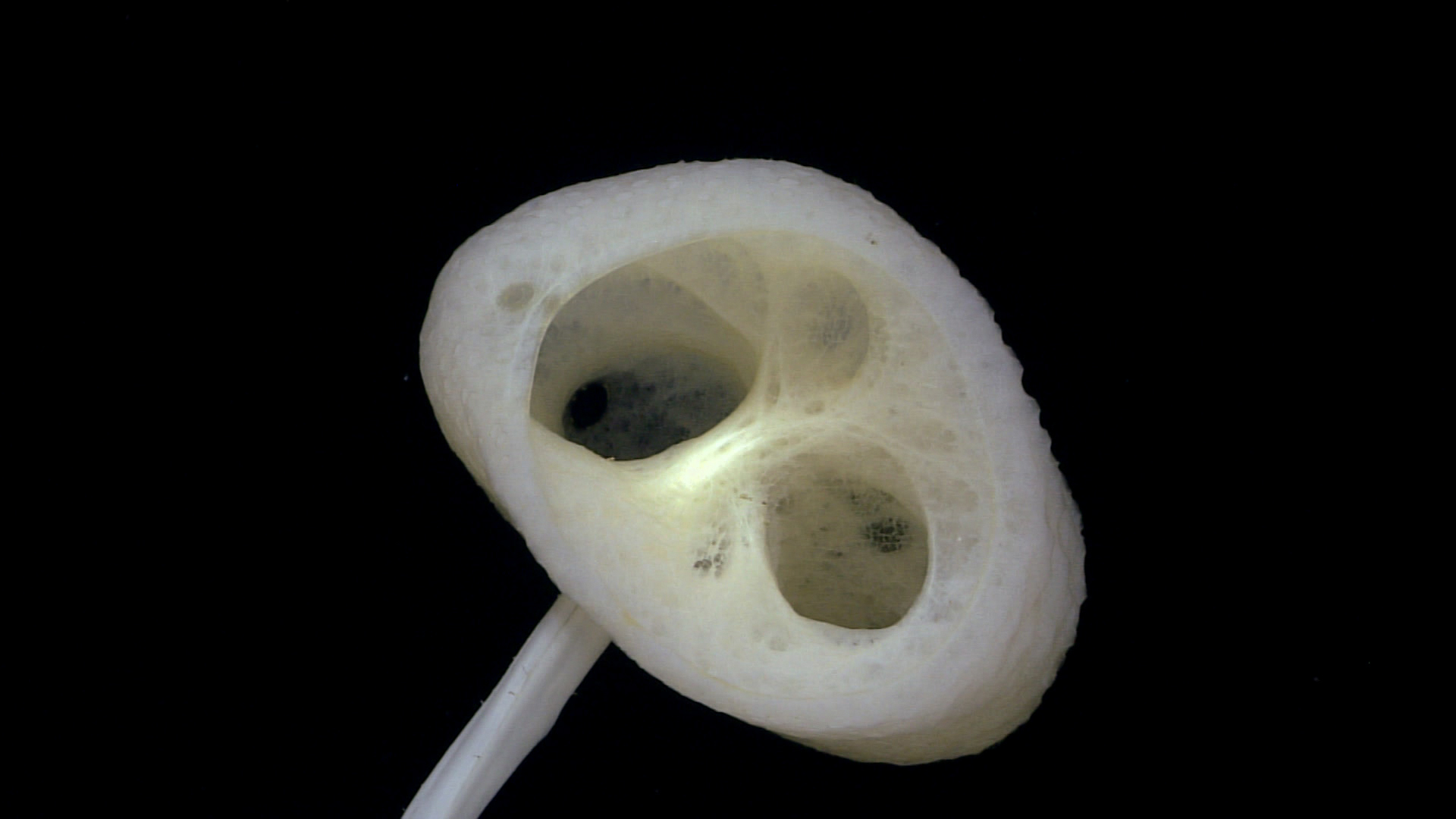
By sharing the data we collect during our exploration of the deep ocean, NOAA Ocean Exploration opens the door to discovery. This “E.T. sponge” (Advhena magnifica) — one of the World Register of Marine Species’ top-10 remarkable new marine species of 2020 — is just one of the discoveries made based on our data. It was first seen and sampled during expeditions in the Pacific on NOAA Ship Okeanos Explorer in 2016. This individual was observed and documented in 2025 on an unnamed seamount during the Papahānaumokuākea ROV and Mapping expedition (Dive 14). Image courtesy of 2025 Beyond the Blue. Download largest version (jpg, 256.8 KB).