


2026 Technology Demonstration
Exploration Team

Philip L. Hoffman is the NOAA Ocean Exploration Technology Portfolio lead and uncrewed maritime systems research and development coordinator. He also serves as the office’s primary research and development liaison to the NOAA Uncrewed Systems Operations Center and manages the NOAA/Navy CENOTE (Commercial Engagement Through Ocean Technology) working group. In these roles, he leverages the broad relationships that he developed in previous roles as the NOAA Research Evaluation Team lead and the NOAA Cooperative Institute Program director. Prior to NOAA Research, Philip served as the NOAA Fisheries Protected Species Program coordinator and was part of the writing team for the original NOAA autonomous underwater vehicle roadmap (2009). He started his federal career as a biological scientist and project coordinator for the U.S. Army Corps of Engineers, Seattle District, focusing on salmon habitat restoration, Dungeness crab dredging mortality mitigation, salmon fish passage construction, and military construction environmental compliance. In addition, he worked for the State of Florida, Pinellas County Florida, and a coastal nongovernmental organization on Tampa Bay. Philip holds a bachelor’s degree in marine science from Eckerd College and a master’s degree in oceanography and coastal science from Louisiana State University. Philip is married to a NOAA Satellites oceanographer and is the proud father of five kids. In addition to pursuing marine fish recreationally with a variety of gear, he serves as a scout leader, enjoys woodworking, and builds railroad models.

Shawn Bailey is a project manager at the NOAA Ocean Exploration Cooperative Institute (OECI). He served 30 years in the U.S. Navy, honing a background in planning and leading dynamic high-stakes operations, risk management, high-performance team building, and people development. He has a Bachelor of Science in marine biology and a Master of Arts in national security and strategic studies. He is currently working on a professional Master of Oceanography at the University of Rhode Island’s Graduate School of Oceanography. While on the expedition, in addition to lending a hand wherever he can, Shawn will be working on an analysis of the concept of operations using multiple autonomous underwater vehicles as a force multiplier for ocean exploration operations aboard NOAA Ship Okeanos Explorer.

Neah Baechler is a member of the NOAA Ocean Exploration Technical Operations Team with a multidisciplinary background in seafloor mapping, GIS, and marine geology on crewed and uncrewed platforms and a career focus in ocean exploration and sustainability. She graduated from the College of Charleston Benthic Acoustic Mapping and Survey (BEAMS) program with a degree in geology in 2015 and launched her hydrographic career as an explorer-in-training aboard NOAA Ship Okeanos Explorer shortly after. She was a contractor predominantly on Okeanos Explorer and Exploration Vessel Nautilus, working with Kongsberg mapping systems and navigating for remotely operated vehicle dives until she joined Saildrone in 2022 as the lead surveyor for bathymetric data collection on uncrewed surface vessels (USVs). Neah was most recently the bathymetry operations manager at Saildrone, shaping drone capabilities and bathymetric procedures and pushing the envelope on USV capability. When she’s not mapping the seafloor, you can find Neah in her garden, playing outside around her hometown of Portland, Oregon, and painting moody water colors.

Amanda Bittinger is a hydrographic surveyor and ocean mapper sailing as a member of the Mapping Team on NOAA Ship Okeanos Explorer since 2015. In addition to serving as the mapping watch lead, she has also been the onboard mapping lead for several telepresence mapping expeditions. She has a bachelor’s degree in oceanography, a master’s degree in coastal management with an emphasis on using remote sensing to determine coral reef health, and 20 years of surveying and mapping experience. She has an interest in integrated mapping operations from shallow to deep water using air, surface, and subsea vehicles, and she aspires to go to Antarctica.

Finn Dahl is a geospatial developer and technical analyst at NOAA’s National Centers for Environmental Information (NCEI), serving as a NOAA Affiliate through the Cooperative Institute for Research in Environmental Sciences (CIRES) at the University of Colorado, Boulder. In his role, he supports the Department of State’s (DOS) Office of Ocean and Polar Affairs within the Maritime Geography Project Office. Finn continues to contribute to the U.S. Extended Continental Shelf Project, where he helped establish the outer limits of the United States’ continental shelf beyond 200 nautical miles. Currently, he is engaged in the U.S. Baselines Initiative, developing new U.S. baselines and maritime limits for the nation’s territorial seas, and contiguous and exclusive economic zones. Additionally, he supports geospatial efforts for NOAA and DOS regarding the Deep Seabed Hard Mineral Resources Act (DSHMRA). A recent milestone for Finn was developing a near-real-time tracking solution for NOAA Ship Okeanos Explorer and ROV Deep Discoverer on behalf of NOAA Ocean Exploration.

Jackson Gosler is a first-year doctoral student in the Massachusetts Institute of Technology (MIT) – Woods Hole Oceanographic Institution (WHOI) Joint Program in Oceanography, where he studies geological oceanography. His doctoral research focuses on autonomous mapping of deep-ocean geological features, including hydrothermal vents and polymetallic nodules. Before coming to MIT and WHOI, Jackson earned his bachelor’s degree at Dartmouth College with a double major in physics and earth science. He has also spent time at NASA’s Jet Propulsion Laboratory studying oceans beyond Earth, on the icy moons Europa and Enceladus. Outside of research, Jackson is an avid scuba diver and guitarist.

Sasha Khidekel is a mechanical engineer at Orpheus Ocean, based in Plymouth, Massachusetts. Since joining Orpheus Ocean, they have primarily focused on design and testing of the autonomous sediment core samplers, as well as general vehicle mechanical design, assembly, payload integration, and testing. This year, they have been in the field operating the Orpheus vehicles off the coasts of Massachusetts, California, and Hawaiʻi, gaining real-world experience in operational environments. Sasha holds bachelor’s and master’s degrees in mechanical engineering from Johns Hopkins University, where they captained the high-power rocketry team and completed several internships in electromechanical systems. When not out at sea, Sasha enjoys reading, collecting rocks, and playing the drums.

Christopher (Chris) Knowlton is the associate director for operation at the University of Rhode Island’s (URI’s) Inner Space Center. He received his bachelor’s degree in geology from Colgate University and his master’s in geological oceanography from URI’s Graduate School of Oceanography. Chris’s primary research interest is paleoceanography, particularly glacial-interglacial cycles over the last 1 million years and the ocean carbon cycle. He has worked on projects from the tropics to the poles. He has been involved in telepresence operations for more than 15 years and has experience developing telepresence workflows and tools as well as designing and installing ship-based systems.

Mashkoor Malik has served as a physical scientist with NOAA Ocean Exploration since 2008. Mashkoor holds a Master of Science in ocean mapping and a doctorate in natural resources and earth science systems from the University of New Hampshire. Mashkoor’s work with NOAA Ocean Exploration includes a diverse portfolio ranging from expedition coordination, ocean exploration data management, and testing and implementing marine innovative technologies. Since 2021, he has served as the chief of the office’s Science and Technology Division, overseeing ocean exploration competitive grants, maritime heritage, technology, and data portfolios.

Jacob Ottaviani is the video production coordinator for the Ocean Exploration Trust (OET). Jacob began working for OET as an assistant video editor shortly after graduating from Rhode Island College in 2021 with a bachelor’s degree in media communications, specializing in digital media production. Over the past five years, Jacob has worked his way up to the roles of video editor and now video production coordinator, where he leads the production of video content for OET and the NautilusLive brand. Jacob has sailed as both a video engineer and documentarian across five expeditions aboard E/V Nautilus. When not working either ashore or at sea, you can usually find Jacob spending time with his fiancée Nikki and their cats Bilbo and Frodo, or training at the Brazilian jiu-jitsu gym where he is a black belt and assistant coach.

Kiki Sarpong holds a Master of Science in robotics engineering with a focus on software for robotic systems from New York University. He has experience working on numerous robotic systems and has worked in the robotics industry for about five years. Kiki currently works at Orpheus Ocean and is committed to the mission of illuminating the deep ocean and exploring more of the unknown. He enjoys writing, watching fantasy TV shows, and biking. Kiki currently resides in Boston, MA.
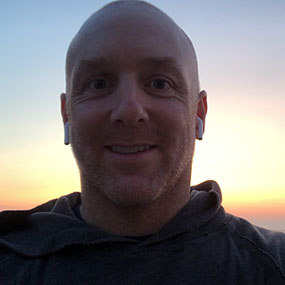
Christopher (Chris) Wright holds a Bachelor of Science in business administration from the University of Mary Washington and a Master of Business Administration from Rollins College. After graduation, he worked as a network and systems administrator and engineer in the hospitality industry in the Northeast and Mountain West for more than 15 years. He completed his first expedition aboard NOAA Ship Okeanos Explorer in 2019, and remains extremely excited about continuing the journey to explore ocean basins around the world. Chris and his family currently reside in Newport, Rhode Island.