


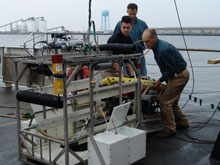
The Saab SeaEye Falcon DR ROV is loaded into its protective "garage" prior to launch. Click image for larger view and image credit.
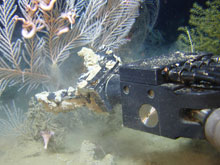
The ROV manipulator arm allows scientists to collect and bring samples to the surface for closer study. Click image for larger view and image credit.
The Seaeye Falcon ROV Explores the Deep
September 29, 2008
Matt Porter
Student
The Pennsylvania State University
One of the most important pieces of equipment on this expedition is the remotely operated vehicle (ROV). For scientists engaging in deep-sea research, the ROV is essentially an extension of themselves, serving as both their eyes and hands at depths too extreme for human life. Without the video and still cameras and manipulator arm on the ROV, detailed observations and collections of deep-sea life would be difficult.
For the Lophelia II cruise, we are using the Saab SeaEye Falcon DR ROV. Deceptively small, this trunk-sized sub is a highly advanced piece of equipment. Equipped with a high-resolution low-light video camera, a seven-megapixel camera capable of taking still shots, and a robotic manipulator arm that mimics a human arm and hand, this ROV is a fully competent human substitute.
As a maneuverable and technically advanced piece of equipment, the ROV requires a control center aboard the ship. The on-ship control center, commonly called the “van,” is a large steel-shipping container placed on the back deck of the ship. When thinking of a steel-shipping container, it may be hard to envision a control center for a submarine. The van, however, is unlike a “normal” shipping container: inside, the van is broken up by walls into two separate rooms.
The back room of the van serves as a workshop for the ROV crew to make repairs and alterations to the vehicle. The separator between the two rooms is where all the essential ROV electronics are stored. These electronics are used to control and store video footage of each dive, to take and store still pictures taken from the bottom of the ocean, and to house critical navigation equipment. This navigation equipment allows the ROV pilots to know the location of the ROV at all times.
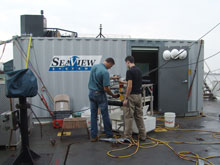
This steel-shipping container serves as the command center for the ROV. Click image for larger view and image credit.
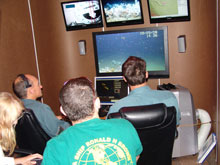
ROV pilots Matthew Cook and Geoff Cook watch the monitors inside the van with chief scientist Erik Cordes and research technician Leslie Wickes. Click image for larger view and image credit.
The front room of the van is set up much like the interior of a car. Mounted on the front wall is an array of flat-screen televisions. These flat screens are analogous to the windshield and instrument panel on a car. From these televisions, the ROV pilots see in high definition exactly what is in front of and behind the ROV. Additionally, important information about the topography and navigation of the dive site is displayed on the screens.
Continuing with the car analogy, the two ROV pilots sit in the “front seat” of the van, directly behind the television monitors. It is from here that the pilots manipulate the ROV controller, a device bearing a striking resemblance to a video game controller. Behind the two pilots, in the second row of seats (or the “back seat”), sit a scientist who provides instructions to the ROV pilots and another individual responsible for recording observations from the dive.
When looking at the ROV and the “simple” joystick used to control it, it is hard to imagine that such an elaborate set up would be required to pilot the ROV. However, without the van and its sophisticated equipment, it would be much more difficult to conduct deep-sea research.
Sign up for the Ocean Explorer E-mail Update List.


