


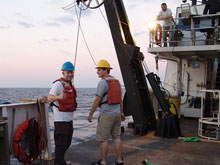
Matt and Jay prepare to help recovery the remotely operated vehicle (under the watchful eye of chief scientist Erik Cordes). Click image for larger view and image credit.
An Adventure Comes to a Close
October 1, 2008Leslie Wickes
Research Technician
Temple University
Matt Porter
Student
The Pennsylvania State University
Jay Lunden
Graduate Student
Temple Universit
After 14 days, 10 dives, 6 collections, and roughly 150 pots of coffee – our first adventure at sea is nearing its end. With our worries and expectations well behind us, our experiences will continue to build until the moment we reach land. In this huge expanse of water we know so little about, we were given the opportunity to make a small dent in understanding the complex unknown territory of the deep sea.
The NOAA Ship Nancy Foster played host to our inquisitive and eager group of 12 scientists, all hoping to learn more about the deep sea and its various creatures. Among the 12 stood the rookies: Matt, Leslie, and Jay. While each of us had our own individual experiences, we shared general feelings of excitement, exhaustion, and even disappointment at times.
Initially, we were challenged with learning the ropes of life on a ship. Sleeping in particularly small bunks was no easy task, especially while attempting to prevent being tossed out of bed due to the motions of our vessel. Another important area requiring adaptation was eating: mariners have somewhat odd eating times; for example, dinner starts at 4:30 pm! Regarding timing, getting adjusted to military time was easier than we expected it to be.
When samples were collected, our nights were somewhat extended. Each sample collected from the ocean must be photographed, identified, measured, and preserved. This took considerably longer than one might expect, particularly given the care required for this procedure.
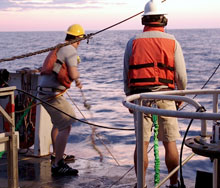
Matt pulls the ROV to the surface after a dive. Click image for larger view and image credit.
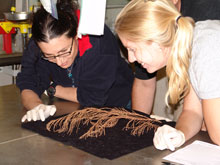
Leslie and scientist Maria Pia Miglietta closely examine a specimen collected during a dive. Click image for larger view and image credit.
Although sea life can be exciting, it can get monotonous. It is hard to keep track of the days, because every day is pretty much the same. We wake up at the same time, work at the same time, eat at the same time, and relax (if time allows) at the same time. But the monotony pales in comparison to the excitement of observing marine life in its natural habitat and taking in fresh ocean air every day.
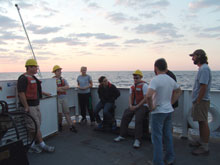
Chief scientist Erik Cordes meets with the science party at the end of the day to talk about upcoming explorations. Click image for larger view and image credit.
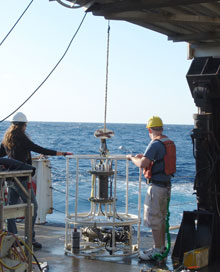
Jay helps Senior Survey Technician Missy Partyka retrieve the conductivity-temperature-depth (CTD) logger. Click image for larger view and image credit.
Aside from all the knowledge obtained about the deep sea and its inhabitants, one of the most important lessons we learned was that of unpredictability. Exploration of the ocean is at the mercy of both weather and technology, both of which challenged us at times. Rather than being defeated, we learned the importance of adapting, letting problems roll off our backs, and continuing what research and work was still obtainable. Despite any roadblocks we may have encountered, the first hand look at the habitat of our future studies was invaluable.
Sign up for the Ocean Explorer E-mail Update List.


