


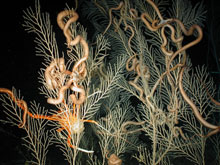
Figure 1. Callogorgia americana delta, an abundant coral species in the Gulf of Mexico. Click image for larger view and image credit.
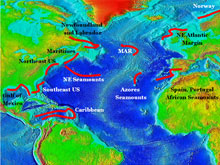
Figure 2. General areas (denoted by red lines) where deepwater corals occur in the North Atlantic, Caribbean, and the Gulf of Mexico. Click image for larger view and image credit.
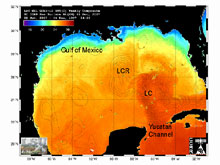
Figure 3. Sea surface height contours overlaid on a weekly composite sea-surface temperature image (captured via satellite) of the Gulf of Mexico. Warm water currents (shown in darker oranges and reds) such as the Loop Current (LC) and LC rings (LCR) are easily determined with sea surface temperature and sea surface height data. Higher sea surface levels are generally associated with subsurface heat, and are thus useful in identifying currents when the sea surface is isothermal (similar in temperature). Click image for larger view and image credit.
CONNECTIVITY AMONG DEEP-SEA CORALS
Andrea M. Quattrini
University of North Carolina Wilmington,
Center for Marine Science, Wilmington, NC
Maria Pia Miglietta
Department of Biology,
The Pennsylvania State University,
University Park, Pennsylvania
One of our primary research objectives is to determine the population connectivity of deep-sea (or cold water) corals. Population connectivity is the exchange of individuals among geographically separated populations. Population connectivity studies aim to determine the rates and pathways of this exchange, which encompasses the larval dispersal phase from reproduction to successful settlement. These linkages affect population structure, community structure, and genetic diversity, and also play a role in the resiliency of populations to human and environmental disturbances. Knowledge of these connections has implications for conservation management, including the design of marine reserve networks. In other words, knowing the ‘sources’ of larval dispersal, the ‘sinks’ of larval settlers, and genetic differentiation can help to successfully protect marine species and their habitats.
Deepwater Corals
Deep-sea (cold water) corals are diverse and abundant in the Gulf of Mexico (GoM). They provide important habitat for numerous fishes and invertebrates, including wreckfish, black belly rosefish, squat lobsters, and sea stars. Stony corals (scleractinians), black corals (antipatharians), soft corals (alcyonacians), and sea whips and sea fans (gorgonians) colonize hard substrata, including natural and artificial structures such as shipwrecks, oil platforms, rock outcrops, and coral reefs. Scleractinians, particularly Lophelia pertusa, create extensive reef habitats in the GoM. The connectivity patterns of L. pertusa are currently being investigated throughout the western North Atlantic including the GoM (C. Morrison, USGS). Connectivity patterns are unknown for other coral species that inhabit deep waters of the GoM.
Our research efforts during this year’s cruise include identifying and collecting abundant coral species that contribute to habitat heterogeneity on the continental slope of the GoM at depths > 300 m (> 980 ft). The gorgonian Callogorgia americana delta (Fig. 1) and the bamboo coral Acanella eburnea areabundant and broadly distributed in the Gulf. Also, at least 30 species of black corals (antipatharians) inhabit GoM waters. We will focus ROV collection efforts on colonies of these species so that genetic studies can soon begin. We will also collect the scleractinians L. pertusa, Enallopsammia profunda, and Madrepora oculata to help fill in gaps for ongoing genetic work (C. Morrison, USGS). With these (and future) collections, we will determine the genetic differentiation of coral populations within the GoM and beyond. We will examine the directionality of gene flow, the connectivity of populations (or communities) among sites and depth boundaries (< 1000 m or > 1000 m), and the sources of coral recruits on shipwrecks and oil platforms (possible sinks) within the GoM.
Connectivity and Currents
Ocean circulation affects the population dynamics of marine organisms. Most marine organisms, including corals, have a pelagic larval stage that can be subjected to physical processes. Large-scale or ocean-scale circulation can transport larvae beyond boundaries between bodies of water, producing a high degree of population connectivity among regions. In contrast, smaller-scale current patterns can minimize long distance transport by concentrating and retaining larvae in localized areas. Throughout the North Atlantic basin (Fig. 2), deepwater coral populations may be variably linked or segregated between and within regions such as the GoM, the Caribbean, the southeastern US slope, and the northeastern Atlantic margin.
Within the GoM, circulation is dominated by the Loop Current (LC) to depths of ~ 1000 m (Fig. 3). The LC transports warm water from the Caribbean into the GoM through the Yucatan Channel and flows clockwise before exiting through the Straits of Florida. The LC acts as a conduit for larval dispersal to/from adjacent regions (i.e., Caribbean and the southeastern US slope) and may affect coral distribution within the GoM. In addition, large rings can spin off of the LC and can carry larvae long distances throughout the GoM. These features can be 50-400 km in diameter and extend over 1000 m deep. There may also be smaller scale current patterns over deep coral reef sites that retain coral larvae within the area.
Larval dispersal is only one aspect of population connectivity. The survival of larvae, successful settlement and metamorphosis to adults, and ultimately reproduction are important factors controlling the relatedness of populations. Contributing to the local gene pool is critical to the maintenance and survival of populations, communities, and even entire species.
Molecular Techniques
Modern molecular techniques will be employed to measure the genetic distances between different populations and communities within the GoM, and between these populations/communities and others in the Atlantic Ocean and Caribbean (Fig. 2). They will shed light on the frequency of interbreeding and the degree of gene flow between those populations and communities. The use of a variety of genetic markers with different evolutionary rates will be crucial to identify the level of connectivity between coral populations, and eventually the presence of genetic breaks. It will also allow investigations on the role of depth or community type as possible barriers to gene flow, preventing populations from exchanging larvae. Finally, it will enable the identification of source populations for organisms on rigs and wrecks.
Species identification will begin with classical taxonomy. We will examine the shape of the coral polyps and skeleton and the branching pattern of the coral colony to identify the species on board. We will also take small samples of the tissues and preserve or freeze them for work in the laboratory. Then we will use molecular markers to recognize cryptic and sibling species that show no or little visible differences. These initial phylogenetic analyses will possibly reveal genetic differences among some pairs of populations (e.g. shallow versus deep, wrecks versus natural sites), but most pairs of populations, especially within regions, are expected to reveal levels of connectivity somewhere between inter-breeding and long-term isolation.
For some species of interest, population genetic studies will be carried out in order to examine population structure and genetic connectivity among populations. Genes that show a fast rate of evolution will be used for this study since they allow for investigations into gene flow within a species or even within a single population. These fine scale phylogeoraphic studies will enable us to individuate sink and source populations and quantify the level of gene flow between deep-sea communities of the GoM.
Sign up for the Ocean Explorer E-mail Update List.


