


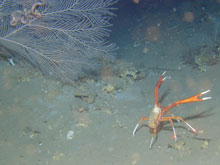
The galatheoid, Eumunida picta. The lasers on its legs are three inches apart. In the background we see Asteroschema sp. wrapped around the sea fan, Callogorgia sp. Click image for larger view and image credit.
Squat Lobsters: More Questions than Answers
September 27, 2008
Morgan Kilgour
Harte Doctoral Fellow
Harte Research Institute,
Texas A&M University-Corpus Christi
Often, crustaceans are overlooked. Most people would rather study a dolphin or a sea turtle. I have never encountered anyone (young) who is wild about crabs. Sure, they are good to eat, but who would want to devote a lifetime to understanding them? Even our pet hermit crab pales in comparison to the popularity of the cat or bird.
But when we really want to understand the complex nature of our oceans, we can’t afford to overlook crustaceans. Crustaceans serve as an integral part of the ocean around them. If we think about communities in the deep sea, all of the animals serve a function. Rocks are foundations for the coral “houses,” corals, in turn, serve as community centers where different animals come to live or eat. Galatheoids, or squat lobsters, are part of this deep-sea society, and we have more questions about them than we have answers.
Galatheoids are found throughout the world from shallow water to deep water, thousands of meters below the surface. There are over 60 species of galatheoids in the Gulf of Mexico; they are members of seep assemblages and deep coral reefs and can be found in burrows on the soft sediment. These animals are predators, scavengers, and detritivores, but we still have only vague notions of what they eat, what eats them, and what they do in the deep oceans. In fact, most of the information we have on deep-sea galatheoids focuses solely on the description of new species.
Reproduction in galatheoids is still a mystery. Some have large eggs, some have small eggs; males may be larger than females, females may be larger than males, or they might be the same size. Difference in size based on sex is called “dimorphism.” We have a lot more work to do to discover the intricacies of how these anomurans (squat lobsters) live, how they reproduce, and what they contribute to their communities.
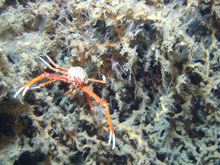
Eumunida picta nestled in Lophelia rubble. Click image for larger view and image credit.
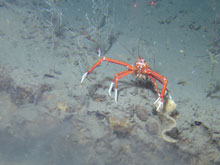
Eumunida picta challenges the remotely operated vehicle. Click image for larger view and image credit.
Previous studies in the Pacific found that galatheoids (of the same species) on similar habitats that were tens of kilometers away are more related to each other than galatheoids (of the same species) just a few kilometers away on a different habitat (soft substrate). How could this be the case? Some larvae may broadcast widely. Could other larvae be retained close to where the parents are, or are they selecting for similar habitats as those of their parents? Would this cause the species to eventually diverge into two different species?
We have much to do before we can begin to understand these animals. With each new visit to the deep, we are excited to possibly solve another piece of the puzzle. The more answers we have, the better we can serve as protectors of the deep sea.
Sign up for the Ocean Explorer E-mail Update List.


