


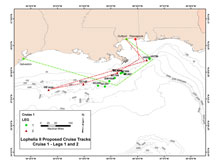
Fig. 1. The cruise track that will be followed during the first cruise of the Lophelia II 2008: Reefs, Rigs, and Wrecks Expedition. In green is the track from the first leg, in red is the proposed track for the second leg. Click image for larger view and image credit.
Mission Plan
Erik Cordes,
Assistant Professor,
Temple University
The goal of this project is to discover and characterize new deepwater coral sites in the northern Gulf of Mexico from 300 to 3000 meters depth. This is the second Minerals Management Service (MMS) funded project of its kind. The first project discovered a number of new sites, included the first quantitative sampling and experiments on Lophelia pertusa from the Gulf, and greatly increased our understanding of coral distribution. In particular, the largest known coral site in the northern Gulf of Mexico, Viosca Knoll (VK) 826 (Fig. 1), was established as our main site and was preliminarily characterized. However, our work was far from done! This study expands on the accomplishments of the first project by exploring a number of new areas of the northern Gulf, further characterizing the communities at the known sites and increasing our knowledge of the biology, ecology, and connectivity of the coral populations of the Gulf of Mexico.
This study is part of an increasing number of scientific investigations of deep-water coral communities resulting from the expansion of human economic interests and impacts into the deep-sea. In the deep Gulf of Mexico, the primary human economic interest is in the abundant oil and gas reserves. Among the key goals of this study are to discover and characterize the deepwater coral communities in areas or current industry activity, or areas that may be future areas of activity. By investigating these communities now, we have the opportunity to learn about them before extensive human impact takes place. This will create a base line so that we may evaluate future impacts against the current, natural state of the communities.
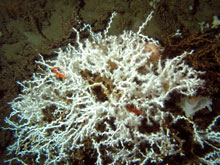
Fig. 2 The hard coral Lophelia pertusa and some invertebrate associates from Viosca Knoll 826 at 500 meters (1,640 feet) depth. Click image for larger view and image credit.
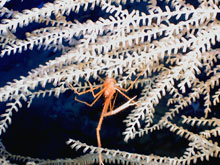
Fig. 3 A gorgonian bamboo coral, Keratoisis sp. from 1,410 meters (4,626 feet) in Green Canyon 852. Click image for larger view and image credit.
The scientists on this cruise come from a number of different institutions and agencies and will be all working together to explore these new sites. We will depart from Gulfport, MS and head to the central Viosca Knoll site to make a few collections. We will primarily target the hard coral Lophelia pertusa (Fig. 2) as well as key species of sea fans (gorgonians) and black corals (antipatharians) (Fig. 3) so we can begin our genetic sampling (link to Andrea Quattrini and Maria Pia Miglietta piece on genetics) and work on our methods for keeping these corals alive on board.
We will then visit a series of new sites, most of which have never been directly observed. At each site, we will begin with a series of long photographic transects to identify the high-density coral communities that we will focus on in future years (if they are there). If we discover any corals during these surveys, we will stop and take some up-close photographs for identification and obtain discreet samples for our genetic studies of species identification and genetic connectivity. This will give us a chance to work on the samples back in the lab before our more extensive sampling in future years. When we discover very extensive coral sites that we will want to return to, we will deploy large markers on the seafloor with temperature probes. This will give us a record of the conditions at the site during the rest of the year when we aren’t there.
If we discover any sites where there are no corals, we will still be gathering valuable information. To understand the appropriate conditions for coral colonization and growth, it is important to also know what the conditions are at sites that appear suitable, but where they are not growing. The ROV is equipped with sensors that will give us information on temperature, salinity, dissolved oxygen concentration, pH, turbidity (a measure of how much material is suspended in the water) and fluorescence (a measure of how much of the suspended material is plant material from the upper depths of the ocean or land). So even when we “strike out” and don’t find any corals, we are still collecting very valuable data that will improve our understanding of coral distribution.
Towards the end of the cruise, we will spend another 3-4 days at the Viosca Koll site. Here we will make additional collections of Lophelia pertusa to bring back to our laboratories and additional tissue samples for genetic work. During this time while we are at one site and not transiting between sites, we will also conduct multibeam bathymetric surveys which will give us a fine scale picture of the surface of the seafloor. This will help us navigate the ROV at this key site during this cruise and in future years. Together, we hope the data from this cruise will lay the foundation for some fantastic research to come over the next four years.
Sign up for the Ocean Explorer E-mail Update List.


