


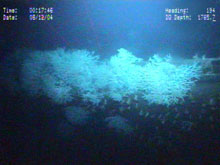
Coral growth on the Gulf Penn wreck off the coast of Louisiana. Click image for larger view and image credit.
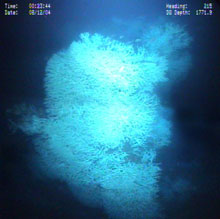
A coral colony grows on the bridge of the Gulf Penn wreck. Click image for larger view and image credit.
The Deep Wreck Science of Gulfpenn
Robert A. Church,
Senior Marine Archaeologist,
C & C Technologies, Inc.
Daniel J. Warren,
Assistant Houston Geoscience Manager,
Senior Marine Archaeologist,
C & C Technologies, Inc.
A team of archaeologists and biologists will set out on an early September cruise onboard the NOAA Research Vessel Nancy Foster to investigate eight shipwreck sites during the first leg of this project. One of the primary goals of this cruise is to assess the archaeological and biological potential of each shipwreck site for inclusion in the next phase of the project that will take place in the Spring of 2009. During this cruise, the science team will visit five unexplored shipwreck sites and be the first people to look upon their decks for many decades. The team will also return to several previously explored wrecks, including two 19th century sailing vessels and a World War II era oil tanker sent to the bottom by a German U-boat, to further document the exciting discoveries made on these wrecks during earlier expeditions.
The World War II era oil tanker Gulfpenn was one of six U-boat victims that were part of a previous deepwater shipwreck study sponsored by the Minerals Management Service, NOAA Office of Ocean Exploration, and the National Oceanographic Partnership Program. Marine archaeologists and biologists first investigated the wreck site in 2004 using a deep sea Remotely Operated Vehicle (ROV). The Gulfpenn lies nearly 640 meters beneath the surface of the Gulf of Mexico. This investigation revealed an unexpected abundance of well-developed deep-sea coral colonies (Lophelia) along with deepwater reef fishes. The site is currently the second best known Lophelia site in the Gulf of Mexico. In addition to its biological allure, the wreck site is also an historic treasure of our maritime past and representative of an understudied aspect of America's history.
The Sun Shipbuilding Company laid the keel of Agwihavre, later renamed the Gulfpenn, on April 2, 1920. The vessel launched on June 16, 1921 was a screw steamer powered by a quadruple expansion engine. The tanker had a length of 480.6 feet (146.5 meters), a beam of 65.6 feet (20 meters), a 36.7 feet (11.2-meter) depth of hold, and a displacement of 8,862 gross tons.
On May 13, 1942, Gulfpenn’s path crossed with the German U-boat U-506 in the Gulf of Mexico. A torpedo from the U-boat exploded in the engine room, destroying that section of the ship and killing all of the engine room personnel. The tanker sank stern first, slipping beneath the waves within 5 minutes. Out of the thirty-eight crew members, twenty-six made it into lifeboats. Of these survivors, all but one were rescued alive by the Honduran vessel Telde less than 3 hours after the attack.
Sixty-two years later, the DeepWrecks science team collected the first spectacular images of Gulfpenn. Visibility at the site was good, averaging approximately 6 meters. The wreck is oriented with the bow pointing north-northwest and stern to south-southeast. The vessel’s bow towers approximately 19 meters off the seafloor as opposed to the aft deckhouse, which only rises approximately 5.5 meters above the sea bottom.
The bow and forward section are relatively intact. The catwalk and piping are still visible from the forecastle to the bridge structure. Coral covers the catwalk and railing, particularly along the starboard side of the vessel obscuring much of the structural detail. The foremast has separated from the deck and fallen forward. The foot of the mast lies on the deck and the mid-portion lies across the forecastle near the end of the catwalk. The mast’s upper parts appear to have broken away and are gone.
The superstructure’s upper works are heavily degraded. The port side of the superstructure is collapsing with sections of metal plating partially suspended from the vessel. The ship’s telegraph has fallen over and spans part of the metal framework of the bridge. The superstructure’s starboard side is almost entirely obscured by an abundance of coral formations.
Gulfpenn’s aft area has the severest damage. The deck of the aft deckhouse is deteriorating and has partially collapsed inward. The main smokestack is gone, leaving behind a gaping hole where it once stood. A skylight or air vent at the deckhouse’s center is relatively intact. Roughly 9 meters aft of the skylight, the hull ends abruptly in a contortion of mangled metal plating. Almost 11 meters of the stern is missing.
A large zone of debris and artifacts surrounds the wreck site. The main debris zone extends nearly 161 meters northwest from the vessel. An area of light debris extends 130 meters southwest of the main hull. Smaller debris extends 65 meters to 70 meters east and west of the primary wreckage. A large section of the ship that may be the missing stern section lies just 27 meters northwest of the bow. A primary goal of this cruise is to confirm this is the Gulfpenn's stern.
The upcoming visit to Gulfpenn will also allow scientists to observe microbiological experiments placed at the wreck in 2004. These experiments, similar to those placed on the RMS Titanic wreck, help scientists determine how fast a wreck is deteriorating. Re-examining the experiments this year will allow the science team to start assessing the deterioration rates on the Gulfpenn wreck.
The science team is eagerly awaiting a chance to see the Gulfpenn and the other wrecks on the project. They are also anticipating the new discoveries that await them on each dive into the depths of the Gulf of Mexico.
Sign up for the Ocean Explorer E-mail Update List.


