


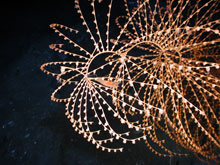
The gorgonian Iridigorgia pourtalesii and an associated shrimp from 1,410 meters (4,626 feet) in Green Canyon 852. Click image for larger view and image credit.
Lophelia II 2008: Deepwater Coral Expedition: Reefs, Rigs, and Wrecks
September 20 - October 2, 2008
This is the first cruise of a 4-year project funded by the US Mineral Management Service (MMS) and the NOAA Office of Ocean Exploration and Research (OER) to explore new deepwater coral communities at both natural and man-made sites. This goal of this project is to discover new coral sites in the deep Gulf of Mexico and characterize them in terms of coral habitat characteristics, biology, ecology, and genetic connectivity. The diverse group of experienced investigators on this project will use a combination of remote sensing, photographic sampling, quantitative community collections, live coral manipulative experiments, geologic characterization, oceanographic measurements, and genetic analyses to further our understanding of cold water corals and the communities associated with them.
This is the first year of the project and the second leg of this cruise investigating a series of previously unexplored sites along the northern Gulf of Mexico between 300 and 1000m. The initial phase of this project has consisted of poring over the extensive bathymetric and 3-dimensional seismic data held by MMS to select the sites we will be visiting. Although past surveys have generated a series of good maps of these sites, we will be the first eye on the bottom at almost all of our sites. The first leg of this year’s cruise examined ship wrecks and the corals colonizing them. During this second leg, we will be using the NOAA Ship Nancy Foster and the SeaEye Falcon ROV to scout out these new sites, run large scale photographic surveys and make collections of a few key species. In the spring we plan to mount a second expedition to explore additional new sites, many in waters deeper than 1000m. In the second and third years of the project we will also conduct additional mapping surveys and examinations of coral colonization on oil rigs. The third and fourth cruises will be larger interdisciplinary expeditions where much of the intensive physical and photographic sampling of the coral species and associated communities will take place.
Updates & Logs
Click images or links below for detailed mission logs and updates.
 Mission Summary Erik Cordes summarized the highlights of this two week exploration: discoveries of gorgonian and antipatharian corals, and data samples for seismic activities.
 October 1 The NOAA Ship Nancy Foster played host to an inquisitive and eager group of scientists, fore 14 days, 10 dives, 6 collections, and roughly 150 pots of coffe.

 September 29 Find out why one of the most important pieces of equipment for scientists on an expedition is the remotely operated vehicle (ROV).
 September 28 Six species of catsharks are found in the Gulf of Mexico, including the Small, Broadgill, Chain, Marbled, Iceland, and Campeche catsharks. These species range from 50-1,850 meters and they are oviparous, meaning they lay eggs.
  Includes Video.
 September 27 Galatheoids, or squat lobsters, are found throughout the world from shallow water to deep water, thousands of meters below the surface. There are over 60 species of galatheoids in the Gulf of Mexico; they are members of seep assemblages and deep coral reefs and can be found in burrows on the soft sediment.
 September 26 The northern Gulf of Mexico harbors a wide variety of rocky reef habitats for fishes, ranging from the shallow siltstone and sandstone reefs of mid-shelf banks, the diverse coral reefs of Flower Garden Banks to carbonate boulders and slabs of the continental slope. Includes Video.
 September 25 Scientist hope that CTD data, along with biological observations from dives will enable them to explore reasons why corals are abundant or absent in particular areas within the Gulf of Mexico.
 September 24 As CO2 levels in the ocean increase, learn why this fundamental chemical dynamic is important to coral survival. The ocean absorbs approximately 20-30 percent of the CO2 produced by humans.
 September 23 Scientist explor site GB201, a large sea-floor structure supported by a shallow feature called a salt diapir. This site appeared to be hardground, and thus, showed the most promise for coral habitat and a ROV dive.
 September 22 Today we came across a good example of a large black coral providing habitat for fish and invertebrates at 300 meters depth.
 September 21 To map the sea floor, ocean scientists bounce a beam of sound waves off the ocean bottom through a technique called ‘echo sounding.
 September 20 With sea legs yet-to-be-acquired, much of the day for the newest travelers was spent fighting off seasickness. The rest of the day was spent participating in scientific meetings, safety briefings, and fire and abandon-ship safety drills.
 Leg 1 Summary During the first leg of this year’s project, a team of archaeologists and biologists investigated eight shipwreck sites in the Gulf of Mexico.
Deep Sea News

 , an account of the adventures of Peter Etnoyer a doctoral fellow at Harte Research Institute for Gulf of Mexico Studies at Texas A&M Univ.-Corpus Christi


