


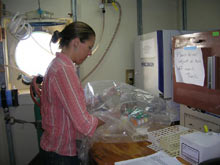
Sheryl Bolton cultures microbes in the lab aboard the research vessel (R/V) Melville. Click image for larger view and image credit.
Despite Challenges, Microbes Seem to Prosper
May 5, 2006
Julie Huber
NASA Astrobiology Institute Postdoctoral Fellow
Marine Biological Laboratory, Woods Hole — Massachusetts
As the fury of the last week of this cruise begins, it is a good time to catch up on what we have collected and discovered, as well as look ahead and plan what's next. The combination of collecting rocks, mats, and fluids have kept us microbiologists busy. These environments present multiple stresses for bacteria and archaea (a group of bacteria-like microorganisms) living in the hydrothermal vents. At some sites, extreme stresses combine and we see vents with low pH (less than 2) and high temperatures (greater than 200°C, or 500°F), not to mention an on-going explosive eruption! Despite these challenges, microbes seem to prosper. It is our job to figure out how they do it, which microbe is living where, and how they interact with this dynamic geochemical environment.
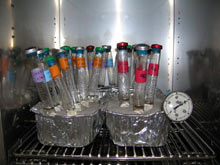
Sheryl Bolton, a research technician at the University of Washington, is trying to culture some of the strange microbes she first detected here with molecular methods in 2004. Sheryl has put together a plethora (more than 400 tubes!) of growth media to try to mimic the diverse vent environments we have found. All of her media is anaerobic, meaning there is no oxygen present, and she is incubating the tubes at high temperatures, from 50 to 90°C (120 to 195°F). Her efforts were recently rewarded with the collection of multiple active chimneys from East Diamante. The upper-most temperature limit for life is 121°C (250°F), and the fluids passing through the interior of these chimneys are in excess of 200°C. So it is no surprise that Sheryl was able to culture microbes from only the exterior portions of the chimneys. However, the fact that she was able to enrich anaerobic hyperthermophiles at a pH of 4 from samples is exciting; and once back at home, we can figure out exactly who these amazing microbes are and how they survive in the chimneys at East Diamante.
Chimneys are only one target for us, and we have also collected an interesting thermal and chemical suite of vent fluids for culturing, counts, as well as DNA-based molecular methods. We are collecting fluids using the hydrothermal fluid sampler mounted on the remotely operated vehicle (ROV) Jason. This sampler allows David Butterfield to collect fluids for chemistry; at the same time, we can collect both filtered and unfiltered fluids for microbiological analyses. Once on land, I will extract the community DNA and attempt to get a genetic "fingerprint" of the entire community. This allows us to determine who is present and in what abundance, without the constraints of culturing. Linking these two methods — culturing and DNA-based methods — along with geochemistry is key to revealing the microbial ecology of hydrothermal vent environments.
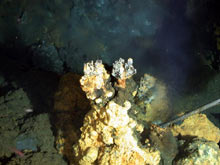
Researchers cultured microbes from the exterior portion of this venting chimney further analysis. These chimneys are at the top of the Five Towers chimney complex at East Diamante volcano. Click image for larger view and image credit.
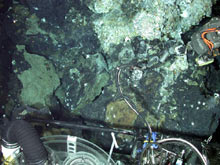
The hydrothermal fluid sampler (HFS) collects diffuse fluids at Seamount X. Click image for larger view and image credit.
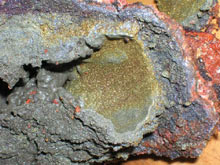
This cross-section of the chimney was cultured for microbial studies. The exterior rinds of silica tell us temperatures were likely less than 70°C (160°F), where microbes could survive. At the interior, we recorded temperatures up to 240°C (460°F) from the venting fluid, which precludes any microbes surviving in the interior conduit. Click image for larger view and image credit.
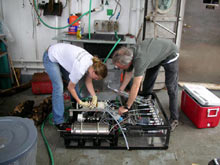
Julie Huber and Dave Butterfield extract fluid samples from the HFS after a Jason dive. Click image for larger view and image credit.


