


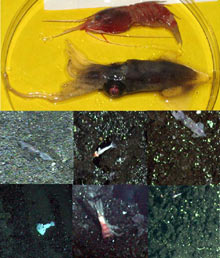
A collage of some of the dead animals we saw on the sea floor at NW Rota-1, killed by the volcanic plume which contained high amounts of sulfur. The top petri dish holds a squid and a pelagic (open water) shrimp – these are not vent species. The bottom images are the dead animals (shrimp, fish, and squid) on the sea floor. Click image for larger view and image credit.
Biology, and Lack of It, at NW Rota-1 Volcano
April 30, 2006
Verena Tunnicliffe
Canada Research Chair in Deep Oceans
Professor, University of Victoria — Canada
 See
how the two species of shrimp found here at NW Rota-1 volcano interact.
(Quicktime, 2.3 Mb.)
See
how the two species of shrimp found here at NW Rota-1 volcano interact.
(Quicktime, 2.3 Mb.)
Some
of the dead marine life observed on the sea floor at NW Rota-1. (Quicktime,
1.8 Mb.)
A shrimp riding on its crustacean vehicle. (Quicktime, 1.7 Mb.)
Falling ash, billowing sulfur clouds, continual tremors, and your habitat occasionally falling away under your feet. . . . Who would want to live on an erupting volcano? On NW Rota-1, not many animals, but two feisty shrimp species are able to reap the benefits of the volcano's hydrothermal activity. Seawater circulates through the cracking volcano and re-emerges as heated fluid seeping through the flanks of NW Rota-1. The fluid is full of reduced chemicals that foster the growth of bacteria. Bacterial mats coat many rock and rubble surfaces thus forming abundant food sources for animals that can use such mats.
As we explored NW Rota-1, we encountered large areas of scattered shrimp and small dense clusters around higher fluid flows. The Loihi shrimp has adapted to grazing bacterial filaments with tiny claws like garden shears. These small shrimp move across the mat snipping the filaments. Their larval stages disperse in the water and do not settle until they are about 1 cm long. A second species, the alvinocarid also grazes on bacteria after they settle to the volcano. But, as they molt to the adult stage, their front claws enlarge and they become predators. Often, we saw the large shrimp eating another animal.
Over several dives, many dead animals appeared on the sea floor. Sometimes, fish and squid fell to the sea floor in front of us. Pelagic animals swimming above the volcano were dying as they passed over the belching plume. We suspect that the high amounts of sulfur (perhaps dissolved sulfite) from Brimstone Pit are lethal to the local water-column animals. But their bodies are food for vent shrimp – an interesting interaction between volcano and pelagic ecosystems! It may be that the shrimp populations are healthier during more intense volcanic activity.
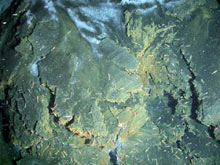
The two species of shrimp that live at the vent sites at NW Rota-1. They are seen here at Fault Shrimp vent. Notice the white bacterial mat at the top of the rock which provides food for the Loihi shrimp and the alvinocarid shrimp juveniles. Click image for larger view and image credit.
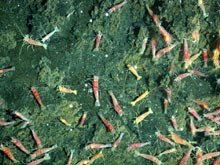
A close-up view of shrimp at NW Rota-1. The reason for the difference in color is not yet clear; however, one possibility is that the longer it has been since they last molted, the more material (perhaps sulfur or bacteria) that accumulates on their carapace (hard, upper shell). Click image for larger view and image credit.
A few other animals have made it to the Rota vents. We saw some large limpets in 2004 at a site called Gastros. Two years later, they are still there – probably the same individuals. They are surrounded by their egg cases – the hatchlings crawl out and grow near the parents. A few white crabs wander among the shrimp. While their large claws are those of a predator, we have seen them cropping bacteria. One shrimp, unafraid of a striding crab, climbed aboard for a ride until it was forcibly ejected from its seat by its crustacean "vehicle." The low diversity of the Rota animal community reflects an unstable environment in which only a few animals can survive.
Sign up for the Ocean Explorer E-mail Update List.


