


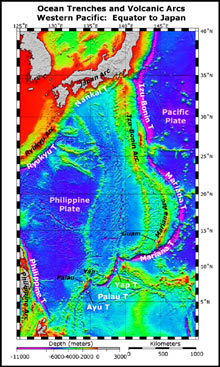
This image presents satellite altimetry data of the western Pacific from the equator to Japan. Submarine trenches are indicated with white text over magenta; volcanic arcs are indicated by italicized text. In the western Pacific, the volcanic arcs (island and submarine) are west of the trenches, due to the western migration and subduction of the Pacific plate under the Philippine plate. Volcanic arcs form when the subducting plate melts at depth and magma (fluid that cools to form igneous rock) is produced, which rises bouyantly and forms volcanic arc lavas. Click image for larger view and more details.
The Role of Magmatic Fluids in Hydrothermal Vents on Volcanic Arcs
David A. Butterfield
Joint Institute for the Study of the Atmosphere and Ocean
University of Washington
Pacific Marine Environmental Laboratory, NOAA
Background
For almost three decades, scientists have been exploring and sampling the hot-spring environments of the mid-ocean ridge, where oceanic plates diverge and volcanic processes create new ocean crust. Although there are still surprises along the mid-ocean ridge, the environment along the “divergent margins” has been extensively explored, and we have a reasonable understanding of the range of features and composition of hot-spring fluids there. Reactions that approach equilibrium between seawater and hot basalt (volcanic rock) are the primary control on vent-fluid composition on the mid-ocean ridge.
At the other end of the oceanic plate, where subduction occurs and the plate is recycled into the Earth's mantle (the region between the crust and core), there is a much higher diversity in the settings of volcanic activity, and there has been much less study of the type of hot spring and hydrothermal features that might exist. There are thousands of kilometers of volcanic arcs behind deep ocean trenches along the “convergent margins” where oceanic crust is subducted. Many of the volcanic islands and submarine volcanoes along these arcs have active hydrothermal systems, but there has been very little direct observation and sampling of hot springs from submersibles. As a consequence, we know very little about the range of hot spring features and fluid compositions on arc volcanoes.
Predictions
In the subduction zone of convergent oceanic margins, the sinking oceanic plate carries large quantities of water and sediment down into the mantle. Water and other volatile (quickly evaporating) components in the subducting slab are expelled and cause increased mantle melting and magma production. This leads to the prediction that the magma and volcanic rocks produced along volcanic arcs will have a much higher water and volatile content. Other elements that are enriched in old ocean crust should also be enriched in the volcanic areas associated with subduction zones. This has been verified in detail by the study of rock chemistry along volcanic arcs and back-arc spreading centers.
High volatile content in the magmas may also lead to high levels of magmatic volatiles in the hot-spring fluids. There is a great deal of evidence from gases sampled on volcanic islands that subducted volatiles are cycled through magma chambers and vented in fumaroles (holes in a volcanic region from which gases escape) or hot springs on land or in very shallow water near the shorelines of active volcanic islands. Prior to 2004, there was almost no data on submarine hot springs in deeper water, but exploration and sampling of submarine volcanoes is progressing rapidly.
The 2004 Mariana Arc expedition: Initial findings
In March/April, 2004, we explored five hydrothermally active submarine volcanoes between 13º and 22º North on the Mariana volcanic arc with the remotely operated vehicle (ROV) ROPOS on the University of Washington research vessel T.G. Thompson. In, November, 2005, the Japanese vessel Natsushima with the ROV Hyper Dolphin made return visits to NW Rota, NW Eifuku, and Kasuga, and also made several dives at Nikko submarine volcano, which we did not reach in 2004. The first result to note from these cruises is that we hit the jackpot in finding magmatic volatile influence in submarine hot springs. The second result is that the hot-spring features on the arc volcanoes that we studied are quite varied and different from those on the mid-ocean ridges.
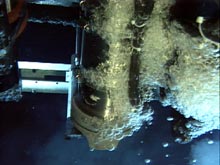
Buoyant droplets of liquid carbon dioxide adhere to the underside of the arm of remotely operated vehicle (ROV) ROPOS while sampling at NW Eifuku volcano, during the Submarine Ring of Fire 2004 (SRoF'04) expedition to the Mariana arc. Click image for larger view and more details.
• Gas-charged vents
We found extreme cases of magmatic gas (CO2 or SO2) dominating the chemical composition of hot springs in the Mariana arc submarine volcanoes. At NW Rota, magmatic sulfur dioxide is escaping from a shallow level magma chamber and mixing with seawater in different ways within the volcano. The sulfur dioxide gas reacts with water to form sulfuric acid, which can attack and dissolve the rock of the volcano. Hot-spring fluids on NW Rota have pH of 2.0 or less, compared to mid-ocean ridge values that are typically 3.5 to 4.5 and rarely as low as 3.0. That means that the concentration of acid is at least a factor of 10 higher at NW Rota than at mid-ocean ridge vents. We have found DNA evidence for microbes living in these extremely acidic fluids. The diversity of microbes is relatively low, and there is some similarity to known heat- and acid-tolerant microbes from other environments.
Other products of the sulfur dioxide reaction are hydrogen sulfide and elemental sulfur, which is blasted out of a crater as molten sulfur that hardens into spherical droplets in the cold seawater [Embley et al., Nature, in press]. Molten sulfur can exist over the range of temperature from 113º to 444ºC. More liquid sulfur was found at Nikko in November, 2005, including pools of molten sulfur and massive sulfur deposits. Similar sulfur deposits have been seen on the Kermadec arc during an Ocean Exploration cruise in 2005 in collaboration with New Zealand partners.
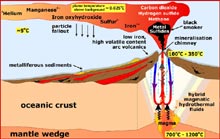
This cross-section of a typical submarine volcano with an active hydrothermal system shows how as magma ascends, water and gases contained in magma exsolve and enter the deep hydrothermal system as pressure is released. Click image for larger view and more details.
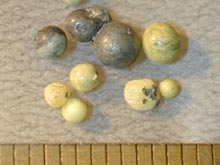
Sulfur "marbles" from NW Rota volcano. Molten sulfur (at temperatures greater than 115°C) is ejected into cold seawater, where it solidifies into round drops and falls to the sea floor. Each division on the bottom of the image is 1/10 cm (1cm equals about .4 in). Click image for larger view and image credit.
The second extreme case of magmatic volatiles appeared at NW Eifuku volcano, 1,600 m below the sea surface. At this site, we found buoyant droplets of liquid carbon dioxide. This is only the second major occurrence of this kind of venting; the other case was found over a decade ago in the Okinawa trough. At NW Eifuku, the carbon dioxide-rich vents are probably fueled by the degassing of a carbon-rich magma. The carbon isotopic composition of the carbon dioxide samples we recovered indicate that the majority of the carbon is derived from marine carbonates, but the nature and location of the vent sites and the chemistry of the water indicates that the system is driven by magmatic degassing rather than hydrothermal dissolution of carbonate minerals [Lupton et al., Geochem. Geophys. Geosyst., in review]. There has been widespread interest in the NW Eifuku site as an opportunity to study the effects of liquid carbon dioxide on ocean chemistry and on the animals that live on or near the sea floor, and it is a fascinating site for the study of magmatic degassing and the physical chemistry of hydrothermal systems dominated by carbon dioxide.
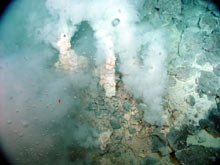
This is the Champagne vent at NW Eifuku volcano, where bubbles of liquid CO2 escape from the white chimneys and surrounding sea floor. The chimneys are about 20 cm (8 in) across and 50 cm (20 in) high, and they are venting fluids at 103ºC (217ºF). Click image for larger view and image credit.
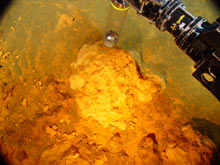
During SRoF'04, the ROV ROPOS sampled the iron-rich bacterial mat at a diffuse (low temperature) vent site on NW Eifuku submarine volcano. Click image for larger view and image credit.
Low-temperature vents dominate
Another difference between hydrothermal vents on submarine arc volcanoes of the Marianas and mid-ocean ridge volcanoes is the dominance of low-temperature, diffuse venting on the arc. We found only one high-temperature site where sulfide mineral chimneys formed on the Mariana Arc. We have not explored enough of the sea floor in arc environments to make a general conclusion about this, but the first look suggests that diffuse venting dominates along the arc volcanoes. The contrast between the arc and the mid-ocean ridge is surely linked to the contrast in geologic structure. Mid-ocean ridges are dominated by linear volcanic ridges with a layered structure, while many arc volcanoes are conical with chaotic and highly variable internal structures rich in permeable volcaniclastic material. The contrast in permeability and heat-source localization between linear mid-ocean ridges and constructive cones on volcanic arcs, combined with the higher volatile concentrations on volcanic arcs, leads to different venting styles and widely varying chemical composition.
References
Embley, R.W., W.W. Chadwick, Jr., E.T. Baker, D.A. Butterfield, J.A. Resing, C.E.J. de Ronde, V. Tunnicliffe, J.E. Lupton, S.K. Juniper, K.H. Rubin, R.J. Stern, G.T. Lebon, K.-I. Nakamura, S.G. Merle, J.R. Hein, D.A. Wiens, and Y. Tamura (2006): Long-term eruptive activity at a submarine arc volcano. / Nature / [In review].
Lupton, J., D. Butterfield, M. Lilley, L. Evans, J. Resing, R. Embley, E. Olson, G. Proskurowski, W. Chadwick, Jr., E. Baker, C. de Ronde, K.-I. Nakamura, K. Roe, R. Greene, and G. Lebon (2005): Submarine venting of liquid carbon dioxide on a Mariana Arc volcano. / Geochem. Geophys. Geosyst. / [In review].
Sign up for the Ocean Explorer E-mail Update List.


