


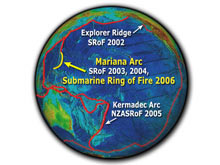
The Submarine Ring of Fire 2006 (SRoF'06) expedition will take place on the Mariana arc. It will be the third Ocean Exploration expedition to the Marianas. This image shows a global view of the Pacific Ring of Fire. The four previous SRoF expeditions are indicated at Explorer ridge, Kermadec arc, and the Mariana arc. The dashed line is the crest of the Mid-ocean ridge system and solid lines show plate boundaries defined by island arcs and trenches. Click image for larger view and image credit.
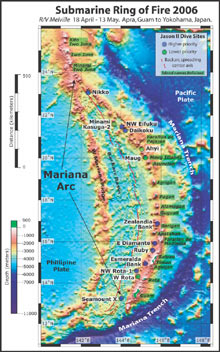
This map shows the Northwest Pacific from Guam to Iwo Jima. Possible dive targets for the remotely operated vehicle Jason II during the SRoF'06 expedition are designated by the blue and green circles. Bathymetry data are satellite-derived (bottom, 3,500 m resolution); EM300 (top, along the arc, 30 m resolution). Plate tectonic features are also indicated. Click image for larger view and image credit.
The Submarine Ring of Fire 2006 Expedition
Bob Embley
Chief Scientist
Submarine Ring of Fire Expedition 2006
Geophysicist
NOAA Vents Program, Pacific Marine Environmental Laboratory – Newport, Oregon
 NOAA Podcast:
Learn what Bob Embley hopes to discover on this expedition with a video or audio podcast on the mission.
The Submarine Ring of Fire 2006 expedition on the research vessel (R/V) Melville will depart April 18 from Apra, Guam, and arrive May 13 in Yokohama, Japan. This is the third in a series of explorative expeditions to the submarine volcanoes of the Mariana arc. The interdisciplinary team of 21 scientists from the United States (US), Japan, Canada, and New Zealand will work closely with the Deep Submergence Operations Group of Woods Hole Oceanographic Institution to utilize the remotely operated vehicle (ROV) Jason II to explore and collect samples at hot springs on these active volcanoes.
The region of exploration lies within the farthest reaches of US waters in the vicinity of the Territory of Guam and the Commonwealth of the Northern Mariana Islands. The 1,450-km-long (800 nautical mi) arc of volcanoes lies only 200 km (about 100 nautical mi) west of the Mariana Trench, where the westernmost, oldest portion of the Pacific tectonic plate begins its plunge back into the Earth's mantle (the region between the crust and the core). Many of these active volcanoes, some of which have emerged as islands, rise more than 3,000 m (almost 10,000 ft) from the deep-sea floor.
The SRoF'06 expedition will investigate several new sites and revisit some of the sites discovered during the 2004 Submarine Ring of Fire expedition as well as a 2005 Japanese-led expedition. The ROV Jason II will conduct intensive explorations, mapping, and sampling at 6 to 8 sites during the expedition. During transits and between Jason II dives, the SeaBeam multibeam sonar system and the CTD (conductivity, temperature, depth) on the R/V Melville will be used to conduct surveys and characterize sites.
In 2004, researchers discovered some extraordinary sites. The NW Rota-1 volcano was erupting concentrated sulfur gas and volcanic ash and lava fragments in 2004 and the revisit to this site in October 2005 showed the eruption was continuing at an even greater intensity! The Japanese ROV Hyper-Dolphin was greeted with a hail of volcanic ejecta and ash erupting out a sulfurous cloud! We are very excited to return, and we plan for a comprehensive program to explore the changes that have occurred at this site since 2004. Other highlights will include the first explorations of several submarine volcanoes (Seamount X, Esmeralda, Ruby, and Zealandia) and revisits to the site of liquid CO2 venting at NW Eifuku and to the amazing crater on Nikko volcano discovered during the 2005 Japanese expedition. Huge expulsions of sulfur and other volcanic gases here fuel an extraordinarily high density of chemosynthetic life.
We hope you will join us as we continue our explorations of the Mariana arc submarine volcanoes, revealing the wonders of one of the Earth's great hidden landscapes.


