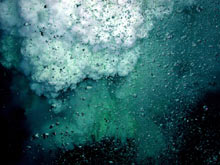
A degassing event at Brimstone Pit at NW Rota-1 volcano releases an
extraordinary number of bubbles, probably carbon dioxide. The yellow
parts of the plume (seen here in the background) contain tiny droplets of molten sulfur.
Click image for larger view and image credit.
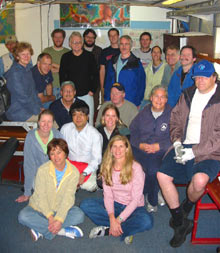
Submarine Ring of Fire 2006 Science Party Explorers:
Front row (from left): Susan Merle, Andra Bobbitt, Leigh Evans;
Row 2: Lori Savage, Ko-ichi Nakamura, Julie Huber, Sharon Walker;
Row 3 (kneeling): Ron Greene, John Dower;
Row 4: Verena Tunnicliffe, Joe Resing, Bob Embley, Dave Butterfield,
Sheryl Bolton, Cornel de Ronde, Bill Chadwick;
Row 5: Boku Takano, Ben Larson, Rick Davis, Nick Deardorff, and Nathan Buck.
Click image for larger view and image credit.
Submarine Ring of Fire 2006: Mariana Arc
Mission Summary
April 18 - May 13, 2006
Bob Embley
Chief Scientist — Submarine Ring of Fire Expedition 2006
Geophysicist
NOAA Vents Program, Pacific Marine Environmental Laboratory
Read the SRoF'06 Final Cruise Report (8.5 Mb, PDF)
 SRoF'06 Exploration Highlight Video (Quicktime, 272.1 Mb)
After all the months of preparation, the extremely exciting Submarine
Ring of Fire 2006 (SRoF'06) expedition on the research vessel (R/V) Melville with the Jason
II remotely operated vehicle (ROV), the hectic follow-up period
of responding to the media requests for stories on the eruption — we can
now reflect on this rich experience. When we departed Guam on
April 18, we had high expectations, but I don't think any one of
us suspected the full magnitude of the discoveries we were about to make. We
really pushed the envelope of exploration on one of Earth's most extreme
environments: the shallow submarine volcanoes of the Mariana arc.
The ongoing eruption of NW Rota-1 volcano (after at least two years!)
was obviously the highlight of the cruise. The video taken during
our dives here became well known throughout the world in the weeks following
our expedition, both on the internet and on various television broadcasts. When
we drove into the crater of Brimstone Pit on April 23 Greenwich Mean Time (GMT) during Dive
187, the activity appeared to have almost ceased. But over the next few
days the activity built until it was a full-scale eruption — more active
than on either of our previous two expeditions. The volcano was
belching red rock extrusions of lava and sudden bursts of gas and ash particles
that, at times, enveloped the Jason II ROV. The small hydrophone we deployed
nearby recorded, for the first time, the sounds of a sea-floor eruption concurrent
with visual observations. However, what was perhaps the most amazing
part of the experience was the fact that we could actually observe it! It
is unlikely that a similar eruption on a volcano above sea level could
have been observed and sampled as thoroughly as we were able to do.
The next big surprise came at Daikoku, a volcano that was not thought
to be particularly active during the previous (and relatively brief) visits in
2004 and 2005. The discovery of the "Cauldron" sulfur pond was extraordinary. It
provided us with a unique window into what we now believe is an extensive
subsurface infiltration of molten sulfur within many of the active arc
volcanoes.
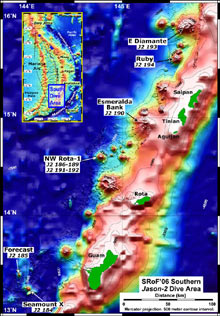
The southern Mariana arc submarine volcanoes visited on the
SRoF'06 expedition. The Jason II remotely operated vehicle (ROV) dives at Seamount X, Forecast, NW
Rota-1, Esmeralda Bank, Ruby, and East Diamante are indicated. Click
image for larger view and image credit.
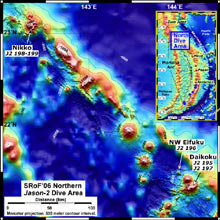
The northern Mariana arc submarine volcanoes visited on the SRoF'06
expedition. The Jason II ROV dives at Daikoku, NW Eifuku, and
Nikko are indicated. Click image for larger view and image
credit.
Nikko is a special place. We had first seen active molten sulfur
flows on the sea floor here in November 2005, during the dives with the JAMSTEC (Japan Agency for Marine-Earth Science and Technology) ROV Hyper-Dolphin. Further discoveries awaited us
this year. The chemosynthetic life in Nikko's crater and on its
upper flanks is probably at the highest density observed to date on any
sea-floor volcano. We also discovered a new molten sulfur site outside
the crater (named Naraku). There was an extensive pool of molten
sulfur at this site, discovered when Jason II broke through a
thin crust and instantly added 80 lbs to its weight! A striking
visualization at this site was the discovery of inactive ornamented sulfur
chimneys.
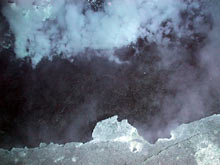
The pond of molten sulfur discovered at Daikoku volcano is about
15 ft long and 10 ft wide. The temperature of the molten
sulfur was measured at 187°C (or 369°F). Click image
for larger view and image credit.
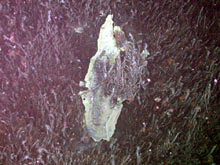
A striking visualization at Nikko was the discovery of inactive
ornamented sulfur chimneys. This one is sitting on end in the
middle of a huge field of tubeworms.
Click image for larger view and image credit.
We also explored hydrothermal vents at the summits of four new sites (Forecast,
Seamount X, Esmeralda, and Ruby) and revisited two other sites discovered
in 2004 (NW Eifuku and East Diamante). The ecosystems at these and
the other volcanoes along the arc continue to be of great interest to the
biologists. The discoveries made at the volcanoes visited for the
first time add new information as well as raise new questions. Forecast
and Seamount X are geographically close (10 km apart), but their
biological communities differ. The diversity of biology at Forecast
is similar to that at other backarc spreading center sites (including Alice
Springs several hundred kilometers north). The biology at Seamount
X is similar to other seamounts on the frontal volcanic arc, which have
a relatively lower diversity of species.
Some Thoughts for Future Explorations
We want to return to the Mariana arc because our brief visits to the exciting
and diverse array of active sites have raised more questions than they
have answered. The experience at NW Rota-1 volcano taught us that we could
learn much more at such an active site if we had some other tools available
to us. For example, there is still the major question of how the deep
plume, which we have now observed around the volcano in both 2004 and 2006, is linked
to the eruptions at the summit. In order to investigate such a linkage,
we will have to collect data in both synoptic and time-series modes. For
the former, we need to observe both the summit and flank activity at the
same time. For example, if we had an autonomous undersea vehicle
on board, we might have been able to conduct surveys with it on the flank
concurrently with observations of the summit with Jason II. Time-series
measurements of seismic activity and water column properties over a period
of months to years could provide linkages between the eruption processes,
as recorded in both the solid earth and the overlying water column. Such
synoptic and time-series measurements are new modes of exploration specific
to active sites, such as NW Rota-1, that we hope to implement on a future
expedition.
(top)
Sign up for the Ocean Explorer E-mail Update List.



