


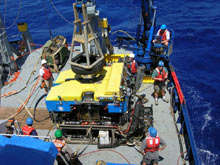
The Jason group and the research vessel (R/V) Melville crew prepare to launch the Jason II remotely operated vehicle (ROV) for another dive on the Submarine Ring of Fire 2006 expedition. Click image for larger view and image credit.
Very Exciting Stuff, Indeed!
May 10, 2006
Will Sellers
Chief Pilot and Expedition Leader of Jason Operations
As a former pilot of the deep submergence vehicle Alvin and presently chief pilot and expedition leader of Jason Operations, I have been doing my part to help the scientific community explore the bottom of the ocean for over 20 yrs. During this time, I have seen some amazing things, natural and manmade. On the manmade side were the shipwrecks: from 2,000-yr-old wrecks of Roman and Phoenician origin to United States war ships from the 1800s and the Titanic. But, on the natural side, the things that have always fascinated me are the hydrothermal vents on the mid-ocean ridges.
I have been to all the hot spots popular with the oceanographic community, but those didn't prepare me for what I've seen on this trip aboard the research vessel (R/V) Melville. Hydrothermal vents seem rather predictable compared to an active volcanic eruption – as we witnessed at Brimstone Pit, NW Rota-1 volcano. The vents at mid-ocean ridges spew their hot water at temperatures up to 400°C (750°F) and are very dangerous, especially to a manned submersible. But they lack the spontaneous danger of the Brimstone Pit site. While hovering Jason just a few meters away and observing the pulsating explosive nature of the violence occurring there, you get the impression that it could "go Mt. St. Helens" on you at any minute. One time, I had to back away at full speed or risk having Jason consumed by the pit. Very exiting stuff, indeed!
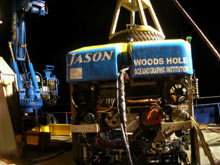
The Jason group prepares for a midnight launch
of the vehicle from the fantail of the R/V Melville. Launches and
recoveries can happen at almost any hour of the day or night since
the operations go around the clock.  Click
image for larger panorama view QTVR
Click
image for larger panorama view QTVR
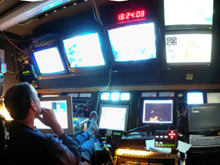
A view from the control van of the R/V Melville as the scientific party looks intently at their computer screens. Click
image for larger view QTVR
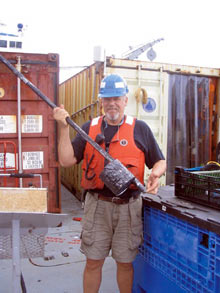
Will Sellers, chief pilot and expedition leader of Jason Operations, holds up his "instant molten sulfur sampler." Click image for larger view and image credit.
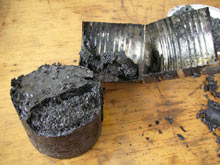
The coveted sample of sulfur, cut free of the sampler. The sample was originally molten, but solidified quickly in the cold seawater above the bottom. Pure sulfur is yellow, but other metals are also present and have combined with the sulfur — creating the black color we see here and on the sea floor. Click image for larger view and image credit.
Another fun experience on this cruise was the molten pond of sulfur at Daikoku volcano. I'd never seen anything like it before. The pond was about 5 m wide by 3 m across (more than 16 by 10 ft) and had undulating waves going through it, as though it were boiling. We were careful to measure the temperature on the sea floor before we set down near the edge, so we wouldn't burn Jason's "feet," so to speak. We sat down right at the edge of the pond and put the temperature probe into the molten sulfur. The temperature measured 187°C (369°F), which really put Jason in harms way. Upon recovery, we discovered that many of the stainless steel bolts on Jason had turned black from the sulfuric acid in the water. After our first dive at Daikoku, I thought of an easy way to get some of the molten sulfur. On the next dive we brought along a ½-gal metal peanut can I got from one of the cooks, and hose-clamped it to the end of a 6-ft aluminum pipe. Viola! Instant molten sulfur sampler. It worked very well. Thinking up quick solutions to surprise problems is the fun part of my job.
Sign up for the Ocean Explorer E-mail Update List.


