


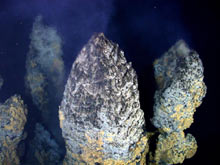
The very top of the Five Towers chimney complex, now 11 m (36 ft) above the sea floor. The beehive-type tops of the chimneys are expelling hydrothermal fluids that make "smoke" upon mixing with the surrounding seawater. Click image for larger view and image credit.
An Enchanted Forest
May 1, 2006
Cornel E.J. de Ronde
Geologist
Institute of Geological and Nuclear Sciences
Lower Hutt, New Zealand
 Sampling extinct chimneys at East Diamante.
(Quicktime, 1.5 Mb.)
Sampling extinct chimneys at East Diamante.
(Quicktime, 1.5 Mb.)
Five Towers chimney at the Black Forest vent field. (Quicktime,
1.9 Mb.)
A multitude of tropical life exists at the Aquarium site. (Quicktime, 2 Mb.)
From the smoky inferno that was Brimstone Pit, we travel north about 250 km (135 nautical mi) to East Diamante volcano. What a difference a day makes. Here, the remotely operated vehicle (ROV) Jason II dives down to a depth of around 350 m (1,150 ft), where we first glimpse the sea floor. What greets us is a scene far more tranquil than that of Brimstone Pit. Sediment covers the slope, soon to be replaced by numerous boulders of blocky lava, some the size of a small car. Not long after we begin transecting up the slope, we notice some tall objects projecting upwards from the blocky slopes. At first they are hard to discern, as both they and the lava are covered in a coat of black manganese oxide. It's as though nobody wants to be seen here. Closer inspection shows the tall objects are chimneys.
Metals like copper, zinc, lead, and even gold are typically transported in solution at high temperatures (greater than 250°C, or 480°F). These hot fluids ascend from unknown depths to be expelled on the sea floor as hot springs, commonly known as "black smoker" hydrothermal vents. The metal-laden fluids are cooled rapidly as they mix with the surrounding seawater causing metal-rich particles to precipitate out of the fluid. This is the "black smoke" seen in the water column. Most of the metals form this smoke although perhaps 5% stay behind and form what are commonly known as "chimneys."
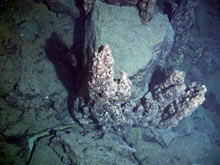
This view looks down on some 1.5 m (5 ft) tall dead chimneys that grew out of a field of lava boulders. The chimney at the top of the photograph has grown over the boulder while at the foot of the chimneys in the foreground lies another chimney that has fallen over. Click image for larger view and image credit.
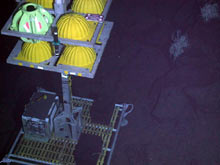
The remotely operated vehicle (ROV) Jason II’s trusty companion, the "elevator," allows the team to bring larger samples back from the sea floor. Click image for larger view and image credit.
On Dive J2-193 we collected some of the chimneys for later analysis, back in shore-based laboratories. Both "dead" and "active" chimneys are sought by the scientists. The former provide insight into past hydrothermal history at the site; while the latter, when combined with samples of the hydrothermal fluid being expelled at the site, tell the scientists how the chimneys are forming right now and even why microbes might want to colonize these areas. Whole chimneys also allow many more people to view these strange structures, other than the few scientists that found them, and have proved popular when displayed in museums. Bringing large chimneys from the sea floor to the surface is not trivial, but an innovation called an "elevator" means it can be done.
The chimneys are ephemeral, meaning that they last for only a relatively short time. Dating the chimneys shows that while a rare few can be over 100 yrs old, most are not more than 40 yrs old, and many are much younger than that. They typically fall down during that time and ultimately either coalesce to form large metal-rich mounds, or break up into sediment. At the Five Towers site, numerous chimneys are found, with a particularly tall (5 m, 16-plus ft) chimney complex seen perched on a 6-m-tall mound that itself is 10 m (more than 32 ft) in diameter. A lot of metal!
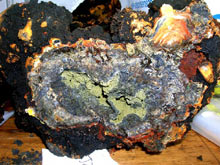
A cross-section view of the base of one of the active chimneys recovered by the ROV Jason II at the Five Towers vent field. The brass-colored mineral lining the central orifice of the chimney is the copper sulfide, chalcopyrite. Click image for larger view and image credit.
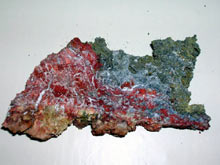
A striking example of the iron-oxide mineral hematite (appears red) intergrown with the sulfate mineral barite (white) and the copper sulfide mineral chalcopyrite (yellow). Click image for larger view and image credit.
Recovery of representative chimneys also allows scientists to examine in detail the mineralogy that makes up the chimney. Minerals are like miniature information centers with each one telling a different story about the conditions under which they were formed. For example, some tell about how acid the fluid was, others what the temperature must have been, and still others how much oxygen was dissolved in the fluid. The chimneys at East Diamante had a surprise in store. A couple of surprises, in fact. Firstly, there was chalcopyrite, a copper-rich sulfide mineral that prefers to be transported in fluids around 350°C (660°F), but here the fluid venting out of the chimney was 240°C (464°F). Interesting. Secondly, sulfides like chalcopyrite like to be transported in fluids that are acidic and which typically contain low concentrations of oxygen, yet only millimeters away there is the distinct red color of what looks like hematite, an iron-rich oxide mineral that needs oxygen in the fluid to form. Now that is really interesting! Do we have a scenario where two fluids of different composition take turns coming out of the vent? Hmmm . . . have to think about that one.
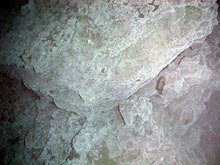
At about 220 m (720 ft) water depth we encounter large talus (a sloping mass of rocks at the base of a precipice) blocks coated with extensive bacterial mat. Notice the tropical fish swimming among the mat. Click image for larger view and image credit.
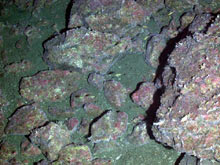
Red-green algae and fine white "beards" of bacterial mat cover the lava blocks at 200 m (about 650 ft) water depth. Here we are observing a rare sight: an overlap of the chemosynthetic and photosynthetic communities. Click image for larger view and image credit.
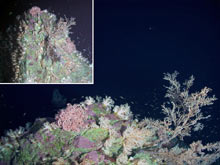
Pink basket stars, soft corals, sponges, and tropical fish adorn the Aquarium pinnacle at its shallowest point. Click image for larger view and image credit.
The dive ends with Jason II traversing up-slope to the shallowest point on the volcano, a central pinnacle known as the Aquarium site. On the way (at about 220 m water depth), we encounter large talus blocks coated with extensive bacterial mat. At about 200 m depth (650 ft), we see evidence of photosynthesis — where energy is derived from sunlight — with beautiful red-green algae covering the rocks. Those same rocks are also coated with "beards" of bacterial mat in places, remnants of the chemoautotrophic microbes from the deeper vent sites that derive energy from chemical reactions. At 165 m (540 ft) water depth we have reached the Aquarium site. The corals and reef fish provide a serene backdrop as Jason II lifts slowly towards the surface.
Sign up for the Ocean Explorer E-mail Update List.


