


New Research Helps Show How Depth Affects Fish Distribution
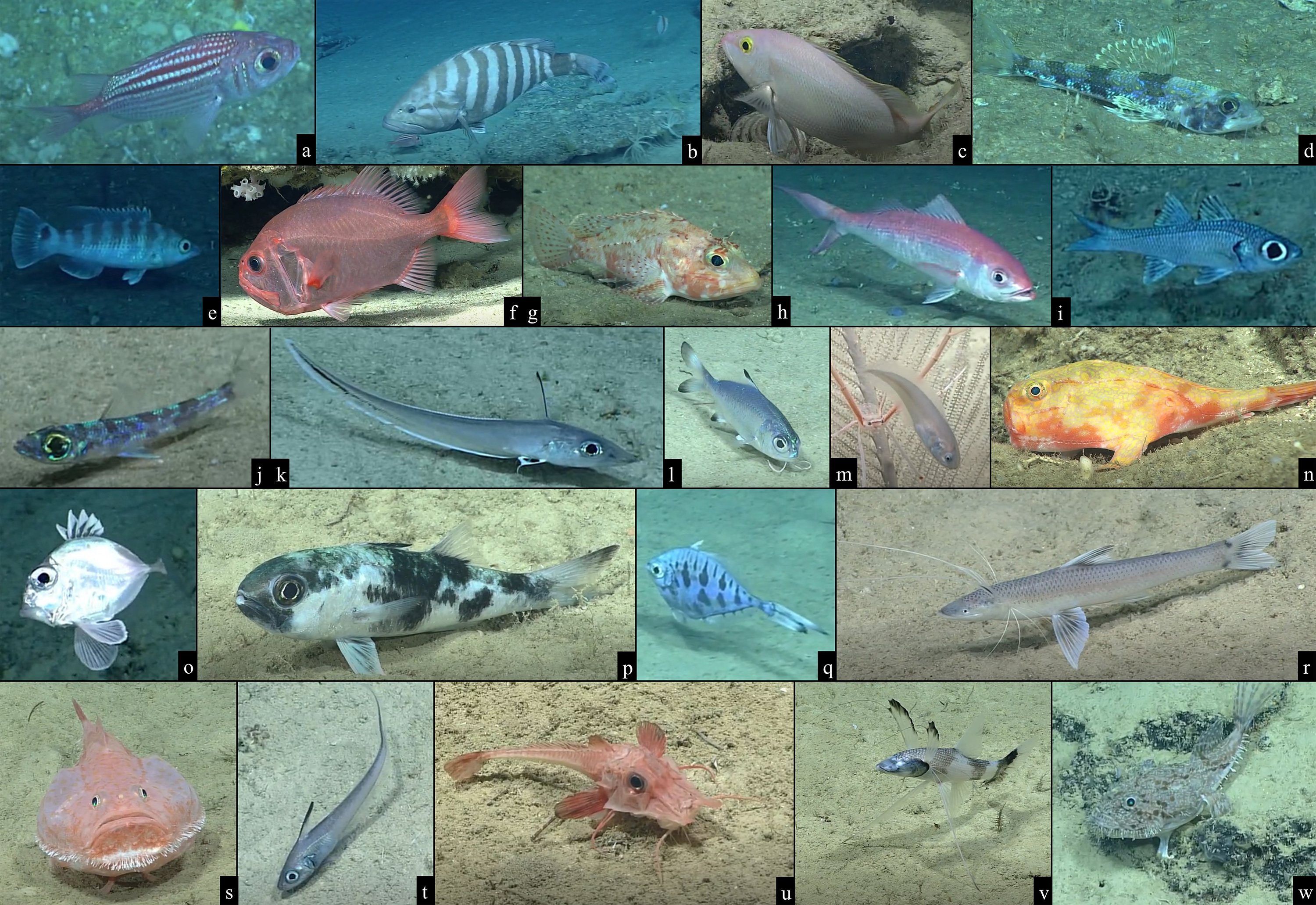
Deep-sea fishes observed in the tropical Atlantic and Caribbean Sea, depths 250–800 m. Images are arranged by depth and are not to scale. Source: Figure 6 from Gerringer et al. (2026), Observations of deep-sea fishes at depths 250 to 6300 m off Puerto Rico. Download largest version (jpg, 2.16 MB)

How do the bodies and lifestyles of fishes change as you dive deeper into the ocean? That question is the subject of a new study analyzing footage from waters near Puerto Rico, which is helping scientists understand how fishes at different depths interact with their environment.
Understanding where different kinds of fish live and how they behave is critical for managing ocean resources responsibly. Research on fish distributions is often done by collecting samples with tools like trawl nets. Those physical collections are essential to marine science, but they don’t tell us how a fish interacts with its underwater ecosystem. For this paper, researchers relied on video recorded by remotely operated vehicles (ROVs) and submersibles to study fish species in their natural habitats.
The paper’s authors, who included undergraduate students at the State University of New York (SUNY) College at Geneseo, reviewed footage from 30 exploration dives recorded by teams operating NOAA Ocean Exploration’s ROV Deep Discoverer, ROV Global Explorer, and the National Deep Submergence Facility’s submersible Alvin, operated by Woods Hole Oceanographic Institution. The results tell a clear story that supports the findings of other deep-sea experts. Abundance and biodiversity of all fishes decreased with depth, showing that life in the deep requires specialized adaptations. Deeper waters correlated with a higher percentage of bottom-dwelling fish living as ambush predators. Perhaps most interesting, though, is that fish species found swimming in deeper and colder waters tended to have long, eel-like bodies, while those in shallower waters appeared more “normal.”
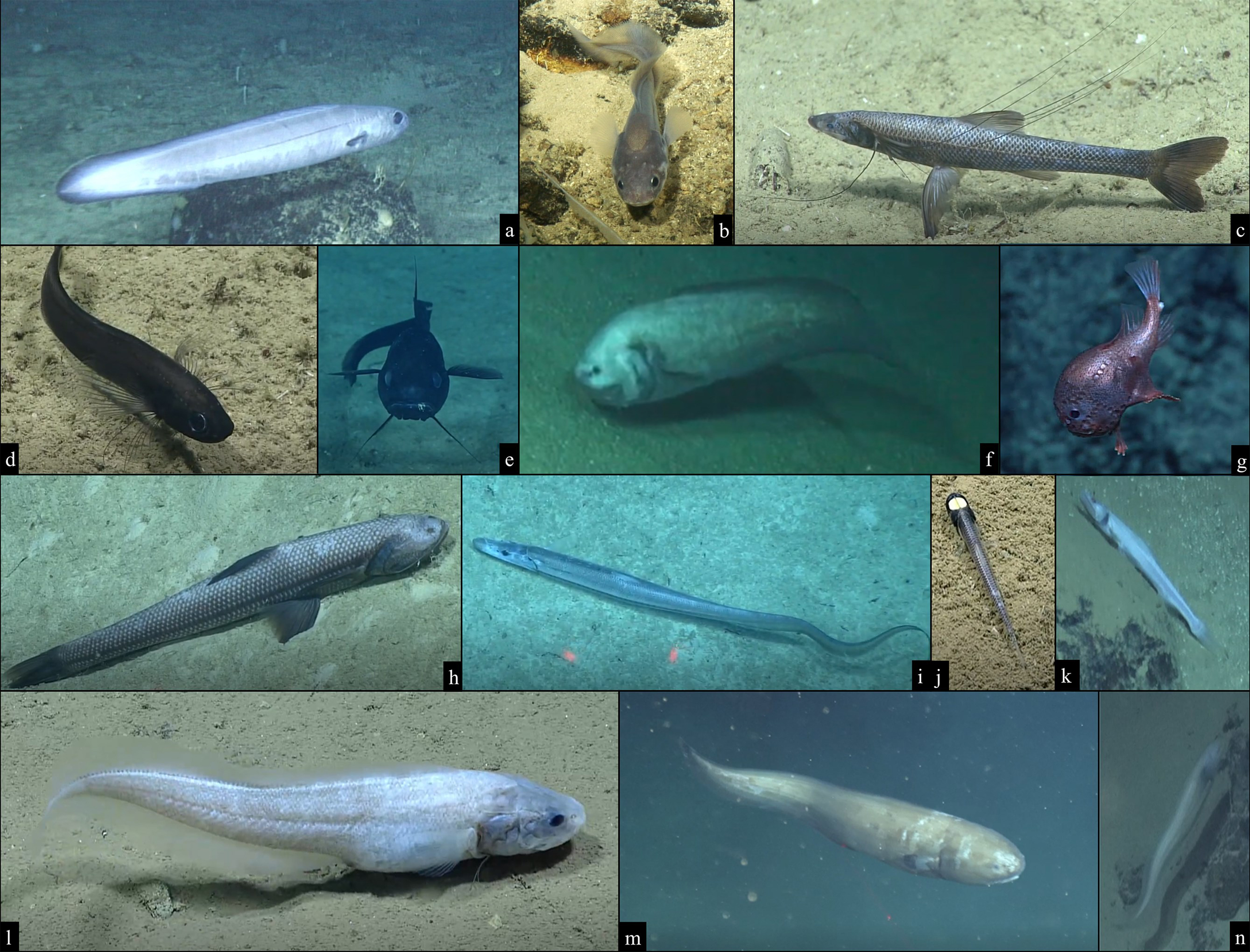
Deep-sea fishes observed in the tropical Atlantic and Caribbean Sea, depths 800–>6000 m. Images are arranged by depth and are not to scale. Note the more eel-like bodies of these fishes compared to the shallower-dwelling fishes displayed in the images above. Source: Figure 7 from Gerringer et al. (2026), Observations of deep-sea fishes at depths 250 to 6300 m off Puerto Rico. Download largest version (jpg, 2.71 MB)

Experts have suggested a few reasons for this trend over the past several years. It could be that longer bodies help deep-sea fishes swim long distances to find food, making them “endurance runners” compared to shallow-water “sprinters.” A longer body could also help deep-sea fishes sense their low-light environment by adding more sensors to their lateral line, an organ that helps fish detect movement in the water. It will take more research to learn for sure what’s behind the eel-like forms, but confirming that the trend is the same in different parts of the ocean is an important step.
The researchers’ strategy of observing deep-sea fishes where they lived led to other interesting findings, too. Some fishes usually thought of as pelagic (swimming in the water column without touching the ocean floor) were seen interacting with the seafloor or narrowly escaping bottom-dwelling predators like anemones. Fish were also filmed living in and around trash, which was observed frequently during the expeditions that provided the recordings. Discoveries like these would not have been possible without deep-sea footage.
This deep-sea skate seen “running over” a bony fish called a dragonet was one example the researchers noticed of interactions between fish and the seafloor. Video courtesy of NOAA Ocean Exploration’s 2022 Voyage to the Ridge 3 Expedition. Download HD version (mp4, 16.3 MB)
“Opportunities to observe deep-sea organisms in their environment are critical to our understanding,” said Mackenzie Gerringer, the lead author of the new study.
“We learn so much from seeing how some fishes position themselves vertically instead of swimming horizontally, or how some cusk eels regularly forage near deep-sea corals. A species is its DNA sequence and its body shape and characteristics from a collected specimen, but it is also much more. We need multiple ways of looking at deep-sea species to truly understand their lives.”
Use of the newly refitted Alvin submersible was especially helpful for observing the deepest-dwelling fish of the study. Researchers saw multiple cusk eels in the Puerto Rico Trench, which appear to be a very important and understudied group of fish in extremely deep waters. Alvin’s new depth limit of 6500 meters (21,300 feet) opens up new opportunities for exploring extreme ocean environments.
“This is exactly what Alvin was made for—and why the National Science Foundation and Office of Naval Research put so much effort into the upgrades that allow it to dive deeper than ever before,” said Anna Michel, the Chief Scientist of the National Deep Submergence Facility at the Woods Hole Oceanographic Institution that manages and operates the sub. “Scientists come away from dives in Alvin transformed, and their firsthand observations have revolutionized understanding of the physical, chemical, and biological processes that govern the deep ocean and that help shape life here on the surface.”
This study was conducted as part of a Course-Based Research Experience (CURE) for Undergraduates in a Marine Biology lab course at SUNY Geneseo. Open-access data such as those provided by NOAA Ocean Exploration support meaningful opportunities for undergraduates to engage in deep-sea research. A study supported by NOAA and the National Marine Sanctuary Foundation’s Ocean Exploration Education grant program (#22-01-B-417 to M.E. Gerringer) shows that deep-sea CUREs enhance students’ understanding of the scientific process and engagement with their biology education. The study details how programs like the deep-sea CURE leading to the paper featured in this article can be implemented in biology courses.
This new study was led by Mackenzie Gerringer of the State University of New York (SUNY) at Geneseo. It was co-authored by Chryssanthi Tzetzis, Jacob Calus, Abisage Sekarore, Erin Patton, Julia Cappiello, Emily McMahon, Nikki Fuller, Gabriel Rosado, Allison North, A.J. Petty, Benjamin McPherson, Emily Morgan, Christopher Cook, Cole Janda, Andrew Kareeparampil, Olivia Knudsen, Brooke Licata, Peyton Mackey, Nathan Phillips, Megan Roell, Catie Sawyer, Makena Scarlata, Giovanna Sineo, Evan Weaver, Brett H. Woodworth (SUNY Geneseo), Kasey Cantwell (NOAA Ocean Exploration), Daniel Wagner (NOAA Ocean Exploration, Ocean Exploration Trust), Brian R.C. Kennedy (NOAA Ocean Exploration, Ocean Discovery League, Boston University), Thomas Morrow, Samuel Candio (NOAA Ocean Exploration), S. Adam Soule (University of Rhode Island), Anna P.M. Michel (Woods Hole Oceanographic Institution), Andrea M. Quattrini (Smithsonian Institution), and A. Leitner (Oregon State University).
Gerringer et al. (2026) Observations of deep-sea fishes at depths 250 to 6300 m off Puerto Rico. ICES Journal of Marine Science 83(1). Access the full article online.