


Exploration and Characterization of Deep-Pelagic Crustaceans in the Southern California Exclusive Economic Zone
Active
Overview
In 2024, a team of researchers began a lab-based project to study the biodiversity of crustaceans collected with trawls from the deep ocean water column off Southern California. The deep ocean is the largest living space on Earth, and the animals that live there are prey for marine predators — including ecologically, culturally, and commercially important species — making them critical parts of their food web.

Representatives from each of the crustacean groups focused on during the Exploration and Characterization of Deep-Pelagic Crustaceans in the Southern California Exclusive Economic Zone project: (a) decapods, (b) lophogastrids, and (c) mysids. Light blue scale bars beneath each panel label represent one centimeter. These individuals are from the Choy Lab Deep Pelagic Crustacean Collection. Image courtesy of the Choy Lab at Scripps Institution of Oceanography. Download largest version (jpg, 300 KB).
Among these animals are crustaceans. Crustaceans, which include shrimp, are very abundant in the deep ocean, but scientists have much to learn about their rich variety and ecology.
This project will focus on three orders of dominant crustaceans (Decapoda, Lophogastrida, and Mysida) found in the water column at depths between approximately 200 and 3,000 meters/656 and 9,843 feet (deep pelagic). The study area includes five sites and encompasses several deep-ocean habitats within the U.S. Exclusive Economic Zone. The team will identify — or document and describe if unknown — recently collected crustaceans based on their morphology (form and structure). They will complement these identifications with DNA sequencing. Using this information, they will then characterize crustacean community composition in the study area.
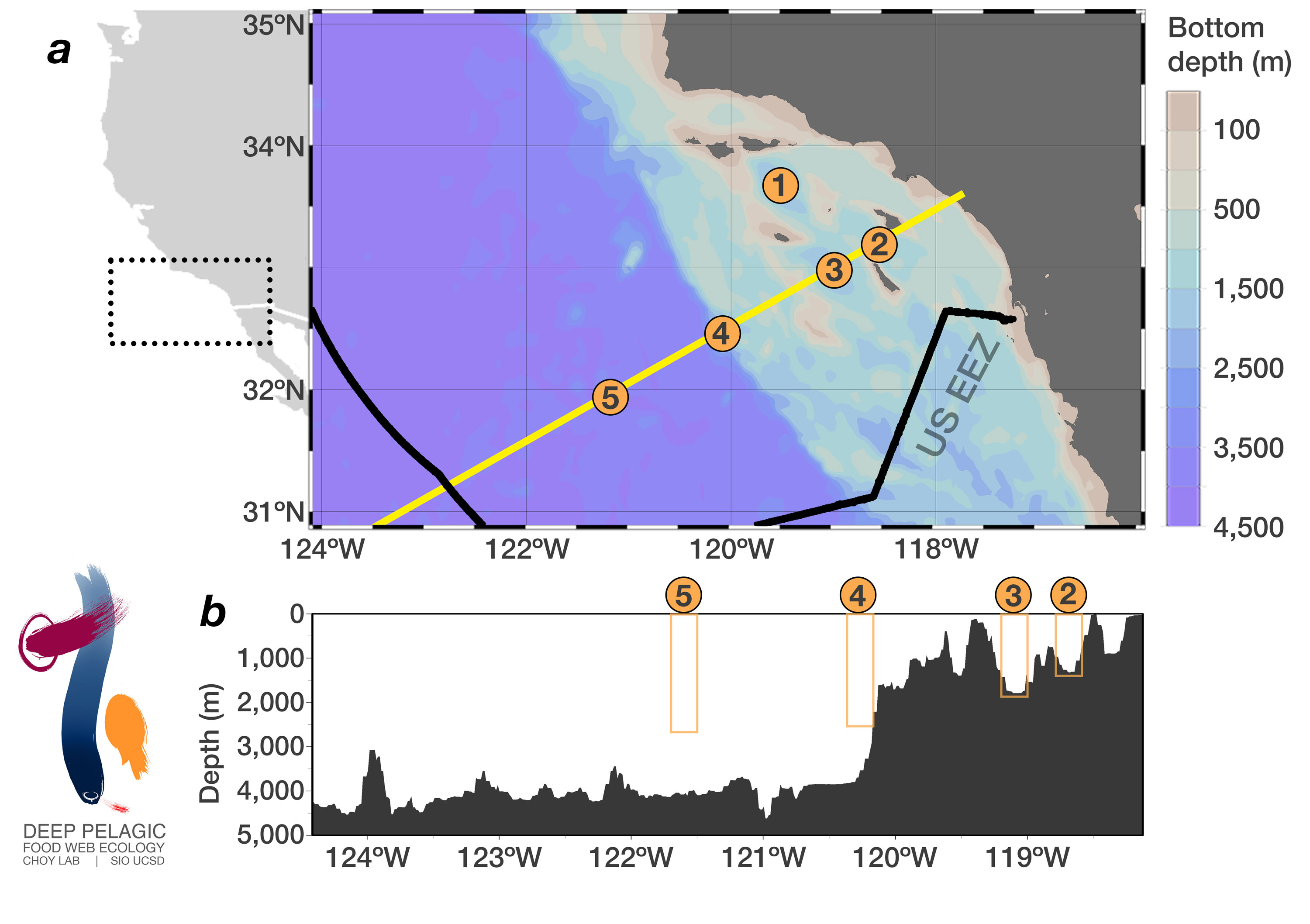
Study area for the Exploration and Characterization of Deep-Pelagic Crustaceans in the Southern California Exclusive Economic Zone project: (a) locations of the five main sampling sites (the yellow line is the bathymetric cross-section for panel b); (b) the approximate vertical extent of sampling sites 2-5. Grey shading represents the seafloor. Image courtesy of the Choy Lab at Scripps Institution of Oceanography. Download largest version (jpg, 414 KB).
Upon completion of their research, they will deposit the samples and the associated genetic material and data in national collections and databases, including DNA sequence reference libraries, which are critical for environmental DNA (eDNA) monitoring and studies. In addition, they will produce a freely available pictorial guide of deep-pelagic crustaceans to guide taxonomic identifications. The guide will also be incorporated into university and high-school ocean science curricula.
This work will increase our understanding of these crustaceans and support future water column exploration, research, and monitoring throughout the ocean to help us better understand the value and services of our natural marine resources and inform their responsible management and use.

Deep-pelagic crustaceans being sorted at sea before they were deposited in the Choy Lab Deep Pelagic Crustacean Collection. The species identities of these individuals will be verified in the lab and some individuals will be barcoded as part of the Exploration and Characterization of Deep-Pelagic Crustaceans in the Southern California Exclusive Economic Zone project. Image courtesy of the Choy Lab at Scripps Institution of Oceanography. Download largest version (jpg, 509 KB).
Education
Our Learn & Discover page provides the best of what the NOAA Ocean Exploration website has to offer to support educators in the classroom. Each theme page includes expedition features, lessons, multimedia, career information, and associated past expeditions and projects. Education themes related to this project include:
Resources & Contacts
- Scripps Institution of Oceanography (Principal Investigator C. Anela Choy)
- Florida International University, Institute of Environment (Co-Principal Investigator Heather D. Bracken-Grissom)
- Emily Crum
Communication Specialist
NOAA Ocean Exploration
ocean-explore-comms@noaa.gov