


Accelerating Ocean Exploration Through Cloud-Native Processing of Active Ocean Sonar Data
Past Expedition
Overview
A team of scientists has developed and added two new tools to their open-source data-processing package Echopype to make ocean sonar data easier to process and analyze using cloud computing. With these new tools, Echoshader and Echodataflow, scientists will be able to handle large amounts of ocean sonar data more effectively and efficiently than ever before to improve our understanding of ocean life.
Examples of animals that could be detected in the water column with acoustic sampling techniques like those developed during the Accelerating Ocean Exploration Through Cloud-Native Processing of Active Ocean Sonar Data project. Images courtesy of NOAA Ocean Exploration; compiled by Garret O’Donnell. Download largest version (jpg, 605 KB).
Echosounders, or active acoustic sonar systems, are important tools for studying life in the ocean. These tools use sound waves to “see” what’s happening underwater. Echosounders send out sound pulses and listen for the echoes that reflect off of small fish, zooplankton, and other organisms living in the water column (habitat between the seafloor and sea surface).
As technology improves, the amount of data produced by echosounders is growing. Many scientists aren’t able to store, organize, and/or analyze it all, making processing large amounts of ocean sonar data slow and expensive. Thus, using such data to track and characterize marine communities is a challenge.
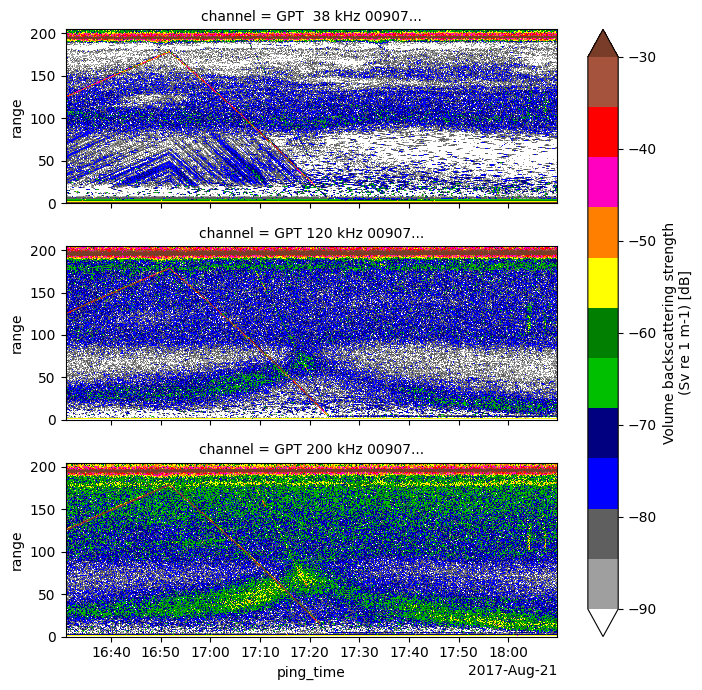
An example of an echogram produced by Echopype. Echograms are visual representations of echosounder data that can be interpreted to characterize abundance and type of organisms in the water column. The Accelerating Ocean Exploration Through Cloud-Native Processing of Active Ocean Sonar Data project enables more efficient use of echograms through the newly built Echodataview package. Image courtesy of Accelerating Ocean Exploration Through Cloud-Native Processing of Active Ocean Sonar Data. Download largest version (jpg, 721 KB).
The new tools developed as part of this project will help scientists address this challenge. While Echopype was designed to ease ocean sonar data processing in the cloud, the new tools build on its foundation to enhance its capabilities. Echoshader allows scientists to quickly check data quality, identify errors early, and clean up datasets. Echodataflow simplifies workflow creation by enabling users to write plain-text “recipes” for processing steps. It’s designed to demystify highly technical workflows and broaden accessibility — particularly for users with limited computer programming expertise.
This project will benefit the U.S. fisheries and ecological acoustics communities by offering free, versatile tools that operate on local computers and in the cloud. By enabling the affordable and efficient processing of large echosounder datasets, these new tools show great promise for advancing the understanding of how midwater communities behave and change beneath the waves.
Resources & Contacts
- University of Washington Applied Physics Laboratory (Wu-Jung Lee, principal investigator)
- University of Washington eScience Institute
- NOAA Fisheries Northwest Fisheries Science Center
- Emily Crum
Communication Specialist
NOAA Ocean Exploration
ocean-explore-comms@noaa.gov