


Beyond the Blue: Papahānaumokuākea ROV and Mapping
Mission to USS Yorktown: Dive Highlights
On April 19 and 20, 2025, as part of the Papahānaumokuākea ROV and Mapping expedition on NOAA Ship Okeanos Explorer, NOAA Ocean Exploration and partners explored the final resting site of USS Yorktown (CV-5). This U.S. Navy aircraft carrier took part in several World War II operations before being sunk by a Japanese submarine following the Battle of Midway. These non-disturbance dives were the first to explore the ship’s hangar deck, revealing a number of unexpected discoveries, described below.
On April 19 and 20, 2025, NOAA Ocean Exploration and partners explored the final resting place of USS Yorktown, a U.S. Navy aircraft carrier lost in the Battle of Midway. The dives revealed several significant discoveries. Download largest version (mp4, 235 MB)
It is important to note that the 2025 remotely operated vehicle (ROV) dives were not the first to explore the shipwreck. Several investigations of Yorktown have occurred since its 1998 discovery and initial documentation by Dr. Robert Ballard, the National Geographic Society and the U.S. Navy, including a characterization mission in 2023 led by Ocean Exploration Trust on Exploration Vessel (E/V) Nautilus. The dives in 2025 built on this previous work, providing answers to existing questions and resulting in new mysteries for historians and scientists to puzzle out.
Mural: “A Chart of the Cruises of the USS Yorktown”
During the dive on April 19, for the first time ever, we were able to image the mural, “A Chart of the Cruises of the USS Yorktown,” hand-painted inside the ship’s #2 elevator shaft. This mural had only partially been visible in historic photographs of other subjects when Yorktown was afloat. The mural displays a world map that tracks the voyages of Yorktown. Measuring approximately 42 feet by 12 feet, its motifs showcase the pride that Yorktown‘s sailors had for their ship, the global scale of Yorktown’s activities, and the strategic role that the ship played in defending the United States.

Download largest version (jpg, 2.39 MB).

Download largest version (jpg, 875 KB).


Close views of the mural, “A Chart of the Cruises of the USS Yorktown,” reveal the intricacies and detail in this painting depicting the travels of Yorktown. Imaged on April 19 during the Papahānaumokuākea ROV and Mapping expedition. Image courtesy of NOAA Ocean Exploration, 2025 Beyond the Blue.
Download largest version of the left image (jpg, 2.92 MB). Download largest version of the right image (jpg, 2.42 MB).

Download largest version (jpg, 754 KB).
A Surprise Automobile
Exploration often provides some surprises. During the dive on April 19, we noticed a faint outline of an automobile while peering into the aft hangar deck from the port side of USS Yorktown. The team aboard Okeanos Explorer and contributors ashore analyzed diagnostic features of the vehicle observed during the follow-up April 20 dive and tentatively identified the car as a 1941 Ford Super Deluxe ‘Woody’ in black. With “SHIP SERVICE ___ NAVY” written on part of its front plate. This car served a variety of roles from ship command to ship supply and traveled everywhere the carrier went.

Download largest version (jpg, 1.21 MB).

Download largest version (jpg, 946 KB).
Why, though, did the car remain stowed in the hangar deck after a brief 48-hour repair period in Pearl Harbor, when the ship’s officers knew it was heading to the Battle of Midway? During the valiant efforts to right Yorktown’s list, why too wasn’t this car jettisoned like the anti-aircraft guns and the aircraft? Did this automobile carry any particular importance to crew and officers who hoped it could be saved?

Download largest version (jpg, 1.35 MB).

Download largest version (jpg, 1.26 MB).
Douglas SBD Dauntless Dive Bombers
Previous exploration at Midway investigated ships engaged in the battle; however, the dive on April 20 resulted in the first-ever discovery of aircraft that fought at Midway — a seminal clash between sea and air power — on the actual battlefield.

Download largest version (jpg, 12.1 MB).

Download largest version (jpg, 496 KB).
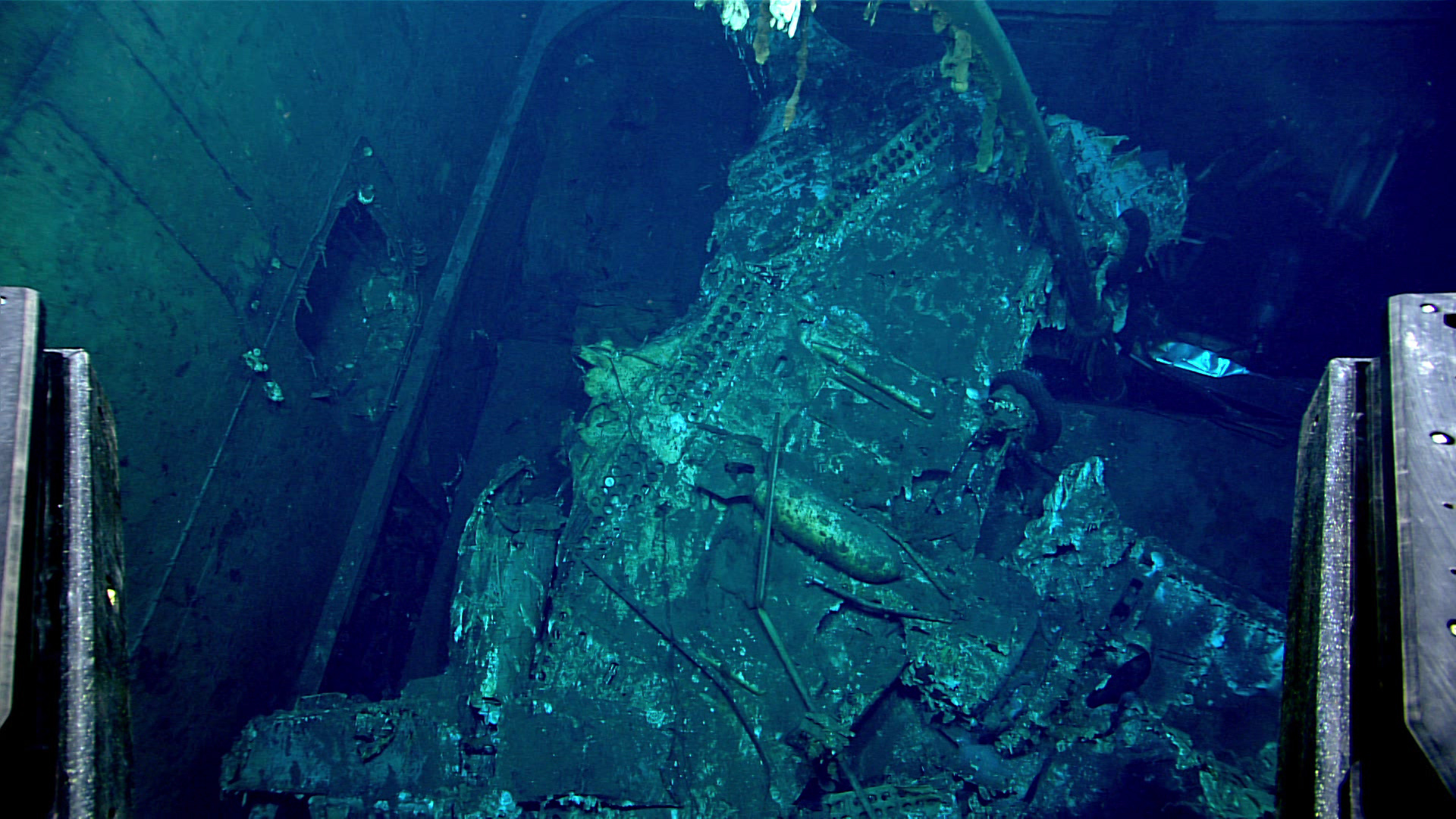
With the incredibly skilled and experienced pilots from the Global Foundation for Ocean Exploration, ROV Deep Discoverer observed Yorktown’s hangar deck by means of the #3 elevator shaft. Deftly avoiding a number of entanglement hazards, ROV cameras soon revealed the jumbled wreckage of at least three Douglas SBD Dauntless dive bombers resting in the aft starboard quarter. One of the planes, likely part of Yorktown’s reserve force on the first morning of the battle, was seen fully armed, lying inverted with a 500-lb bomb still secured in the release cradle. This armed plane, potentially SBD “Black 17,” was damaged during the Japanese aerial attacks. Another plane, with “B5” boldly legible on its fuselage, has been identified as Bureau Number 4581, an SBD-3 assigned to Bombing Squadron Six from USS Enterprise (CV-6). Damaged during the attack on the Japanese Imperial Navy aircraft carrier Kaga that morning and low on fuel, the plane landed on Yorktown, where it remains today. Its crew included Lieutenant (Junior Grade) William E. Roberts of the United States Naval Reserve and Aviation Machinist’s Mate First Class William B. Steinman of the United States Navy. These refugee aircraft were stowed at the rear of the carrier and later set on fire by one of three enemy bombs that ignited ordinance and aviation fuel in Yorktown’s hangar deck.
The team was also able to confirm that an aircraft wing imaged forward of the #2 elevator during the 2023 expedition on E/V Nautilus belonged to a Grumman F4F Wildcat, the primary U.S. Navy fighter used during the Battle of Midway. In addition, the team located a pair (or potentially folded set) of wings in the hangar deck; these wings likely were spares.
Download largest version (jpg, 1.04 MB).

Download largest version (jpg, 1.17 MB).
Shipwreck Biology
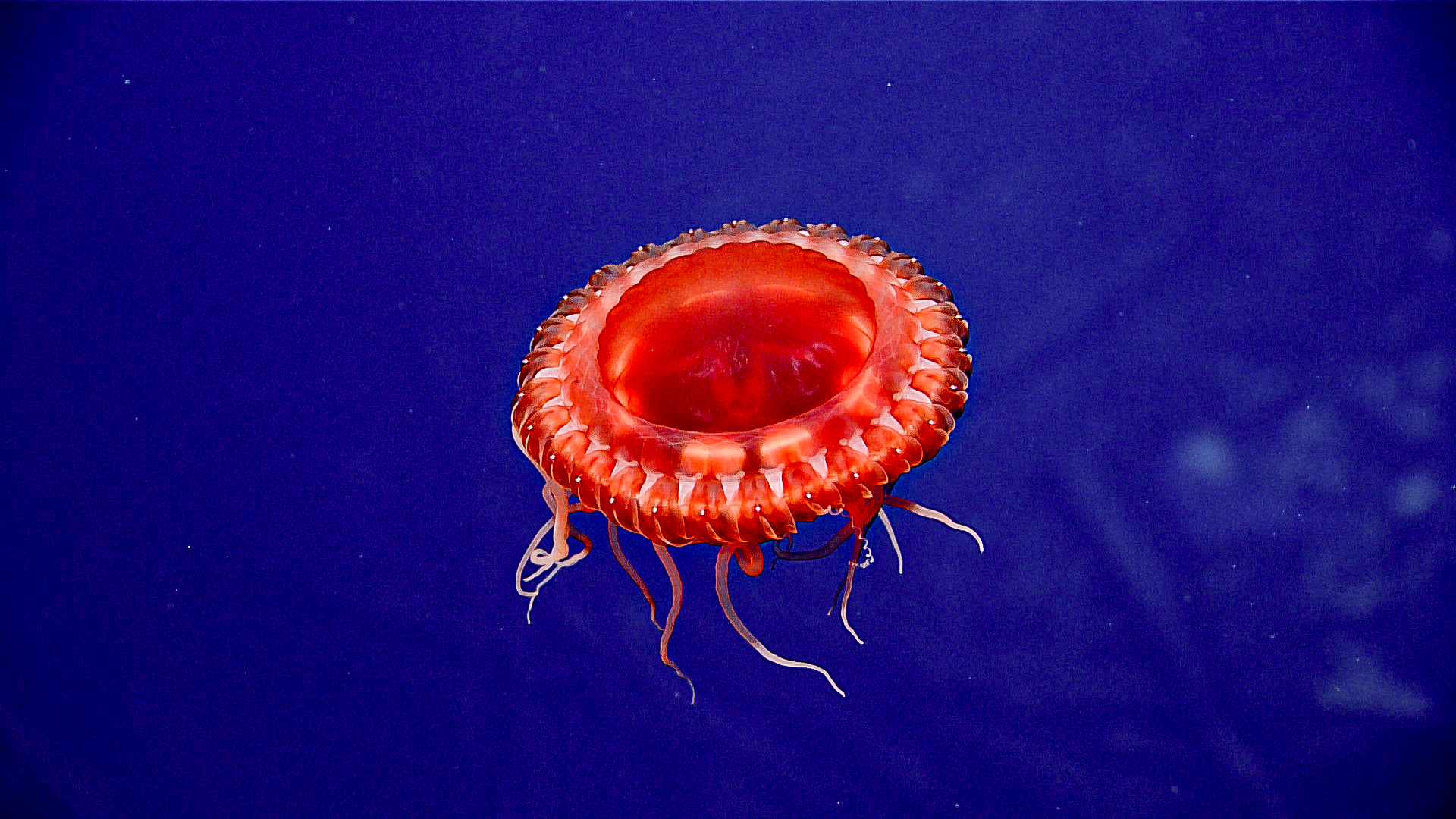
In addition to being a historic time capsule, the wreck of USS Yorktown provides habitat for a variety of marine life. Observations of this life made throughout the ROV dives on April 19 and 20 are important in helping us better understand how the deep-ocean environment changes over time. A few of the animals encountered during the dives are shown below.
Download largest version (jpg, 1.48 MB).

Download largest version (jpg, 1.30 MB).

Download largest version (jpg, 1.38 MB).
This mission was only possible through the contributions of partners including the Global Foundation for Ocean Exploration, NOAA Office of Marine and Aircraft Operations, NOAA Office of National Marine Sanctuaries, the Naval History and Heritage Command, SEARCH, Air/Sea Heritage Foundation, the Defense POW/MIA Accounting Agency, Nauticos, Ocean Networks Canada, Ocean Exploration Trust, Chuck Haberlein, Jonathan Parshall, and Anthony Tully.
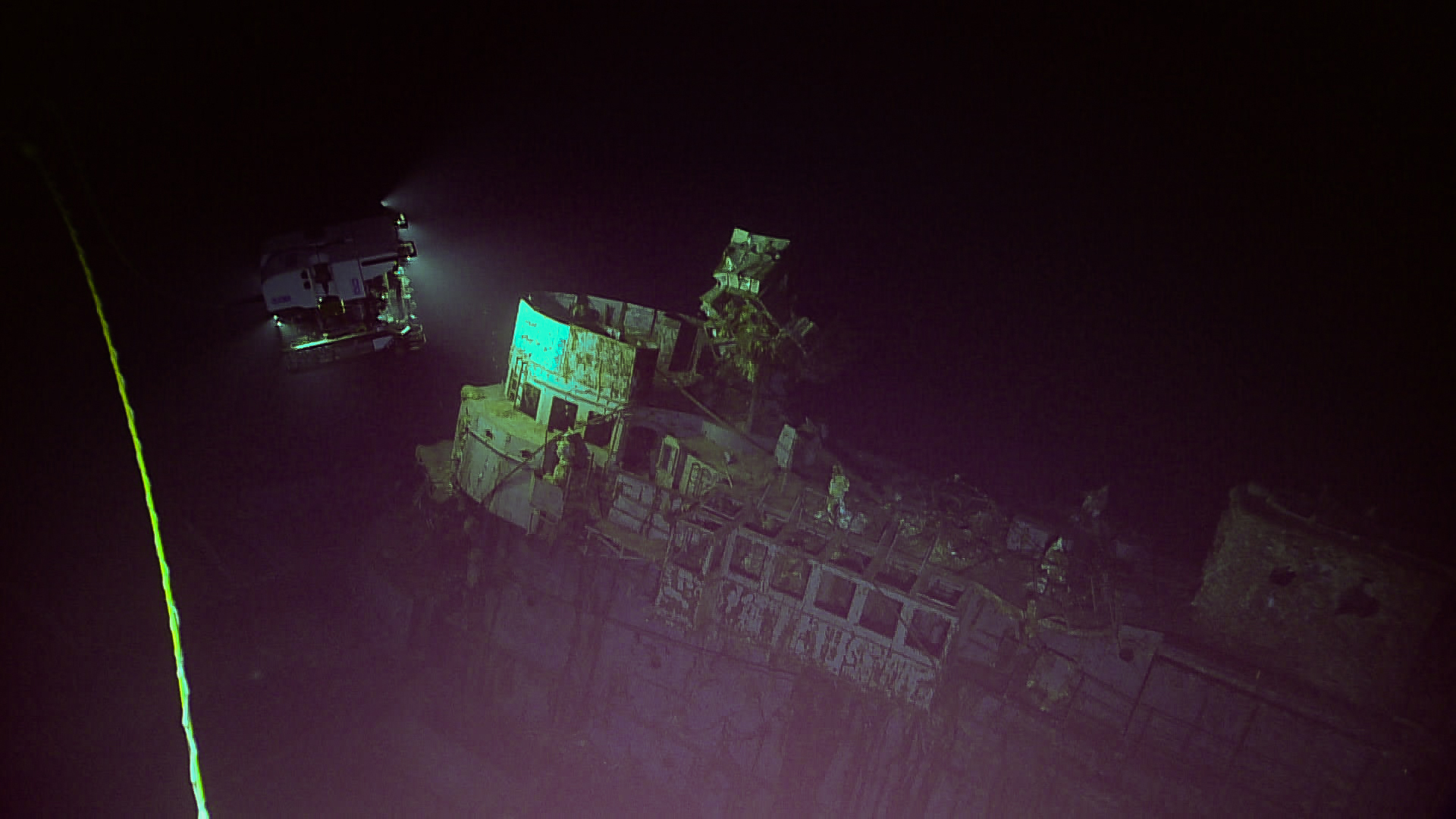
The wreck of USS Yorktown is a protected sunken military craft managed by the Naval History and Heritage Command, and, most importantly, serves as the final resting place for hundreds of servicemen that gave their lives in defense of the nation. In recognition of the importance of the Battle of Midway to the United States as well as the incredible state of preservation, in 2023, the United States Navy designated the wreck of USS Yorktown (CV-5) as a Site of Extraordinary Character.
Download largest version (jpg, 677 KB).
For More Information
- Exploring USS Yorktown
- April 19, 2025: Full annotated video on SeaTube (mural and aircraft)
- April 20, 2025: Full annotated video on SeaTube (car and aircraft)
- NOAA Ocean Exploration Photogrammetry Collection
- Exploring Iconic Shipwrecks from Battle of Midway to Provide Never-Before-Seen Details
- Battle of Midway Oral Histories
- Delgado, J.P., Hartmeyer, P., Matthews, R.E., & Brennan, M.L. (2025). Exploring the Wreck of the Yorktown. U.S. Naval Institute. Download PDF
Acknowledgements
This mission couldn’t have been made possible without the contributions of Chuck Haberlin, Anthony Tully, Jon Parshall, Russ Matthews, James Delgado, Mike Brennan, Frank Thompson, Alexis Catsambis, George Schwarz, Hannah Fleming, Annie Wright Nunn, Sara Kahanamoku-Meyer, Brian Kennedy, Willie Hoffman, and many others. Thank you for your contributions.