


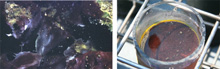
Figure 1. (Left) A diver took this photo of purple mats at the shallow sunlit Middle Island Sinkhole. (Right) This diver-collected sediment core, also from the Middle Island Sinkhole, shows the purple cyanobacterial mat community. Thick, organic-rich sediments lay directly beneath the mat. Click image for larger view and image credit.
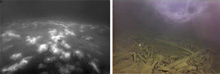
Figure 2. (Left) A remotely operated vehicle (ROV) captured this image of conspicuous benthic grayish-white and brown mats, composition unknown, in the deep aphotic Isolated Sinkhole. (Right) An ROV image of sediments and exposed logs in Isolated Sinkhole at 93-meter (305-foot) depth. Also in the photo is a cloudy nepheloid layer about 1 meter above the lake bottom, presumably caused by venting groundwater at the site, as indicated by water chemistry. Click image for larger view and image credit.
Deep Lake Huron Sinkholes: A Microbiogeochemical Frontier
Stephen C. Nold
University of Wisconsin – Stout
Bopaiah A. Biddanda
Annis Water Resources Institute
Scott T. Kendall
Annis Water Resources Institute
Thomas H. Johengen
University of Michigan
Underwater explorations have revealed unique hotspots of biogeochemical activity at several submerged groundwater vents in Lake Huron. Since groundwater emerging at these sinkholes contains high sulfate and low dissolved oxygen, these habitats lack the fish and metazoan communities typically found in Lake Huron. Instead, sinkholes are dominated by single-celled microorganisms, such as bacteria and archaea.
In shallow (0- to 30-meter/0- to 93-foot depth), sunlit sinkholes, spectacular purple mats are created by photosynthetic cyanobacteria (Figure 1). In addition to substantial production by the photosynthetic mats at the surface of the sediments, sinkholes act as carbon sinks, effectively trapping falling phytoplankton production in organic-rich sediments underneath the cyanobacterial mat. We have carefully studied two shallow Lake Huron sinkholes and are learning much about microbial diversity and activity in these habitats (Ruberg et al., 2008; Biddanda et al., 2008 – In Review).
While Lake Huron's shallow sinkholes are beginning to be well characterized, deep sinkholes are largely unexplored. Earlier surveys of Isolated Sinkhole during 2001 and 2002 (at about 93-m [305-ft] depth and 10 miles [16 kilometers] offshore, at 45º 10.727' N, 83º 09.201' W) provided still and video imagery, water chemistry, and some bacterial community composition data (Ruberg et al. 2005; Biddanda et al. 2006). These preliminary data suggest that Isolated Sinkhole also acts as a microbiogechemical “hotspot”— a place of high microbial diversity and activity, compared to the surrounding lake.
Groundwater entering the lake floor at Isolated Sinkhole has similar characteristics to shallow sinkholes, but it enters at a depth far too deep for light penetration. This lack of light completely changes the kind of microbial communities that develop. Instead of colorful purple photosynthetic mats, grayish-white and brown mats cover the sediments (Figure 2). And unlike photosynthesis-based physiologies, mats in deep aphotic sinkholes may perform chemosynthesis-based sulfur physiologies.
Like shallow sinkholes, Isolated Sinkhole likely experiences significant deposition of carbon from the water column (Fig. 2). Under the anaerobic (lacking oxygen) conditions experienced by sinkhole sediments, this carbon is fermented and converted to methane via methanogenesis. In the presence of sulfate, this methane may be oxidized anaerobically in a process called anaerobic oxidation of methane, or AOM.
During this cruise, we will sample Isolated Sinkhole sediments to measure microbial diversity and processes. We will pay special attention to sulfur cycle microbes and the organisms that perform AOM. We will also identify the brown and gray mat-forming microorganisms. To measure microbial activities, we will use radioisotopes to measure dark anaerobic carbon incorporation, or chemosynthesis. Finally, we will measure sediment porewater chemistry and gasses to understand the dominant physiological processes.
These studies will allow us to understand the identity and activity of microbes in deep aphotic sinkholes. By comparing the organisms and processes found in deep sinkholes to what we know about shallow sinkholes, we will complete our comparison along gradients of depth, water chemistry, and light penetration. Ultimately, these studies will help to further our understanding of sinkhole ecology and the roles sinkholes play in the broader Lake Huron ecosystem. Such knowledge will also help us place these newly discovered lake sinkhole ecosystems in the context of other extreme ecosystems, such as the sulfate rich ground water fed lakes of Switzerland, ice-covered lakes of Antarctica, hot springs of Yellowstone National Park, and the cold seeps/thermal vents of the deep sea.
References
Biddanda, B. A., D. F. Coleman, T. H. Johengen, S. A. Ruberg, G. A. Meadows, H. W. VanSumeran, R. R. Rediske, and S. T. Kendall (2006), Exploration of a Submerged Sinkhole Ecosystem in Lake Huron, Ecosystems, 9: 828-842.
Biddanda, B. A., S. C. Nold, S. A. Ruberg, S. T. Kendall, T. G. Sanders, and J. J. Gray (In Review). Submerged Sinkhole Ecosystems in the Laurentian Great Lakes: A Microbiogeochemical Frontier. Eos, Transactions, American Geophysical Union.
Ruberg, S., D. Coleman, T. Johengen, G. Meadows, H, VanSumeren, G. Lang, and B. Biddanda (2005), Groundwater plume mapping in a submerged sinkhole in Lake Huron, Marine Technology Society Journal, 39: 65–69.
Ruberg, S. A., S. T. Kendall, B. A. Biddanda, T. Black, W. Lusardi, R. Green, T. Casserley, E. Smith, S. Nold, G. Lang and S. Constant (2008, In Press). Observations of the Middle Island sinkhole in Lake Huron: a unique hydrologic and glacial creation of 400 million years. Mar. Technol. Soc. J.


