


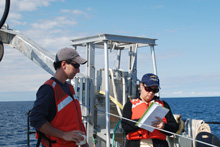
Tom Novell (left) discusses groundwater data collection with Ocean Explorer data manager Susan Gottfried. Click image for larger view and image credit.
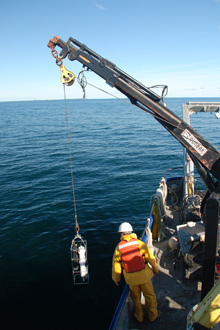
A conductivity-temperature-depth (CTD) sensor is deployed near the Middle Island Sinkhole. These sensors provide valuable data about ambient water conditions. Click image for larger view and image credit.
The Science of Data
September 9, 2008
Susan Gottfried
Ocean Explorer Data Manager
NOAA National Coastal Data Development Center
Have you ever wondered why, when you search the Internet, you find resources based on the word or phrase you searched? It's because of metadata. Metadata is the who, what, when, where, why, and how of data collection. Metadata is the data about data.
Through a competitive proposal process, NOAA's Office of Ocean Exploration and Research (OER) either partially or wholly sponsors Ocean Explorer (OE) expeditions each year. Several are selected as signature expeditions, meaning they are highlighted on OER's education and outreach Web site— the one you are reading now — and have an assigned OE data manager. As the assigned OE data manager, I am charged with managing the metadata and the data collected, recorded, generated, or otherwise produced from the Thunder Bay Sinkholes 2008 expedition. My job is to ensure that this expedition's data are documented by metadata and that they are eventually archived to the NOAA archive centers. With the U.S. taxpayer footing at least part of the bill for OE-sponsored expeditions, the government mandates that the data and results of the research are eventually made available to the public for inspiration, for education, for academia, for science, for legislation, and indeed, for the future.
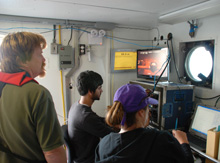
Experiencing data collection first hand, Susan Gottfried (right) and Steve Ruberg (left) watch Devin Bonnie piloting of the Phantom remotely operated vehicle. Click image for larger view and image credit.
The modern-day explorers who participate in OE missions are on a quest for discovery. They want to be able to study, analyze, and publish their findings. As a result, they are protective of their data until they've had time to complete their research. In fact, research scientists on all ocean expeditions have intellectual property rights to the data they record and collect, to the products they generate, and to the publications they produce. But because of government funding, the general public has its own right to the data. By preparing the metadata for the expedition data during or soon after the expedition, OER stands ready to submit the metadata and data to the archive centers in the appropriate standard formats at such time that the scientists are ready to release their data — and, in doing so, to further science research and make their mark in history.
Sign up for the Ocean Explorer E-mail Update List.


