


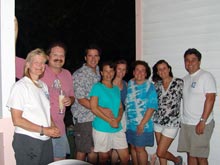
The Cayman Island Twilight Zone 2007 exploration science team. Click image for larger view and image credit.
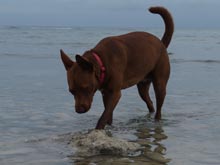
Darwin, barophile¹ wannabe. Click image for larger view and image credit.
Confessions of a Barophile¹
May 31, 2007
Marc Slattery
Chief Scientist — Cayman Islands Twilight Zone 2007
The Cayman Islands Twilight Zone 2007 expedition has been an incredible experience for each of us, made more so by the opportunity to share our experiences in near real-time with the public through the Ocean Explorer (OE) Web site. Many thanks to the individuals at OE who develop and maintain this Web resource for us! Over the past two weeks, and in advance of the expedition, we tried to give a sense of the reasons we are doing this research, our results to date, and our strong commitment to see these relatively unknown ecosystems conserved so they might continue to provide nursery habitat and refugia for commercially and ecologically important coral-reef species. In addition to documenting the transition community, we have demonstrated the capabilities of technical diving for deep-reef research.
Team Twilight Zone represents a cross section of researchers and educators from broad disciplinary fields. As we wrap up our first field season, I’ve asked each member to share his or her favorite moment from this research expedition.
Marc Slattery, University of Mississippi: My own spiritual moment came when we dropped below the wall lip at about 200 feet (60.9 meters) and officially entered the Twilight Zone. Seeing the spectacular differences in communities above and below this transition was truly amazing.
Michael Lesser, University of New Hampshire: I continue to be amazed at the increase in my telepathic powers on each successive deep dive beyond 200 ft. It now seems that the only person I can effectively communicate with is the laboratory mascot and sage, Darwin. This canine wonder seems to understand my connection with the sea and the deep narcosis I am now grappling with as a result of our two weeks of deep exploration into the Twilight Zone. Rod Serling and I have also been having several conversations since we began this expedition. He’s a little miffed at our using the name of his signature television series but is now convinced it is in the best interest of public outreach and marine education.
Deb Gochfeld, University of Mississippi: On one dive I was excited to see a hawksbill sea turtle feeding intently on a large sponge, Geodia neptuni. The moment was made comical by a juvenile three-spot damselfish, a mere one inch in length, that kept trying to chase the turtle away from its territory. The poor turtle had to keep brushing the little fish away from its face — like it was a mosquito — so it could finish its meal.
Julie Olson, University of Alabama: Coming up from a wall dive, I was completely surrounded by a large school of blue and brown chromis fish. They were so intent on their interactions that they totally ignored my presence and continued darting around. It was an incredible feeling to be in the midst of such colorful and abundant life.
Liz Kintzing, University of New Hampshire: I’m a firm believer in "Salt H20 Hydrotherapy" — it’s a cure for everything. My top ten favorite moments on this expedition were:
1) Slipping into the 84º F, clear blue Cayman H20 in a thin suit, while two days earlier I had been in the dark murky, 39º F H20 of the Gulf of Maine in my dry suit.
2) Discovering Darwin, the Little Cayman Research Center's puppy dawg.
3) Realizing Marc really is a "barophile."
4) Figuring out how the mixing panel works.
5) Being in sync with the VR3 (my dive computer).
6) Looking over the edge on our 200 ft dive and knowing we would be back to go deeper.
7) Seeing with my own eyes the colorful and diverse sponge community in the Twilight Zone at 240 ft depth.
8) Reliving the movie Nacho Libre on a daily basis.
9) Hanging out with Jerry the Grouper (groupers are Labrador retrievers of the sea).
10) Key lime pie for every meal!
Cristina Diaz, Museo Marino de Margarita – Venezeula: The walls were really attractive!!! So much life everywhere, and the sponge communities were healthy and large; there is clearly an important oceanographic component to this system. I was also amazed to see so many sponge recruits. This is a really interesting community.
Beth Biegler Hines, Mountain Brook High School, Alabama: My exciting moment was the first dive where I did something other than concentrate on my buoyancy or some other aspect of diving. I brought the still camera and took many beautiful pictures — including one of a hawksbill turtle eating a sponge. I’ve been obsessed with what can be found inside a sponge . . . brittle stars, little fish, algae. Got some really great shots. That was my proudest moment, though, realizing that I was comfortable enough diving to work at the same time.
Nicolas Alvarado, NOAA's Office of Ocean Exploration, Silver Spring, Maryland: My exciting moment was the instant I descended into the water column on the first dive and on every subsequent dive after that. Having the opportunity to document Team Twilight Zone 2007 has been my highlight, from diving down and collecting samples to post-dive workup and characterization. As a result of this trip, not only did I learn a lot about sponges and corals but I have come to realize I am truly a "barophile" — I just can’t seem to get enough of the deep blue.
Darwin, Little Cayman Research Center: (Translated from canine.) Hi. I'm the lab mascot at LCRC. My life is all about food, being the center of attention, hiding the shoes of our lab visitors, and communicating telepathically with Michael Slattery. Team Twilight Zone spoiled me rotten with attention, and they all had such wonderful shoes. . . . I’m looking forward to another field season with this group.
¹Note: Barophile is a term that was coined by Team Twilight Zone to indicate a person with an obsessive love of deep diving. At least one member of the team has been seriously afflicted with barophilia; but we hope he will return for our next field season in June 2008 . . .


