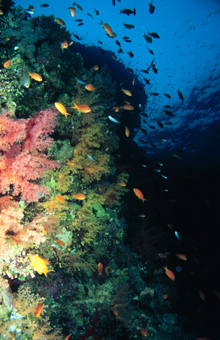
The biodiversity of vertical walls can be impressive, as this photo from the Indo-Pacific demonstrates. Click image for larger view and image credit.
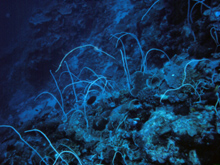
As light becomes limited in the deep reef, fewer hard corals are able to survive. Here many species of soft corals and black corals serve the functional role of habitat and/or food. Click image for larger view and image credit.
Marine Biodiversity
Marc Slattery
Chief Scientist – Twilight Zone 2007
Department of Pharmacognosy
University of Mississippi
Biodiversity is defined by ecologists as the sum variation within the genes and the species of a given region. "Hotspots" are recognized as containing exceptional levels of endemic species (those that are found nowhere else) in regions seriously threatened by habitat loss. They may also include unique ecological and evolutionary boundaries. A number of marine ecosystems fit this definition of a biodiversity hotspot due to the uniqueness of the habitat (e.g., deep-sea hydrothermal vents, etc.); and others fit due to sheer numbers of species and the threat to these organisms (e.g., coral reefs).
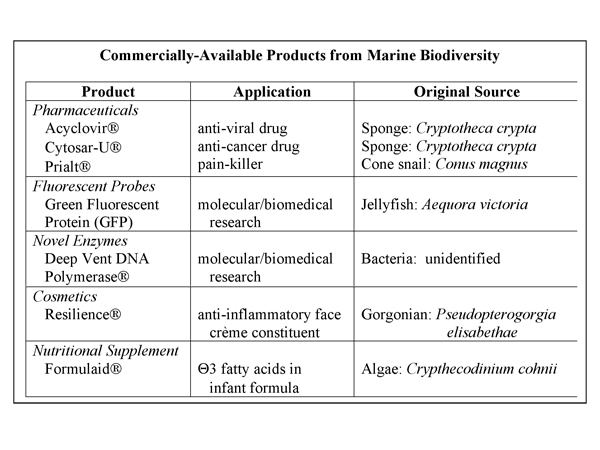
Marine biodiversity has a variety of societal benefits. These include food, medicine, industrial materials, ecosystem service (e.g., global temperature maintenance, etc.), as well as its aesthetic/recreational value (see Table). Conservation of marine biodiversity is thus an important goal of marine scientists, resource managers, and the public.
Biodiversity is often highest in biological transition communities found at the border of two discrete biotic regions. These hotspots include the fauna of the two neighboring biotic regions at their extremes, as well as a unique endemic fauna that is specifically adapted to the environment within this overlapping zone. These transition communities are well documented at the interfaces of biogeographic provinces (e.g., Wallacea, the transition community at the Wallace Line in Indonesia, is now recognized to not only segregate the Indo-Malayan from the Australasian biogeographic provinces, but also to harbor a rich endemic fauna).
However, transition communities can also occur over smaller spatial scales representing the boundary between discrete ecosystems. One such transition community is the Twilight Zone, the deep-reef interface between tropical coral reefs and the aphotic (lacking in light) deep-water communities. These communities are characterized by reduced photosynthesis. While diversity of reef-building corals decreases with increasing depth, many sponges, soft corals, tunicates, and even low-light-adapted primary producers are abundant.
These deep-reef communities are also recognized to be important nursery habitats and/or refuges for many species of coral reef fish and invertebrates. Destruction of these important habitats may, therefore, enhance degradation of shallow-water reefs, while understanding these unusual communities might help in recovery efforts of coral reef managers.