


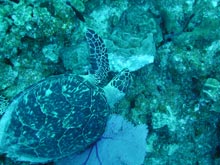
A hawksbill turtle feeds on a sponge. Click image for larger view and image credit.
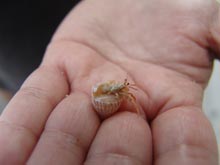
We found this hermit crab at the steps of the Little Cayman Research Center. Click image for larger view and image credit.
Scientific Collaboration
May 30, 2007
Beth Hines
Marine Science Teacher
Mountain Brook High School
Birmingham, Alabama
 See how histology (mircoscopic tissue study) helps scientists determine what kind of sponge they have discovered.
(Quicktime, 3.8 Mb.)
See how histology (mircoscopic tissue study) helps scientists determine what kind of sponge they have discovered.
(Quicktime, 3.8 Mb.)
The Twilight Zone 2007 expedition has been an enlightening look into the very definition of "scientific collaboration." As a high school teacher with a research background, I was included on this adventure for several reasons. First, the experience would provide me with an ocean field experience that would broaden my scientific horizons and help me to transfer my enthusiasm for scientific research to students. Next, it would allow me to meet and work with some of the foremost researchers in marine science, learning new techniques and refining old ones. Finally, it would inspire me to create lessons and activities for teachers and classrooms everywhere, sharing the knowledge and information I gained on this expedition.
All of this brings me back to my original statement about scientific collaboration. The greatest lesson that I will take away from this expedition is that scientists do not work in a vacuum. They discuss ideas over breakfast, on the boat en route to dive sites, and while hauling someone else’s gear from one place to another. They stimulate and inspire each other through discussion, debate, and spirited conversation. They share resources, information, data, and opinions freely in a spirit of academic community. But best of all, they allow a schoolteacher into their midst and patiently teach her to understand their work and their world. . . . It's scientific collaboration at its best.
Many of the studies and activities that took place during the Twilight Zone cruise can be recreated (to varying degrees) by high school students. What follows are a few of them.
• Chief Scientist Marc Slattery’s passion for connectivity of environments is most evident when he is discussing a project to teach high school students about biodiversity and ocean zonation. His research on the differences in the distribution and abundance of corals and sponges on shallow reefs vs. deep reefs will provide an outstanding basis for a collaborative student project.
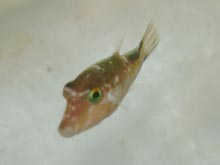
A sharpnose puffer fish swims in one of the 20 tanks in the wetlab, where Deb Gochfeld conducted her bioassays. The bioassays consisted of feeding the puffer both pureed squid and pureed squid with chemical compounds to see how the fish reacts to the various chemicals. Click image for larger view and image credit.
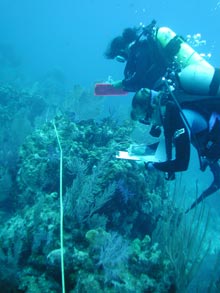
Team Twilight Zone members Deb Gochfeld and Julie Olsen conduct a site survey at 40-foot (12.2-meter) depth. You can clearly see the tape measure on the left of the image. Here Deb and Julie are taking notes on what they see along the tape, making observations at increments of 10 centimeters (cm) along the tape and 50 cm on either side of the tape. They record all the sponges and corals they see and provide information on location and abundance. Click image for larger view and image credit.
• Deborah Gochfeld’s feeding deterrence assays with puffer fish will be an engaging experiment to recreate in the classroom. While learning about chemical defenses among sessile (attached to a base) sponges and corals, students will strengthen experimental design skills by creating their own puffer fish feeding assay.
• Julie Olsen’s search for the causes of problems in corals will allow students to examine the differences between a disease and a syndrome, and how these definitions apply to the marine environment. A literature review and opinion paper by Mike Lesser will fuel the debate, while teaching students about scientific communication and interaction between scientists.
• Learning to make sponge spicule and specimen slides with Cristina Diaz, one of the world’s leading sponge taxonomists, was an unforgettable experience. Cristina’s training in sponge re-aggregation experiments and sponge identification through spicule preparation will be an asset for classroom labs.
I am very grateful to NOAA's Office of Exploration as well as to Marc Slattery, the Twilight Zone 2007 principal investigator, for the opportunity to participate in this expedition. It was the opportunity of a lifetime for a marine science schoolteacher. I will remember this experience for years to come as future students benefit from my interaction with this outstanding group of researchers, who gave of their time, talent, expertise, and dedication to excellence in science education. I leave Little Cayman Research Center energized and invigorated, ready to share this incredible experience with students and colleagues. And I leave with a renewed appreciation for the spirit of scientific collaboration.


