


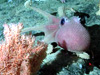


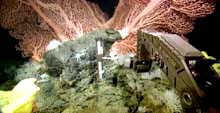
The remotely operated vehicle (ROV) mechanical arm holds the current meter in front of a bubblegum coral (Paragorgia sp.) to measure the flow of particles around the coral. Yesterday, some of the white coral-like animals — collected for the first time by the ROV — turned out to be a species of sponge. Click image for larger view and image credit.
Filming Begins
January 28, 2006
Penny Allen
Producer
British Broadcasting Corporation
The British Broadcasting Corporation (BBC) and Monterey Aquarium Research Institute (MBARI) have been planning this trip to film the Davidson Seamount for almost two years, so it seems almost unbelievable that we are finally here! We (along with all 18 cases of our filming equipment!) are aboard the research vessel Western Flyer, over 70 miles off the coast of California, with a massive underwater volcano right beneath us!
We are here to try to capture video images of this amazing deep-sea seamount for a major new BBC television documentary series called Planet Earth. The series is due to broadcast this year in the United Kingdom and next year in the United States. There are 11 programs in the series, each one covering a different habitat — such as mountains, deserts, and caves — and its wildlife. We plan to feature Davidson Seamount as part of the final program, which will tell the story of open-ocean and deep-sea habitats, and the creatures that live there.
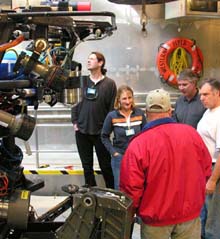
Penny Allen (center) and Warwick Sloss (left) from the BBC confer with Monterey Bay Aquarium Research Institute scientist Jim Barry and ROV pilots Buck Reynolds and Buzz Scott about lighting modifications that will show off the high definition (HD) images to their fullest. The HD camera housing (lower left) has a yellow tag on it. Click image for larger view and image credit.
There are two parts to our filming plans. First, we are using a high definition camera, mounted on the remotely operated vehicle (ROV) Tiburon, to gather images from the deep. We are filming the topography of Davidson Seamount, as well as all the corals and sponges and other marine life that inhabit its slopes and summits. Yesterday, we caught our first glimpse of life on the seamount, watching images being sent back to the ship from the ROV working on a science dive. We had heard many reports about how spectacular this place was, and they certainly proved to be no exaggeration! Spectacular forests of colorful corals, sponges, and anemones stretched as far as the eye could see: a gorgeous expanse of pink, yellow, orange, and white. We want to move the lighting on the ROV around a bit tonight, and then we can't wait to get started with the camera tomorrow!
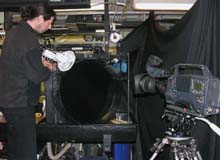
Cameraman Warwick Sloss adjusts the light through the round kreisel tank in preparation for filming mid-water animals. The white fan keeps condensation from forming on the front window of the tank, allowing for a much clearer view. Click image for larger view and image credit.
The second part of our plan is using a special tank (called a kreisel), which is on loan from MBARI, to film close-up images of mid-water animals (mostly jellies) brought to the surface by the ROV. We spent most of yesterday setting up the kreisel, along with our filming lights and camera, and we've hung a huge black curtain all around it to eliminate problems with reflections from the windows and lights in the lab.
Tonight we're quite excited, as we collected a crown jelly (Atolla sp.) at the end of the day's dive and had the tank ready to film it!
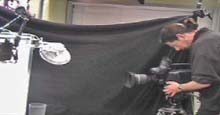
Warwick Sloss films the Atolla jelly in the kreisel tank after a long day of ROV dives. Click image for larger view and image credit.
Sign up for the Ocean Explorer E-mail Update List.


