


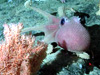


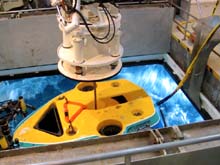
The remotely operated vehicle (ROV) Tiburon is launched though the "moonpool," a special opening in the middle of the research vessel (R/V) Western Flyer. The moonpool's floor is high above the surface of the water. Click image for larger view and image credit.
Annotating Video
January 27, 2006
Lonny Lundsten
Research Technician
Monterey Bay Aquarium Research Institute
My role on this expedition is primarily to manage the video data that comes in from the remotely operated vehicle (ROV) Tiburon. On this expedition, that includes recording both DigitalBeta and high definition video tape. In addition, I am using the Monterey Bay Aquarium Research Institute (MBARI) video annotation and reference system (VARS) to annotate the ROV dives in real-time. The annotation process involves identifying all of the geological and biological features that we observe during the dive and noting this in the computer. The VARS computer program makes this task much easier, because it has a built in dictionary, or knowledgebase, which allows us to easily and correctly enter observations into a searchable database. Instruments on the ROV record depth, oxygen, temperature, and salinity, and these measurements are synched with the video image.
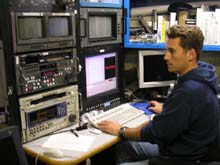
Research technician Lonny Lundsten at the video annotation and reference system (VARS) console aboard the R/V Western Flyer. Click image for larger view and image credit.
VARS also allows us to capture still images, or frame grabs, from the video, giving us a visual record of interesting and unique observations made during the dive. We can easily label samples with sample numbers and collection methods. We can even frame-grab individual samples so that we can match the image with the exact specimen when the ROV returns to the ship.
With several years experience as a video annotator, I've become pretty good at identifying most of what I see. But every dive is unique, and we typically see some bizarre deep-sea creature that we've never seen before. Sometimes we find organisms that are new to science— animals which no one has ever seen before! Most often, however, we observe organisms that have been described, but haven't been observed using sophisticated technology like MBARI's ROV Tiburon. Today, for example, we collected an unusual branched sponge that looks like a coral.
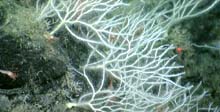
It looks like a coral, but this organism is actually a white branching sponge. Click image for larger view and image credit.
MBARI engineers recently installed a high definition video camera on the Tiburon, and the picture resolution has dramatically improved. Now we can see organisms that are 1 mm in length! This new technology allows scientists to observe animal associations that have never before been seen and to observe the behavior of even the smallest deep-sea creatures.
As part of my graduate studies at Moss Landing Marine Labs, I am working on a project that entails using VARS to identify and characterize the organisms and habitats that we've observed on several California seamounts. Part of the work that we're doing on this expedition will help us better understand the relationship between seamount communities by comparing our findings here with observations made at other seamounts. I'm also using these data to better understand how corals are distributed on the seamount in relation to physical factors, such as currents, water chemistry, relative elevation, and substrate type. In addition, I'm trying to get a sense of the associations that exist between corals and the other organisms that we've observed. Many of the larger corals (e.g., Paragorgia arborea) are habitat-forming corals, meaning that their presence creates habitat for other organisms to utilize.
Sign up for the Ocean Explorer E-mail Update List.


