




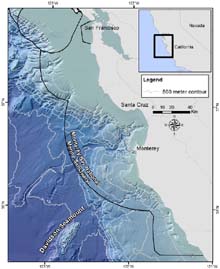
Davidson Seamount is located off the coast of central California in the United States. Click image for larger view and image credit.
Mission Plan
Andrew DeVogelaere, PhD
Chief Scientist
Davidson Seamount: Exploring Ancient Coral Gardens
Marine Scientist/Research Coordinator
Monterey Bay National Marine Sanctuary
NOAA
Why study deep-sea corals?
Recent advances in technology enable us to explore deep in the ocean and to study the corals that live there. Why is this important? For starters, there are relatively few studies on deep-sea corals, but initial findings indicate that a diverse group of these corals exist — and that some are hundreds of years old. The corals also seem to provide essential habitat for other groups of smaller species.
Increasing the sense of urgency in studying deep-sea corals is their fragility and the extensive human impacts from fisheries where nets are trawled along the sea floor. These nets effectively catch bottom fishes, but they also bring up "non-target" or "bycatch" species, such as corals. The taxonomy of deep-sea corals — essentially, their names and how they are related — remains challenging because of the relatively few scientific collections and high quality images. While scientists are beginning to see patterns of where these corals are found in the deep sea, such as on rocky ridges, we are not yet sure why they grow best in these locations.
So, with deep-sea corals, we have a situation where lots of basic, exciting science questions have yet to be answered in order to help address the conservation needs of these spectacular organisms.
The exploration site: Davidson Seamount
Davidson Seamount is located 120 km (75 mi) to the southwest of Monterey, California (35º 43' 23''N, 122º 43' 23''W), and is one of the largest seamounts along the western United States. It is 42 km (26 mi) long, and 13.5 km (8 mi) wide. From base to crest, Davidson Seamount is 2,400 m (7,874 ft) tall; yet, it is still 1,250 m (4,101 ft) below the sea surface. Davidson Seamount has an atypical seamount shape, having northeast-trending ridges created by a type of volcanic activity only recently described by scientists at Monterey Bay Aquarium Research Institute. It last erupted about 9.8 million years ago, and this large geographic feature was the first to be characterized as a "seamount." Seamounts are an important habitat for deep-sea corals, and they demonstrate a high degree of endemism (species living on a particular seamount and nowhere else).
Exploration goals
We have four general goals for our exploration of corals on the Davidson Seamount:
• Understand why deep-sea corals live where they do on the seamount;
• Determine the age and growth patterns of the bamboo coral;
• Improve the species list and taxonomy of corals from the seamount; and
• Share the exciting experience with the public through television and the Internet.
Methods
On our last exploration of Davidson Seamount in 2002, we found over 20 types of deep-sea corals; we noted they were largely found in dense gardens on ridges near the top of the seamount; and we found the longevity of corals reached hundreds of years. At that time, we were documenting all species, not just corals. The Davidson Seamount is still 99.98% unexplored.
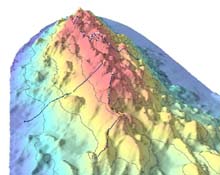
This image shows the remotely operated vehicle (ROV) Tiburon's tracklines, as well as coral locations, from the 2002 expedition to Davidson Seamount. Click image for larger view and image credit.
We have developed a simple model to predict where we will most likely find corals, and on this expedition we will test this model by visiting unexplored ridges, valleys, and slopes along the Davidson Seamount. We will then use instruments that measure ocean currents and food particles to describe in more detail the environments where corals are thriving. With this understanding, our future studies of deep-corals will be more efficient, with targeted (rather than random) searches of the seamount.
We will be collecting coral specimens to determine more carefully their identities, ages, and genetic diversity. The analyses will be completed after the cruise, and we are likely to find that some species are new (at least to humans) and will need a name; that some species are ancient, which would predict a slow recovery, if they are damaged; and that genetic diversity within a species will be more similar among individuals collected close to each other on the seamount (as compared with those collected farther apart). These types of general ideas will be developed carefully into hypotheses that will be tested once we know what samples we are able to collect.
Sharing discoveries can be as much fun as making them. The British Broadcasting Corporation will be joining the scientists to gather footage for an upcoming television series, Planet Earth. We also look forward to interacting with the public on our Web site by exchanging information and ideas.


