




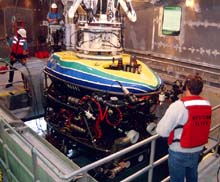
The remotely operated vehicle (ROV) Tiburon (shown here as it's launched from the research vessel Western Flyer) is the most important piece of equipment on the Davidson Seamount expedition. Click image for larger view and image credit.
Equipment Used on the Davidson Seamount Cruise
ROV Tiburon
The most important piece of equipment on this cruise is the remotely operated
vehicle (ROV) Tiburon, a high-tech undersea
robot that is connected to the surface by a long tether. The tether
carries electrical power and computer-driven instructions down to the ROV,
and transmits data and high-resolution video back up to the surface. The ROV Tiburon does not carry people, but it
does carry over a dozen different computers, several video cameras, and
an array of scientific instruments. Some of the main instruments we'll
use on the Davidson Seamount cruise are described below. (Find out more about ROV Tiburon  on
the Monterey Bay Aquarium Research Institute Web site.)
on
the Monterey Bay Aquarium Research Institute Web site.)
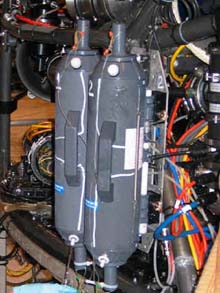
Niskin bottles on the ROV Tiburon. Click image for larger view and image credit.
Sampling equipment on the ROV Tiburon
• Niskin bottles
The ROV Tiburon carries Niskin bottles to collect samples of seawater and particles within that water. These Niskin bottles are gray PVC cylinders about half a meter (18 in) tall. They have lids at both ends that are left open until the sample is taken; this allows ambient seawater to flow freely through the bottle. When a scientist wants to take a water sample, the ROV pilot sends a command down to Tiburon, which in turn causes the lids on the Niskin bottles to close, trapping the local seawater inside. After Tiburon returns to the surface, samples of this water will be filtered to separate out particles of material that might provide food for corals on Davidson Seamount. By weighing the amount of particles in different locations at different times, we can get an idea of how much food is available.
• Tiburon's manipulator arm
The ROV Tiburon carries several different tools for collecting samples of coral, rock, or sediment. Coral samples are collected using the ROV's robotic arm, which is called a "manipulator arm." The ROV copilot, who is stationed in the control room of the research vessel Western Flyer, controls the arm. With at least five different joints, the manipulator arm is almost as flexible as your arm, but much stronger. Advanced robotic computers allow the ROV pilots to "feel" how hard they are gripping objects so they can delicately tweak off the tip of a coral colony or break loose a two-kilo (five-lb) chunk of lava.
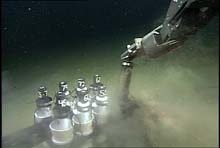
Tiburon's manipulator arm collects a push-core. Click image for larger view and image credit.
• Push-cores
Two instruments aboard Tiburon let us collect sediments. One is called a push-core, and it looks like a clear plastic tube with a rubber handle on one end. Just as its name implies, the push-core is pushed down into loose sediment by Tiburon's manipulator arm. Sediment fills up the core, while water exits out the top via one-way valves. When the core is pulled up again, these valves close, which (most of the time) keeps the sediment from sliding out of the core tube. When we bring these cores back to the surface, we typically look for living animals and organic material in the sediments.
• Suction sampler
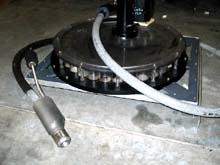
The suction sampler and its carousel of glass jars. Click image for larger view and image credit.
A suction sampler enables us to collect small samples of very fine sediment, or sometimes small bottom-dwelling animals. Like an underwater vacuum cleaner, the sampler consists of a long flexible tube with a nozzle on one end and a collection jar on the other. Actually, the sampler is equipped with carousel that contains 24 collection jars, each of which can be used for different samples. A small video camera that can point at any of the the jars allows researchers to see what's going inside.
• Current meters
Our main goal on this cruise is to learn why corals thrive in certain parts of the Davidson Seamount, but not in others. We suspect that the success of the corals is partly determined by local variations in currents, which carry the small organisms and nutrients that corals need to survive. For this reason, we are bringing several different types of current meters on this cruise. These current meters will help us understand current speed and direction close to the corals, in their general vicinity, and at larger distances above and around the Davidson Seamount.
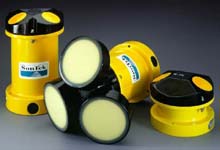
This is the acoustic Doppler velocimeter, or ADV. Click image for larger view and image credit.
• The acoustic Doppler velocimeter (ADV)
The ROV Tiburon carries a small, portable current meter that allows us to measure water flow between and around individual corals. This extremely sensitive device, called an acoustic Doppler velocimeter (ADV) looks like a metal rod with three prongs on the end. It measures water currents by bouncing sound waves off of particles carried within the moving seawater and taking advantage of the "Doppler effect."
You may not have heard of the Doppler effect, but you hear the results of this effect all the time. For example, when you hear the whistle of a passing train, it starts out sounding high (as the train moves toward you) and then sounds lower (as it moves away from you). Of course, the whistle itself is not changing its pitch; the change you hear is caused by the movement of the train. The result is what's known as the Doppler effect.
Using this same effect, the ADV measures the movement of particles in seawater. Unfortunately, most particles in seawater don't whistle like trains, so the ADV emits high-pitched clicks (much higher than humans can hear) that bounce off these particles. Three tiny microphones at the end of each prong on the ADV collect the reflected sound waves. Microprocessors within the sensor determine how much the pitch of the reflected clicks has changed, depending on whether the particles are moving toward or away from each microphone. From this information, the sensor can determine how fast and in what direction the particles (and the water around them) are moving.
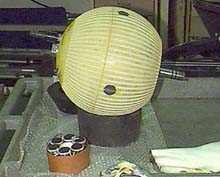
The electromagnetic current meter. Click image for larger view and image credit.
• The bottom-moored electromagnetic current meter
To measure near-bottom currents for a longer period, we will use a bottom-moored electromagnetic current meter, sometimes referred to as an "S4 current meter." This instrument measures the direction and strength of currents within about 1 m (39 in) of the sea floor. We plan to leave this current meter on the bottom for several days to find out how currents around the Davidson Seamount vary with, for example, the changing tides. This instrument measures water currents using four electrodes spaced evenly around the sides of a vertical cylinder. Inside the cylinder is an electromagnet. As seawater moves around the magnetic field on the outside of the cylinder, it acts like a generator, creating a voltage that is sensed by the two pairs of electrodes, which are aligned north-south and east-west. The faster the water flows, the more voltage is generated. The current meter stores the data, which we will download once we bring the meter back to the surface.
• The acoustic Doppler current profiler (ADCP)
The third type of current meter we will be using on Davidson Seamount is called an acoustic Doppler current profiler (ADCP). We will place this instrument near the top of Davidson Seamount and point it upward into the water column to measure currents in the water above the seamount. By sending sound waves up into the water column, the ADCP can simultaneously measure currents at a variety of distances. Like the acoustic Doppler velocimeter described above,the ADCP uses the Doppler effect to detect the motion of particles in the moving water.


