


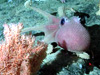


View a slide show illustrating some of the science activities that took place off the central California coastline during an earlier expedition to Davidson Seamount, back in 2002.
 Click image to view a slide show.
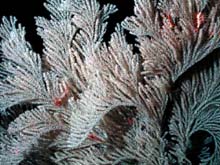
Researchers discovered this big white coral (an unidentified primnoid) on the Davidson Seamount at 1,570 m depth. Click image for larger view and image credit.
Davidson Seamount: Exploring Ancient Coral Gardens
January 26 - February 4, 2006
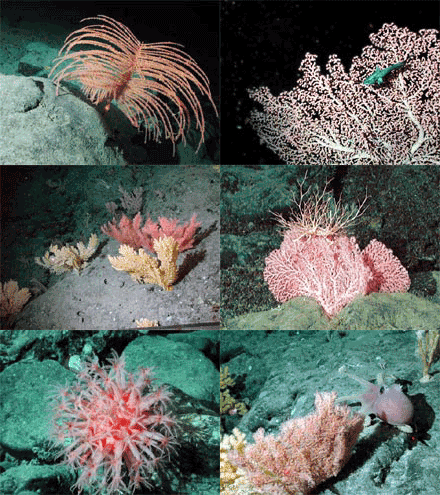
Most people think that corals are found in warm water and that mountains exist only on land. But this is not the case! In 2002, deep-sea researchers used new technologies to explore Davidson Seamount, located in the cold waters from 1,250 to 3,660 m depth (or 4,100 to 12,000 ft) off the central California coastline. What did we discover in this deep, cold, underwater environment? The seamount was covered with spectacular organisms, including large and ancient coral gardens. We also determined that the corals are located primarily on seamount ridges, and that we still have much to learn about the taxonomy (scientific names) of these species.
Now, in 2006, we are returning to Davidson Seamount — which remains 99.98% unexplored — to test a model we have developed that predicts where corals will be found. At the seamount, we will take measurements of water currents and food availability to understand what causes corals to thrive in some areas, but not others. Along the way, we will photograph and collect corals to determine if they are new species as well as their ages and growth patterns.
The British Broadcasting Corporation (BBC) will be filming during the cruise. Join in on the fascination of deep-sea life on an upcoming broadcast of their series, Planet Earth. Be sure to watch!
The collaborating institutions on this project are the Monterey Bay National Marine Sanctuary, the Monterey Bay Aquarium Research Institute (MBARI), Moss Landing Marine Laboratories, the BBC, and NOAA's Office of Ocean Exploration.
Related Links:
Learn more about the background of this mission at the MBARI Davidson Seamount Web site  .
.
See art from local students illustrating interesting facts about the mission.
Updates & Logs
Click images or links below for detailed mission logs and updates.
 Mission Summary The Davidson Seamount team made 70 hours of observations and collected 102 deep-sea animal and rock specimens — including some species likely new to science! Now the real work begins . . .
 February 4 Explorers share their favorite moments and discoveries from the Davidson Seamount expedition.
 February 3 Expeditions are expensive and resource intensive, but sharing data and images with others spreads the wealth and adds value to the work.
 February 2 While the remotely operated vehicle (ROV) Tiburon "flies" with its instruments through the deep sea, many skilled individuals back on the research vessel Western Flyer are overseeing its operation.
 February 1 Scientists gather data to determine how water flowing around the Davidson Seamount may affect the distribution and abundance of corals on its surface.
 January 31 Enormous amounts of information are collected during ocean expeditions. Find out how scientists keep track of it all.
 January 30 The Sanctuary Integrated Monitoring Network (SIMoN) catalogues hundreds of photos from previous Davidson expeditions. The explorers can't wait to add the 2006 crop.
 January 29 Scientists use the ROV Tiburon to photograph
and collect two
coral species of particular interest — bamboo coral and a pink
coral.
January 29 Scientists use the ROV Tiburon to photograph
and collect two
coral species of particular interest — bamboo coral and a pink
coral.
 January 28 The BBC begins filming! Capturing the underwater environment in high definition video is both exciting and challenging to the crew.
 January 27 Managing the video data on expeditions can be a daunting task. Some computer tools and the personal knowledge of explorers make the job easier.
 January 26 Join scientists on Day 1 of the cruise as they are welcomed aboard with an orientation to the ship and safety protocols — and a practice session putting on survival suits.


