


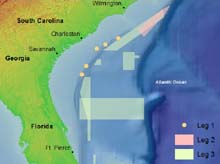
Areas within the South Atlantic Bight that will be explored during the Islands in the Stream 2002 expedition..
Exploring Underwater Oases
July 27 - September 1, 2002
"Islands in the Stream 2002: Exploring Underwater Oases" consisted of four scientific investigations to study the continental shelf break and slope from the eastern coast of Florida to North Carolina — an area known as the South Atlantic Bight. The mission took place in three "legs" and focused on the characterization of deep-reef habitats, with particular emphasis on the discovery, exploration and description of reef fish spawning sites; exploration of the unique outer shelf and slope habitats off the Carolinas; discovery of new resources with pharmaceutical potential; and exploration of vision and bioluminescence in the deep-sea benthos.
Each project was conducted by groups of interdisciplinary investigators led by scientists from the South Carolina Department of Natural Resources, North Carolina National Estuarine Research Reserve, and the Harbor Branch Oceanographic Institution (HBOI). They used the R/V Seward Johnson and the Johnson-Sea-Link submersible for direct access to this rarely seen underwater world.
Background information for this exploration can be found on the left side of the page. Daily updates are included below. Detailed logs and summaries of exploration activities are found on the right.
Updates & Logs
Click images or links below for detailed mission logs and updates.
 Aug 30 Read about the many new and exotic organisms that have been observed and sampled as the third and final leg of the Islands in the Stream 2002 expedition comes to a close.
 Aug 29 Exploring Region 4, the expedition team investigates a deep ocean reef they estimate covers a greater area than the shallow coral reefs off of Florida's coast.
  Watch a video of a deep sea coral bioluminescing as it is agitated by the manipulator arm of the Johnson-Sea-Link II submersible (mp4, 1.7 MB)
 Aug 28 In today's log Dr. Peter Herring writes about the evolution of ocean exploration and how todays technology is allowing us to really begin understanding the many mysteries of the deep sea.
  Aug 27 Read about the expeditions exploration of "site 3" and an interview with one of the expedition scientists. Watch a video of large snowy groupers as they swim around the JSL II (mp4, 1.5 MB).
 Aug 26 Sponges, sponges everywhere !The expedition team is making new discoveries every day. Read about the new species of sponge that they've discovered that looks like a Christmas tree.
 Aug 25 What is it like to visit the ocean floor in submersible? Through submersible technology, humans can dive depths never before possible. Read today's mission log.
 Aug 24 The R/V Seward Johnson has reached the "Charleston Bump" and conducted dive operations on an area rich in sponges, hydroids, and corals. Read about it in today's log. Watch a video of lunar-like scenery and a snowy grouper swimming under a ledge. (mp4, 1.5 MB).
 Aug 23 Read about the first deployment of a new deep-sea observatory system, the Eye-in-the-Sea. Also meet one of the reseacher aboard the R/V Seward Johnson.
 Aug 22 New Frontiers are explored. Today John Reed writes about his experiences observing deep sea coral reefs that have never been seen before, and only once described by oceanographers back in 1962!
 Aug 21 Got It! Why would anyone want to spend two weeks away from land, in crowded quarters, while working until 2 a.m.? Perhaps the chance to dive over 2,100 feet underwater and see things that no one else ever has. Read about teacher Arte Roman's experiences in todays log. Watch video footage captured by the Johnson-Sea-Link II. (mp4, 1.4 MB)
 Aug 20 “Hagfish, My Biggest Nightmare!” In today's log, Tammy Frank finds unwelcome guests as she opens her deep water light tight traps. Watch video of Johnson-Sea-Link II deploying crab traps. (mp4, 1.3 MB).
 Aug 19 Glass sponges, gorgonian corals, soft corals, hard corals, hydroids, brittle stars, sea stars, are just some of the invertebrates that the science party has brought up from the depths during today's submersible dive. Watch video of Johnson-Sea-Link II sampling benthic invertebrates. (mp4, 1.3 MB).
 Aug 18 As the third leg of the Islands in the Stream 2002 Expedition gets underway, an open house is held aboard the R/V Seward Johnson for over 300 guests and the science party reviews its mission plan and organizes its operations.
 Aug 15 What’s in a name? Ever wonder how a creature gets named Slime Nose or Noctiluca? Find out in today's log. This is the final log of leg two. Watch a video of moray eel (mp4, 1 MB) Watch a video of a hogfish (mp4, 1 MB).
 Aug 14 Read about the exploaration of the Lophilia coral banks, but beware of swordfish! The science team has also located a coral sample that no one has ever seen before.
 Aug 13 Learn how scientist are using GPS and GIS to map and navigate to ocean research sites in today's mission log. Watch a video of the beautiful and complex habitat of the Lophilia coral banks. (mp4, 1.4 MB)
 Aug 12 Follow Art Howard, the onboard film maker, as he describes his first dive in the submersible, the Johnson Sea-Link. Watch a slideshow of the organisms Johnson Sea-Link encounters as it conducts a research dive. (mp4, 1.5 MB)
 Aug 11 Today's log discusses how advances in technology allow marine scientists to utilize their time and resources very efficiently. Watch a video of the deployment of an Otter trawl. (mp4, 1.2 MB)
 Aug 10 Alan Felker, a North Carolina Educator discusses his experience a board the R/V Seward Johnson.
 Aug 9 Sargassum communities can stretch for miles along the surface and travel northward with the Gulf Stream. Read about the different species that call the sargassum home.
 Aug 8 Read about the exploration of The Steeples of the North Carolina Deep Reef in today's mission log. Watch a video of the Johnson Sea-Link during a dive, (mp4, 1.7 MB). Watch a video of Almaco jacks (mp4, 1.1 MB). Watch a video of fish swimming around spatially complex areas such as boulders and caves (mp4, 1.4 MB).
 Aug 7 Learn about the different techniques used to collect data on fish communities in today's mission log. From neuston nets, to ROVs, it all depends on what you want to know.
 Aug 6 A new science team has boarded the R/V Seward Johnson to begin the second leg of the exploration. Read the first log of the second leg.
 Aug 5 Thus ends the first leg of the Islands in the Stream 2002: Exploring Underwater Oases. Read about how reef fishes are managed, and ideas for their protection.
 Aug 4 Scientists are using the Young Grab to retrieve sediment samples. Read about how this technology works, and what it tells the science party, in today's mission log.
 Aug 3 The Johnson Sea-Link is an amazing piece of technology. During this expedition, it is using two different types of bottom samplers. Read about both of them in today's mission log. Watch a video of the two underwater sampling techniques. (mp4, 2.7 MB)
 Aug 2 Lionfish are spotted during routine dive operations. Although this fish is an amazing site, with its venomous spines, it is charaterized as an invasive species, not usually found in the South Atlantic Bight. Read today's log. Watch a video sighting of a Lionfish, an invasive species. (mp4, 3 MB)
 Aug 1 Since characteristics of fish can change, or appear differently on the surface, the science team must use a combination of body shape, pigment patterns and colors, and shape and location of fins to properly ID fish while underwater.
 July 31 Using side scan sonar scientists collect information about the structure and composition of the seafloor. This data is critical to recreational and commercial fishermen as hard-bottom areas provide habitat for many species of reef fish.
 July 30 Today we are diving on Jacksonville Scarp, a reef 30 miles north of the St. Augustine Scarp. We are seeing vermilion snapper, greater amberjack and a type of grouper called scamp. Submersible dives on habitats frequented by these species will help us to better understand reproduction in reef fishes. Watch a video of a fish rapidly changing its color to reflect an immediate change in behavior (mp4, 1.8 MB).
 July 29 Where there are rocks, there is life! Using the JSL II's powerful manipulator arm rock samples covered with thick mats of brightly colored algae, soft coral, barnacles, and tube worms are collected and examined. Watch a video of a "living rock being brought aboard the R/V Seward Johnson and examined for species diversity (mp4, 2.8 MB).
 July 28 Ever wonder what it is like to live the life of a stinking vase sponge? Several organisms live inside these "living hotels" in a unique commensal relationship, where one party benefits while the other is not significantly affected. Watch a video of a sponge as it's plucked from the seafloor by the JSL II's scoop (mp4, 3.3 MB).
 July 27 The expedition begins. The R/V Seward Johnson is mobilized in Ft. Pierce, FL. You can also watch a video on the science team preparing for the mission. (mp4, 2.7 MB)
Sign up for the Ocean Explorer E-mail Update List.


