


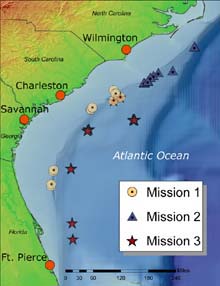
Summation of all the submersible dives during the Islands in the Stream 2002 expedition. Click image for a larger view.
Islands in the Stream 2002:
Exploring Underwater Oases
Mission Summary
The Islands in the Stream 2002 expedition was designed to explore and investigate deep-water reefs, rocky outcrops, and hard-bottom areas at the edge of the continental shelf, as well as on the continental slope, off the southeast coast of the US. As with Islands in the Stream 2001, the overarching theme of the expedition was to conduct geological, biological, and ecological observations of these habitats, and to collect samples for further analysis as a means to better characterize these little known and poorly understood areas. Scientists from several organizations were brought together to accomplish this, each exploring discrete areas within the region and each focusing on a distinct and unique research question. The expedition used a variety of methods to collect information, including the Johnson-Sea-Link II 4-person submersible that completed a total of 48 dives during the 33 days at sea. The information gathered will complement the data collected in similar areas during Islands in the Stream 2001, and will be made available to other scientists and natural resource managers as they struggle to determine how to best manage human activities that may influence the health of the habitat and the species that depend upon it.
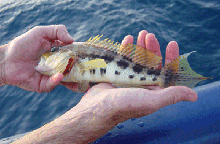
This Bank sea bass, a common reef fish that spawns on deep shelf-edge reefs, was caught during hook-and-line tagging of fish. Click image for a larger view.
Mission 1: July 27-August 5, 2002
Read full summary (PDF, 1.1 Mb)
This mission focused on exploring the spawning locations and behavior of economically valuable reef fishes, such as snappers, groupers and porgies, whose populations are in decline. One strategy currently being debated to reverse this trend is to designate Marine Protected Areas in important spawning locations. The scientists leading this mission chose their submersible dive and shipboard sampling locations based on an assessment of historical data of suspected fish spawning locations. The primary objective was to locate and characterize these areas, as well as the oceanographic processes that affect them. It is hoped that this information will help better define the characteristics of critical spawning habitat and help establish strategies for protection.
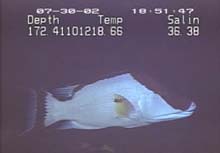
An adult male hogfish.  Click image to see a video.
Several exciting fish reproduction sightings were recorded during the submersible dives. At three sites, scamp grouper were seen in the gray-head courtship color phase, while a pair of hogfish also appeared to be in courtship display. A potential pre-spawning aggregation of at least 200 red snapper was seen, and gray triggerfish were observed possibly guarding nests consisting of hollowed out depressions in the sand. These behaviors, however, will need to be confirmed by additional study of videotapes.
Some of these reefs were visited by the same scientists, using the same submersible, 17 years ago. The dives conducted during this mission further characterized the amount of rocky habitat, and in contrast to the previous dives it was observed that the numbers of commercial or recreational important fish species were much lower, and in some cases some species were lacking.
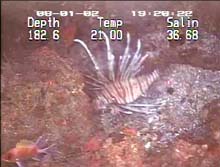
The red lionfish, with its highly venomous spines, was sighted several times during dive operations. Click image to see a video.
Perhaps the most sensational discovery of the mission was the sighting of the red lionfish, Pterois volitans, an unmistakable marine fish with highly venomous spines that is native to western Pacific waters. These fish had been recently reported from Florida to North Carolina in shallow near-shore reef systems, but had never been observed or photo-documented in association with deeper reefs. Six lionfish were observed during three of the nine dives made along the shelf-edge reefs off South Carolina to depths of 193 ft. The frequent sighting of this invasive species suggests that it is rapidly becoming established in these reef areas. Eradication of this species from these depths will be impossible, and the impacts of its presence are unknown at this time.
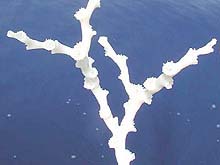
This is a healthy branch of Lophelia coral sampled from the deep ocean reefs off the coast of South Carolina. Unlike tropical species of coral, Lophelia possesses no zooxanthellae (a symbiotic dinoflagellate) which often give their coralline hosts beautiful colors. Click image for a larger view.
Mission 2: August 5-15, 2002
Read full summary (PDF, 1.3 Mb)
This mission explored two major types of unique and biologically productive habitats along the North Carolina coast, both of which have seen an increase in commercial and recreational fishing activities, as well as increasing interest for hydrocarbon exploration and development. Given that human activities are expanding into these areas, as well as the lack of knowledge concerning the habitats, species, and how they function, this research is critical. Furthermore, learning more about these deep water systems will help scientists and natural resource managers understand more about potential connections with shallower water systems.
During this mission, the science party was able to make much progress toward characterizing two deep-reef systems (>1000 ft) comprised almost entirely of Lophelia pertusa, a branching tree-like coral that forms expansive banks along the continental slope. Scientists were able to collect enough information on habitat, species and ecology, to determine that the invertebrate and fish communities were very different between the two systems, despite only being separated by 50 miles. Overall, the habitat in these areas appeared to be healthy, but very little is known about these areas so establishing a baseline for health is difficult.
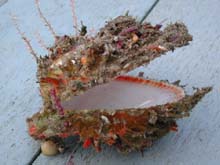
This deep sea scallop shell was retrieved by the Johnson-Sea-Link II submersible during a dive at an area off the South Carolina coast called “The Steeples”. Even though the scallop within the shell has died, the shell itself provides a home for bryozoans, tunicates, serpulids, and algae which grow upon it. Click image for a larger view.
Scientists also explored some shallower reefs, comprised of rocky outcrops and a diverse community of corals, sponges, benthic organisms, and fish species. Observations made while transiting over extensive sand fields to target outcrops indicate that even small areas of outcrops provide habitat for numerous species. As with Mission 1, scientists observed numerous lionfish along these reefs, some at depths approaching 300 ft.
The mission to investigate these areas was a success on all counts. The data obtained – video tapes, audio tapes, specimens, water chemistry – will be assessed in conjunction with data collected from these areas over the past few years in an effort to develop a better understanding of their characteristics, status and health, and to assist with establishing potential Marine Protected Areas. In addition, the data will be used in continuing efforts to engage students and teachers.
This is a healthy branch of Lophelia coral sampled from the deep ocean reefs off the coast of South Carolina. Unlike tropical species of coral, Lophelia possesses no zooxanthellae (a symbiotic dinoflagellate) which often give their coralline hosts beautiful colors. Click image for a larger view.
Mission 3: August 16-31, 2002
Read full summary (PDF, 2 Mb)
The science party for this leg of the expedition consisted of two groups of scientists from the Harbor Branch Oceanographic Institution. The first group searched for previously undiscovered compounds in marine organisms that may be able to study, treat, or diagnose human diseases. The samples collected primarily consisted of sponges and octocorals. The abundance and diversity of these organisms was greater than expected, and over a half-dozen new species of sponges were recorded. Although much of the processing of these samples will be performed post-mission, the potential for pharmaceutical use looks promising. Initial chemical profiles of sponge and octocoral extracts indicated that novel compounds were present in many of the samples. Antimicrobial activity was also exhibited by several species.
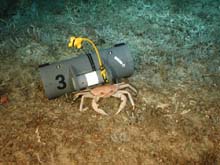
The second project focused on enhancing our understanding of how bottom-dwelling organisms visualize their environment, particularly with regard to bioluminescence. Two instruments were specially designed for this study. One was the Eye-in-the-Sea camera, which was meant to be left on the sea floor for one or two days at a time to record the surrounding bioluminescence in the absence of the bright lights and loud noise of the submersible. The hard disk failed during the first dive, making it impossible to collect many images of bioluminescence in this way. The limited recordings, deployment and retrieval worked well however, suggesting a promising future for this new instrument. The second specially designed instrument was an insulated benthic trap that was deployed from the submersible to collect organisms and bring them to the surface without blinding them or damaging their eyes with the relatively bright lights at the surface. The benthic traps successfully caught two healthy crabs, whose undamaged eyes were then put through a number of tests to determine how they are adapted to see their environment. The scientists made the first ever electrophysical recordings from deep-sea benthic organisms with intact eyes.
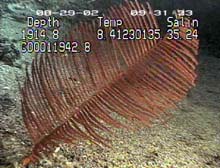
This Black coral was spotted during one of the submersible dives. Click image for a larger view.
Also discovered was “Reed's Peak”, a 500-ft-tall coral pinnacle at the Stetson Reef site, one of the highest deep-water Lophelia coral pinnacles known. It was found on the eastern edge of the Blake Plateau, approximately 140 nautical miles southeast of Charleston, SC. It consisted of live bushes of Lophelia coral and coral debris on its flanks. The crest consisted of a flat plateau at 2050 ft, covered with live coral, sponges, gorgonians and black coral bushes.
Conclusion
The work conducted during the Islands in the Stream 2002 expedition carries on a tradition of exploration and research in the South Atlantic Bight region. The data collected on habitats and organisms is critical to furthering scientific research, aiding natural resource managers with making decisions on how to best protect habitats and species for long-term sustainability, to enhance efforts to educate future scientists and managers, and to provide the public with a growing awareness of the richness and diversity found in the marine environment. “It’s amazing to me that we know more about the face of the moon than we do about what’s under our oceans.” -- Liz Baird, Co-Principal Investigator, Mission 2, Islands in the Stream 2002.
Sign up for the Ocean Explorer E-mail Update List.


