


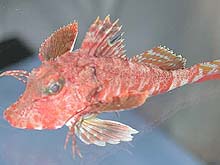
While it can swim, this bottom dwelling fish usually moves across the ocean floor crawling on a pair of modified pectoral fins. Click image for a larger view.
First Day on the Job
August 06, 2002
Bruce Moravchik
Web Coordinator (Leg 2)
NOAA Ocean Service
Today was the first full day of operations for the second leg of the Islands in the Stream 2002 Expedition. It was a picture perfect day to begin exploring the unique outer shelf and slope habitats off the Carolinas. The calm weather and seas were a welcome change from the winds and choppy waves we experienced during our six-and-a-half hour transit from Charleston, SC to meet the R/V Seward Johnson as it conducted research operations seventy miles offshore.
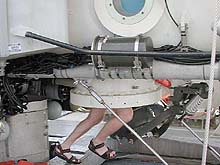
One of the JSL II dive team enters the aft observation compartment to flush the compartment with air and check on the carbon dioxide sensors. Click image for a larger view.
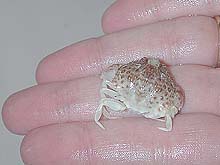
A member of the calappidae family of crabs collected by the JSL II during a dive to the Steeples. Click image for a larger view.
Upon arrival yesterday, we prepared the wet and dry labs, and discussed operating procedures for submersible and sampling operations. The overall plan for our mission is to investigate four distinct areas—the Steeples, the proposed "Snowy Wreck" marine reserve, an area called "Mid Bay" which is suspected to contain numerous outcroppings harboring a wide variety of fish and invertebrates, and the Lophelia coral banks. Our team will be using the Johnson-Sea-Link II (JSLII) to conduct video transects and collect representative species. We also will be using a variety of nets to collect additional species and data. Our objective is to add to the growing body of data that characterizes the habitat in these areas, as well as how these areas function
The objective of today’s submersible dives was to collect data in conjunction with a nearby fishing vessel. We wanted to see whether the composition of fish in the area observed via submersible was similar to the fish being caught in the fishing vessel’s nets. The fishing vessel can only infer from what they catch what the underwater ecological community looks like. The submersible, however, can make direct visual observations of these fish communities.
The morning dive was delayed for two hours when sensors picked up unusually high levels of carbon dioxide in the JSL II’s aft observation compartment. The compartment was flushed with compressed air, and the sensors were checked and recalibrated. When the carbon dioxide readings were found to be at normal levels, the dive was allowed to proceed.
After descending 400 ft, the JSL II reached a sandy-bottomed area. Unfortunately, this type of habitat does not attract many of the commercially valuable species that we had hoped to observe. Most fish prefer to live in more structurally complex habitats where they can find more food and shelter from predators.
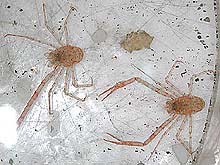
These crabs are members of the galatheid family, commonly known as squat lobsters. Click image for a larger view.
Although few reef fish were observed in the area, numerous invertebrates and some bottom-dwelling fish were seen. Some of these were collected and brought aboard the ship for further examination. These included galatheid and calappidae crabs, a sea robin and a dragonete fish. While these specimens do not tell us much about the reef fish communities we were hoping to find, they provide us with valuable insights about the bottom dwelling communities living between the complex reef environments.
Sign up for the Ocean Explorer E-mail Update List.


