


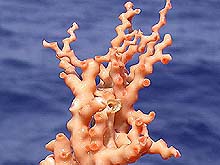
This beautiful piece of Madrepora occulata was collected at the Lophelia coral banks. Very different from the surrounding pale white Lophelia, we have never seen this type of coral here before. Click image for a larger view.
Views Forward, Views Aft
August 14, 2002
Dr. Martha Nizinski, Zoologist
NOAA, National Marine Fisheries Service National Systematics Laboratory
Dr. Steve Ross, Principal Investigator
Outer Shelf and Slope Project, North Carolina Coastal Reserve
The Johnson-Sea-Link II accommodates two scientific observers on every dive. One observer sits in the forward compartment, a 5-foot diameter and 4-inch thick plexiglass sphere. From this vantage point the observer has an almost unobstructed 360o view of the ocean depths. The aft viewing compartment is very different. Constructed of steel, it is about 5 feet long, 3 feet in diameter, and has only two 8-inch plexiglass portholes to look out of; one on the port side, and one on the starboard. On one dive to the deep water Lophelia coral banks, invertebrate zoologist Martha Nizinski, rode in the forward sphere, while Steve Ross, the principal investigator for this leg of the Islands in the Stream 2002 Expedition, rode in the aft compartment. Here they give us their impressions of their dive.
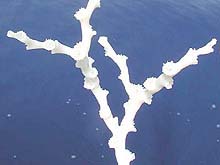
This is a healthy branch of Lophelia coral sampled from the deep ocean reefs. Unlike tropical species of coral, Lophelia possesses no zooxanthellae (a symbiotic dinoflagellate), which often give their coralline hosts beautiful colors. Click image for a larger view.
Views Forward
By Dr. Martha Nizinski
No description, photograph, or video can begin to prepare you for the spectacular views you enjoy from the bow sphere – truly a window to the deep sea. Only through direct observation can one begin to appreciate the great expanse of water that surrounds you, and the abundance and diversity of organisms living in these habitats. The views are awesome! What a privilege it has been to explore these deep-sea reefs and have the opportunity to see these animals up close; an opportunity most people will never have the chance to experience.
Few people are aware that coral reef-like structures occur off the coast of North Carolina. There are no rock-like corals, which are common in the tropics, present here. Lophelia is a delicate ahermatypic, branching coral that is found at depths in excess of 500 m. Although the diversity on the Lophelia banks is not as high as that on tropical coral reefs, Lophelia banks are home to a thriving assemblage of invertebrates. We have surveyed two different areas, but because of limited observations we are not able to make direct comparisons between sites. However, the faunal composition is similar between the two study locations and the organisms that occur there are very abundant. From the invertebrate perspective, these reefs are characterized by squat lobsters (three species), a lithodid crab, brittle stars (two to three species), anemones (two species), and sea urchins (three to four species).
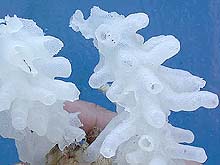
These are deep sea glass sponges retrieved at 1400 feet. Glass sponges are typically very fragile and rarely hold their shape when transported to the surface. Click image for a larger view.
Because these unique habitats are difficult to sample, each piece of information broadens our knowledge of the diversity of organism found here. During this expedition we have observed several species that have not been recorded previously from these study site. New additions to the invertebrate fauna include a glass sponge, another coral species, portunid crab, spider crab, hermit crabs, gastropods, bivalves and barnacles.
Many of the invertebrate species we have observed in our research sites have not been studied in detail, especially in their natural habitat. Working from the sub, taking video and collecting voucher specimens allows us the opportunity to identify the animals, observe live colors and behaviors, and assess the assemblage of organisms that live in these deepwater habitats. In many cases the majority of information available on these animals comes from museum specimens, where colors have faded and behaviors are impossible to observe, or from the literature. Habitat characterization and biodiversity assessment is the first step in answering community structure and function questions. We need to know what is out there before the more difficult questions can be answered.
Views Aft (aka: Attack of the Swordfish !)
by Dr. Steve RossEarly in this dive I experienced one of those rare encounters that keeps marine biology exciting. We were moving along the side of a sand ridge covered with deep water corals (Lophelia) at a depth of about 440 meters. I was in the stern compartment of the Johnson-Sea-Link submersible, alternately observing from both portholes. I looked out the port side down the slope of the ridge into the depths, and very suddenly, but very clearly, a large fish swam straight for us. I immediately saw that it was a swordfish about 5-6 feet long. It came swooping up from the base of the ridge at high speed hugging the bottom. It obviously targeted the submersible and struck us high on the port aft side just above my porthole.
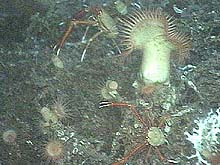
This deep sea anemone and galatheid crabs are extremely common on Lophelia coral banks. One member of our science party commented that the anemone resembled an underwater venus flytrap. Click image for a larger view.
A dull thud was heard throughout the sub. The whole episode took no more than 10 seconds, but it was clearly etched in my mind. While exciting, this type of "attack" has been noted before. A swordfish impaled the submersible Alvin, and wooden ships used to report having swordfish bills embedded in their hulls. Perhaps these aggressive fish view us as competitors for mates or food
The rest of our dive was more routine but nevertheless quite productive. We traversed a series of ridges and valleys, whose slopes and crests were covered with large thickets of Lophelia corals. These hard corals build complex reef structures, but unlike the tropical corals familiar to most, these carry out their lives in complete darkness and in cold waters (6-9o C). These coral colonies have been reported to be hundreds or even thousands of years old. Such habitats serve to concentrate animals, providing them with shelter and foods. Large lobsteret and Lithodid crabs cover these coral bushes, as do sea urchins, anemones, brittle starfish and basket starfish. Within the coral branches are many smaller invertebrates as well as fishes. Large conger eels, slimeheads (related to the orange roughy), smaller, rarely seen eels, and several species of scorpion fishes hover near or within the coral thickets. The bright red Alfonsin (Beryx splendens) was common during our dive as were several small sharks. Two of the shark species, a cat shark and a dogfish shark, were species that have been rarely collected or seen previously. We managed to snag one of the sharks with our collecting claw on the manipulator arm. Such collections are very important as they help us to verify the identities of what we observe in our videos as well as providing biological data (sex, size, reproductive state, etc.).
The three hour dive went quickly. It was a successful mission. We mapped out a large segment of reef, noting habitat characteristics. We collected corals, some fishes, hours of videotape from three different cameras, some still photographs, audio logs of all activities, and basic water chemistry data (salinity, temperature, depth, dissolved oxygen logged by the sub). And, a swordfish attacked us.
Sign up for the Ocean Explorer E-mail Update List.


