


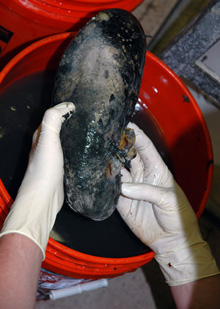
Scientists discovered several communities of football-size mussels, Bathymodiolus brooksi, at Mississippi Canyon 853 during deep submergence vehicle (DSV) Alvin Dive 4178. This is the biggest B. brooksi specimen ever collected. Notice staining from the oil that is sometimes found in the sediment around seeps. Click image for larger view and image credit.
Specializing in Bacteria
May 20, 2006
Jillian Petersen
Graduate Student
Max Planck Institute for Marine Microbiology
Bremen, Germany
27°22.39 N
090°34.53 W
 Alvin pilot Pat Hickey collects one of the largest mussels ever seen. (Quicktime, 1.52 Mb.)
The hands-on work begins in the afternoon when the deep submergence vehicle (DSV) Alvin is brought back on deck. We have to get our samples off the sub and into cold seawater quickly. These animals have been pulled up from the cool 4° C of the ocean floor, and will perish in the heat on deck. I am always excited when I look into the collection boxes and see that the DSV Alvin has brought back Bathymodiolus, the chemosynthetic mussels that inhabit cold seeps in this area. In fact, Bathymodiolus can be found at vents and seeps worldwide, which makes this a great system for studying biogeography.
So why is a microbiologist interested in mussels? The answer lies in the secret weapon of the mussels: they host symbiotic bacteria in their gills. Shallow-water mussels are typically filter-feeders, but the deep-sea Bathymodiolus mussels use their symbiotic bacteria as their own in-house food source. This may be the key to their worldwide success in chemosynthetic environments. The bacteria can use energy sources that animals can’t: sulfide and methane, compounds found in abundance at vents and seeps. They use the chemical energy stored in these compounds to make organic matter from carbon dioxide, in much the same way that plants make food from sunlight. The symbiotic bacteria provide food for the host in the form of organic matter, and the mussel, in turn, provides the bacteria with ideal living conditions.
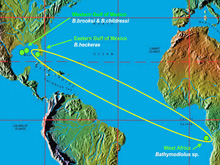
Despite the close geographical distance between Bathymodiolus heckerae, B. childressi, and B. brooksi in the Gulf of Mexico, the symbionts in B. heckerae are much more closely related to the symbionts in a species of mussel off the western coast of Africa. Scientists are still trying to understand how and why these symbionts on opposite sides of the Atlantic are so closely related. Click image for larger view and image credit.
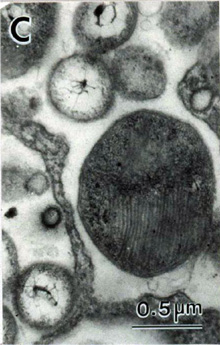
The image shows the two types of symbionts found in Bathymodiolus brooksi. The large circle is a methane oxidizing bacterium; the smaller circles are sulfide-oxidizing bacteria. Click image for larger view and image credit.
The story gets even more interesting. There are two different types of bacteria involved. One type can use methane as an energy source, the other sulfide. The way that the different species of mussel interact with these two types of bacteria is fascinating. For example, in the Gulf of Mexico we find three species of mussels with different combinations of bacterial symbionts. Both types of bacteria are found in Bathymodiolus brooksi and B. heckerae, but B. childressi has only one type — the methane-oxidizer. Researchers still don’t understand how some of these species co-occur, as they do at some seep sites in the Gulf of Mexico, with different symbiosis strategies.
The genetics of the symbionts is even more perplexing. The closest relative of the methane-oxidizing symbiont of B. heckerae doesn’t come from the Gulf of Mexico, but is a symbiont found in mussels at seeps off the West African coast. Deep-ocean currents crossing the Atlantic may be responsible for dispersing mussel larvae and bacteria, but more research is needed to answer this question. I’ll take my samples back to the lab in Germany to continue to study the genetic relationships.
That’s why it’s so exciting every time we can sample Bathymodiolus: the mussels we collect on this cruise will help us to understand more about symbiosis and about the distribution of organisms in the deep sea.
Sign up for the Ocean Explorer E-mail Update List.


