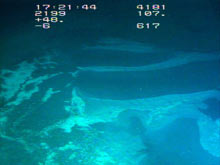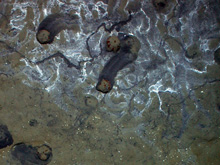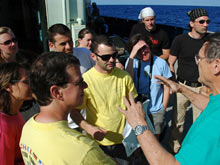
Once back on the ship, Harry Roberts excitedly describes the findings from deep submergence vehicle Alvin Dive 4181 to the rest of the science party. Click image for larger view and image credit.
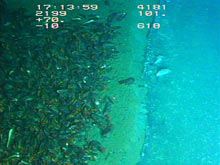
The distinct interface between a very extensive mussel bed on the perimeter of a large mud flow and brine seep feature at Atwater Valley Site 340. Click image for larger view and image credit.
Mussel Mound
May 17, 2006
Harry Roberts
Louisiana State University
27°38.84 N
088°22.41 W
 Video of the interface between a very extensive mussel bed on the perimeter of a large mud flow and brine seep feature. (Quicktime, 1.94 Mb.)
Today we visited Atwater Valley Site 340 (AT 340), water depth of about 2,170 m, where three previous dives have been made. AT 340 is a great site, with living tubeworms, mussels, and other benthic (bottom-dwelling) organisms like urchins and soft corals. The site was selected by studying geophysical maps of the bottom and also subsurface profiles that show the geology below the sea floor. The subject of this dive was an inviting target slightly to the northwest of the areas investigated earlier. This target had all the geological characteristics that suggested a productive site: highly reflective sea floor, indicating hard-bottom habitat, and a subsurface pathway to allow fluids and gases escape at the sea floor.
Our target was a mound that is about 10 m above the surrounding sea floor. We landed the deep submergence vehicle Alvin to the northeast of the target and immediately started running toward the mound. We soon started seeing evidence of hydrocarbon seepage, such as seep-related rocks, mussel shells, and small white bacterial mats. When we finally encountered the base of the mound it was truly an exciting experience! There were more tubeworm bushes and mussels than we had seen at any previous site during this cruise. The mound itself was made of mussels. Over the years, one layer of mussels after another had grown and died. The result was an entire mound of thousands of mussels cemented together. We named the site “Mussel Mound.”
When we reached the top of the mound, we found living mussel beds and tubeworms growing out of cracks in the rocks as well as in free-standing bushes. Mussel shells outnumbered the live mussels. The sheer number of the tubeworms was astonishing. Since the main objective of the dive plan was to collect mussels, we focused on mussel-pot collections and saved the tubeworms for later.