Photo & Video Log
This page contains photos and videos taken during the "Thunder Bay 2010: Cutting Edge Technology and the Hunt for Lake Huron’s Lost Ships" exploration taking place between August 16-27, 2010. Click on any image to view
a larger version and for additional information.

If a movie camera icon
is
present, a QuickTime video can be viewed by clicking on the image. Other
video formats are available on the linked pages. If a Podcast icon
is
present, a video or audio file is available for download or you can subscribe to the RSS Podcast Feed. ![]()
If a slideshow icon
is
present, a visual log of exploration images can be viewed. You can scroll
through them one by one, or select the play button for an automatic slideshow.
(HR) = "High Resolution" images available.
Video & Slideshows
Images
Mission Summary
These piles dot the northern half of Thunder Bay near Alpena. Each circle is roughly 15m in diameter and some contain lumps of coal.
Mission Summary
In the northern half of Thunder Bay there are numerous 'tracks' appearing similar to anchor drags, but they are often 17m wide.
Mission Summary
The bottom in this area has a brush-stroke appearance that might be glacial scrapings and brighter lines that may be drag marks.
Mission Summary
A very simple and effective technique to transport the AUV to the marina and launch it was to use a standard boat trailer.
August 27 Log
The ATLAS in the water while the team prepares to attach it to the crane during the last recovery of the mission. (HR)
August 23 Log
The 40 Mile Point lighthouse was named because of its location — 40 miles southeast of Mackinac Island, 40 northwest of Thunder Bay. (HR)
August 23 Log
Here you can see remains of the J.S. Fay — which washed up on the beach in front of the 40 Mile Point lighthouse in 1905. (HR)
August 23 Log
The Old Presque Isle lighthouse was completed in 1840, but was replaced by the New Presque Isle lighthouse 31 years later. (HR)
August 23 Log
The Alpena Breakwater Light at sunrise as the ATLAS team leaves the harbor to begin surveys. (HR)
August 22 Log
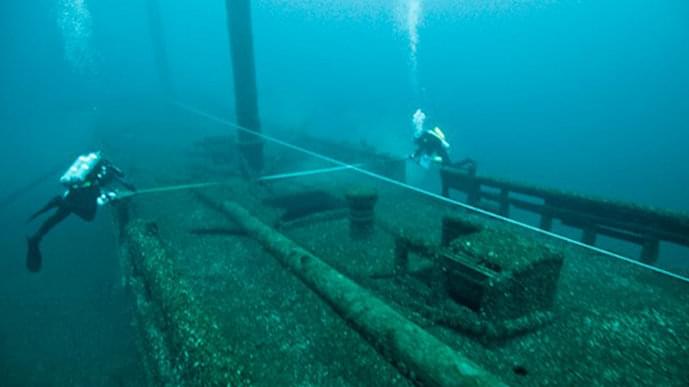
Maritime archeologists document the Montana, a wreck in the area that the ATLAS imaged during this expedition. (HR)
August 20 Log
During a night time recovery, Jonathan Hartje remotely navigates the ATLAS towards the research vessel. (HR)
August 19 Log
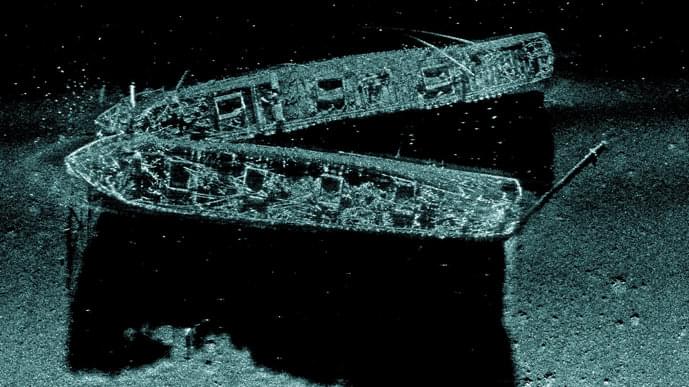
This image shows the shipwreck Gilbert as imaged from the ATLAS. The lighter area is closer to the AUV. (HR)
August 19 Log
Scientists are still not sure what to make of this image, however it’s been showing up fairly consistently in the data so far. (HR)
August 19 Log
Here, there’s a change in bottom depth that the ATLAS picked up and you can see a geological feature that is similar to a plateau. (HR)
August 18 Log
The University of Texas team launches the ATLAS around 11:30am and it will be in the water for nearly 12 hours. (HR)
August 18 Log
Clinton Johnson takes a sound velocity profile using a device that records temperature as it sinks to the bottom. (HR)
August 17 Log
Step 1—The team loads the AUV on a boat trailer in order to transport the 500-pounds that will then be loaded on the R/V Storm.
August 17 Log
Step 2—The ATLAS had never been launched from a boat trailer before, so it was a new process for everyone involved. (HR)
August 17 Log
Step 3—After guiding the ATLAS off the trailer, they detached the rope and used a remote to guide it over to the vessel. (HR)
August 16 Log
The work area where the AUV was unpackaged and assembled, provided by NOAA’s Thunder Bay Sanctuary. (HR)
August 16 Log
The ARL:UT team inspects one of the shipping pallets containing cases of equipment. (HR)
August 16 Log
The vehicle electronics section and sonar computers section of the AUV are assembled and inspected. (HR)
August 16 Log
The team runs tests on the electronic and mechanical components of the completed AUV. (HR)
Launching an AUV
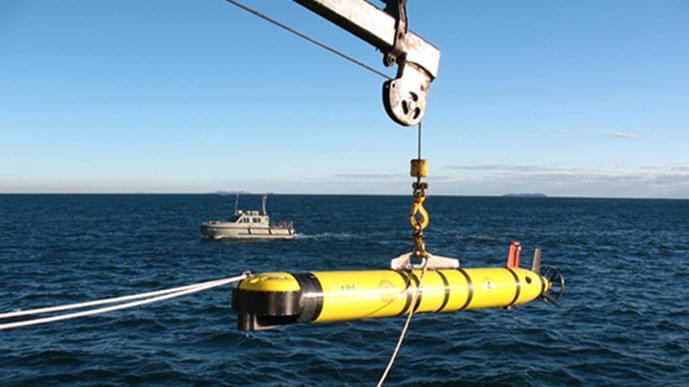
A view of the AUV just before lowering it into the water. It is about 20 feet above the water.
Sonar and AUV Technology
The ATLAS AUV free-swimming underwater vehicle, which is 1 ft in diameter and 10 ft long.
Sonar and AUV Technology
The ATLAS sonar is designed with a long detection and consequently a wide swath width.
Sonar and AUV Technology
Single ping from the ATLAS sonar shows the 200o sector with distinct small objects, bottom features, pier, and the shoreline.
Shipwreck Vignettes
The steamer R. G. Coburn, lost in an October 1871 gale with the loss of as many as thirty-two passengers and crew.
Shipwreck Vignettes
The steamer Gilbert and the shore-side infrastructure that kept her cargo hold full of bulk freight.
Thunder Bay
The remains of the 1840s sidewheel steamer New Orleans, one of the oldest known wrecks in the sanctuary.
Mission Plan
Archaeologists document the wreck of the schooner Defiance resting in 185 feet of water just north of the sanctuary.
Mission Intro
The team hopes to find shipwrecks in similar states of preservation as the one pictured in the background here- the 300-foot long bulk freighter Norman.
Mission Intro
The team will look first for historic shipwrecks searching within the historic shipping lanes.
Mission Intro
The bow of the 300-foot long bulk freighter Norman, located in 200 feet of water in northern Lake Huron.