


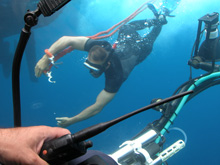
As part of the human-occupied vehicle (HOV) Thetis' recovery process, safety diver Vasilis Stasinos attaches large ropes to the HOV so it can be lifted out of the water and up onto the deck of the research vessel Aegaeo. Click image for larger view and image credit.
Detecting Disappearing Gases
June 27, 2006
36 N, 24 E
Dr. Richard Camilli
Co-Principal Investigator — Project PHAEDRA 2006
Assistant Scientist
Woods Hole Oceanographic Institution
Our mission during this morning’s second dive is to explore for hydrothermal vent sites off the coast of Milos. Over the previous days, our Greek colleagues from the Hellenic Center for Marine Research have used acoustic echo soundings from the ship to identify likely areas of venting. I wake up at 5 am following a few hours of sleep, and begin mission preparations. Dawn breaks as I step out onto the fantail (the rear deck of the ship), and I can see the planet Venus shining over Milos against an orange-pink sky. A celestial Venus de Milo to greet me this morning.
Dive preparations leave us without time for breakfast, only a quick cup of Greek coffee, and by 7 am the human-occupied vehicle (HOV) Thetis begins her descent into Aegean waters. Beginning at about 60 m depth, we plunge into a flurry of tiny white and yellow particles outside of the submarine. These particles, often referred to simply as "marine snow," limit our visibility to about 2 m at best. This is our first clue that we are close to an active vent site. We arrive on the sea floor at a depth of 102 m (334 ft) and transmit our position to the mother ship Aegaeo. One last systems check, then we initiate sensor startup sequence and start our search for the vents.
We first head east, then north. The onboard chemical sensors allow us to identify active venting areas within seconds of encountering them. We combine sensor data with acoustic navigation to provide the critical data needed to survey each site. We quickly gather water and biological samples to take back to the ship for analysis.
At one of the vent sites we notice what looks like a strange organism – it's cylindrical shaped like a sea sponge, but white with a shaggy surface. Kostas gently plucks this furry little wonder from the sea floor with Thetis’ robotic arm and brings it closer to the sub for us to see. To our surprise it is a plastic water bottle covered with a microbial mat! We place the bottle in the sub’s basket so we can analyze the microbes and also do a little trash collection. Plastic garbage on the sea floor is not unusual. Unlike most metals and organic matter, plastics tend not to decompose in seawater. As a result, a tremendous amount of plastic rubbish has accumulated on the world’s sea floors in the short time since humanity has developed and used these materials.
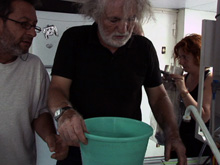
Geologists Andreas Sioulas and Christos Anagnostou prepare to handle rock samples collected during a Thetis dive, while organic chemist Aleka Gogou smells the collected samples, confirming the presence of hydrogen sulfide. Click image for larger view and image credit.
About an hour into our mission, the winds and seas increase to a point where it is critical that we surface immediately to be recovered by our mother ship, Aegaeo. This is slightly disappointing, but we must always operate with safety as the first priority for ourselves as well as for Thetis’ recovery diver, Vasilis Stasinos. Vasilis is the strongest swimmer I have ever seen – an underwater superman. As a part of the recovery process, he must dive into the water and swim to Thetis with large ropes. He attaches these to the submersible so that Thetis can be lifted out of the water and up onto the deck of Aegaeo.
One of the things we discover during this dive is the presence of hydrogen sulfide — an exciting find because hydrogen sulfide reacts rapidly with dissolved oxygen in the water and disappears. In fact, later gas chromatograph analysis of the samples we collect at the site do not show the hydrogen sulfide. It does reveal byproducts that indicate hydrogen sulfide was present; but by the time the samples were returned to the ship’s lab for analysis, the gas itself was gone.
During a subsequent Thetis dive, a geologist collected rock samples exhibiting a coating of sulfurous material. Back in to the ship’s lab, our own noses confirm the presence of hydrogen sulfide, which smells like rotten eggs. We even have to open the doors and portholes to clear out the air! While human sense of smell may not be as scientifically accurate, having in-situ chemical sensors on board Thetis allowed us to "sniff" out and relay the presence of a gas that otherwise may not have been detected, providing more data about the vent chemistry of a particular site.
Sign up for the Ocean Explorer E-mail Update List.


