


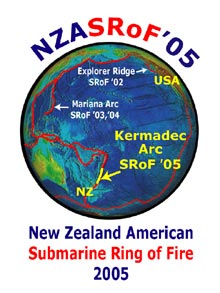
The New Zealand American Submarine Ring of Fire 2005 (NZASRoF'05) expedition took place on the Kermadec Arc, northeast of New Zealand (indicated by the thick, yellow line). The image shows a global view of the Pacific Ring of Fire. The 3 previous Submarine Ring of Fire expeditions are indicated at Explorer Ridge and the Mariana Arc. The dashed line is the crest of the Mid-Ocean Ridge system and solid lines show plate boundaries defined by island arcs and trenches. Click image for larger view.
New Zealand American Submarine Ring of Fire 2005 - NZASRoF'05
April 3 - May 10, 2005
The New Zealand American Submarine Ring of Fire 2005 (NZASRoF'05) Expedition
explored active submarine volcanoes in the Kermadec Arc, located north
of New Zealand, with a pair of manned submersibles. This is a subduction
zone where tectonic plates converge and a chain of restless volcanoes is
formed along the boundary. The dive sites chosen were at volcanoes
that showed evidence of having vigorous seafloor hot springs. This evidence
comes from previous New Zealand / American expeditions to the area that
mapped the seafloor and surveyed the ocean above each volcano for
signs of hydrothermal plumes. Seafloor hot springs are dynamic environments
where heat and chemicals from inside volcanoes are vented into the ocean
and support unique biological communities. Most of the dive sites have
never been visited before and so the potential for exciting discoveries
was high.
Visit the  Kermadec
Arc virtual fly-throughs of the nine individual dive sites.
Kermadec
Arc virtual fly-throughs of the nine individual dive sites.
Updates & Logs
Click images or links below for detailed mission logs.
 Leg 2 Summary The
second leg of the expedition traveled over 1350 kilometers, visited
four underwater volcanoes and was a total success.
Leg 2 Summary The
second leg of the expedition traveled over 1350 kilometers, visited
four underwater volcanoes and was a total success.  Includes
slide show
Includes
slide show May 9, 2005 Brothers
volcano is arguably the jewel in the crown of the NZASRoF expedition. Scientists discovered that there
was active hydrothermal venting, in the form of “black smoker” chimneys,
along the northwest caldera wall.
May 9, 2005 Brothers
volcano is arguably the jewel in the crown of the NZASRoF expedition. Scientists discovered that there
was active hydrothermal venting, in the form of “black smoker” chimneys,
along the northwest caldera wall. May 6, 2005 Scientists find that Rumble V is a classic-looking volcano, with a
cone that rises from the seabed at over two kilometres (>6500 feet)
water depth to a summit only metres across.
May 6, 2005 Scientists find that Rumble V is a classic-looking volcano, with a
cone that rises from the seabed at over two kilometres (>6500 feet)
water depth to a summit only metres across. May 5, 2005 As a storm strikes the ship, most of the science team hunkers down. The
large hanger door holding the Pisces IV submersible is stuck
in the closed position after a large wave smashed into it. Includes
slide show
May 5, 2005 As a storm strikes the ship, most of the science team hunkers down. The
large hanger door holding the Pisces IV submersible is stuck
in the closed position after a large wave smashed into it. Includes
slide show  May 4, 2005 There were high expectations of new life forms and
new fields of black smoker chimneys leading up to the first dive at
the Healy Volcano. Yet, scientists found the
caldera covered with blankets of orange-red microbial mats and delicate
and intricate chimneys of
material rich in iron and silica. Includes
slide show
May 4, 2005 There were high expectations of new life forms and
new fields of black smoker chimneys leading up to the first dive at
the Healy Volcano. Yet, scientists found the
caldera covered with blankets of orange-red microbial mats and delicate
and intricate chimneys of
material rich in iron and silica. Includes
slide show  April 30, 2005 Alex Malahoff, a 35 year veteran
of diving, dove to the seafloor at Clark volcano. Two
large sulfide chimneys were discovered streaming hot water at a temperature
of 221° C (430° F).
April 30, 2005 Alex Malahoff, a 35 year veteran
of diving, dove to the seafloor at Clark volcano. Two
large sulfide chimneys were discovered streaming hot water at a temperature
of 221° C (430° F). April 29, 2005 The expedition team waits for the seas to calm. The winds over
the past few days have made it unsafe to launch the submersible.
April 29, 2005 The expedition team waits for the seas to calm. The winds over
the past few days have made it unsafe to launch the submersible.
 Leg 1 Summary Shallow hydrothermal systems are venting into the
photic zone at 160-180 meters. Read
about this and other exciting discoveries in this summary log. Includes
slide show
Leg 1 Summary Shallow hydrothermal systems are venting into the
photic zone at 160-180 meters. Read
about this and other exciting discoveries in this summary log. Includes
slide show  April 22, 2005 Scientists in the PISCES V made their final
dives of Leg I on Volcano “W” and Rumble V.
April 22, 2005 Scientists in the PISCES V made their final
dives of Leg I on Volcano “W” and Rumble V. April 18, 2005 So what is it like to be an explorer … to
go where no one has ever been before? Includes video.
April 18, 2005 So what is it like to be an explorer … to
go where no one has ever been before? Includes video. April 15, 2005 View the diverse
biological fauna and marine life that the Macauley cone hydrothermal system supports. Includes
slide show and video.
April 15, 2005 View the diverse
biological fauna and marine life that the Macauley cone hydrothermal system supports. Includes
slide show and video. April 14, 2005 See how the scientists and crew get a 14 ton submarine with three people in and out of the water safely. Includes
slide show and video.
April 14, 2005 See how the scientists and crew get a 14 ton submarine with three people in and out of the water safely. Includes
slide show and video. April 12, 2005 A large
numbers of mussels are found fighting for a piece of real estate
near a warm hot-spring discharge. Includes
video.
April 12, 2005 A large
numbers of mussels are found fighting for a piece of real estate
near a warm hot-spring discharge. Includes
video. April 5, 2005 The expedition team discuss the
hazards of diving on Monowai,
an active submarine volcano.
April 5, 2005 The expedition team discuss the
hazards of diving on Monowai,
an active submarine volcano. April 3, 2005 The expedition team has settled
in and is making
the four-day transit toward their first dive site, Monowai Volcano.
April 3, 2005 The expedition team has settled
in and is making
the four-day transit toward their first dive site, Monowai Volcano.The Ring of Fire Missions
Click images or links below for more information on all Ring of Fire missions.
 Magic Mountain Virtual Site
Take a trip to the seafloor! Explore the hydrothermal vents of the Magic Mountain Chimney Fields via a series of interactive computer animations and videos. (Where is Magic Mountain?)
 Submarine Ring of Fire 2007
(July - August) Scientists return to the Kermadec Arc, to explore in great detail the Brothers submarine volcano. This will mark the most comprehensive exploration of this type of arc volcano and is one of the most vigorous geothermaly active yet discovered.
 Submarine Ring of Fire 2006
(April - May) Scientists return to explore active submarine volcanoes lying along the Mariana Arc, extending for more than 800 nautical miles.
 New Zealand American Submarine Ring of Fire 2005
(April - May) Join scientist as they explore the active submarine volcanoes along the Kermadec Arc, located north of New Zealand, with a pair of manned submersibles the PISCES IV and V.
 Submarine Ring of Fire 2004 - Mariana Arc
(March - April) An interdisciplinary team of scientists returned to the submarine volcanoes of the Mariana Arc to explore, utilizing an underwater tethered robot (ROPOS).
 Pacific Ring of Fire 2003
(February - March) An interdisciplinary team of scientists explored the submarine volcanoes of the Mariana Arc lying north of Guam in the western Pacific.
 Submarine Ring of Fire 2002
(June - August) An interdisciplinary exploration team used new technology to investigate the birth of new ocean crust off the coast of western North America, part of the Pacific "Ring of Fire."


