


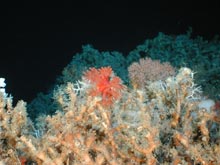
Scientists from the Harbor Branch Oceanographic Institution discovered a deep-water (2,000 ft) reef community in the Straits of Florida during NOAA's 2002 "Islands in the Stream" expedition. This coral (Anthomastus grandiflorus) is found there. Click image for larger view.
Medicines from the Deep Sea: Exploration of the Gulf of Mexico
September 8-19, 2003
During this expedition, explorers sought untapped sources of new drugs within the U.S. Exclusive Economic Zone. The team collected and studied marine organisms found in deep-water habitats in the Gulf of Mexico in their quest to identify new medicines.
Deep-water marine habitats constitute a relatively untapped resource for the discovery of drugs derived from natural products. Virtually no drug discovery research has targeted the deep-water reef communities in this region, and, in particular, the microbial associates living in these communities. The team at Harbor Branch Oceanographic Institution  had a proven record of success in this field with the discovery of discodermolide, an antitumor agent that entered Phase I clinical trials in 2003. Prior observations by the group, as well as extensive review of published reports, strongly supported the premise that these habitats would yield exceptional new discoveries.
Updates & Logs
Click images or links below for detailed mission logs and updates.
 Sep 19 A teacher from the Educator at Sea Program remembers the hard work, frustration, dedication and satisfaction of field research.
 Sep 18 See how scientist use Confocal Microscopy in their search for pharmaceutical compounds from the sea.
 Sep 17 Instead of the ROV, scientists use SCUBA to get up close and personal with the science.
 Video of the diversity of marine life hidden beneath oil platforms. (mp4, 3.4 MB)
 Sep 15 Developing the techniques for supply of marine-derived drugs from Aquaculture and Cell Culture.
 Sep 14 Lithistids are a very rare type of sponge that are not normally found at depths as shallow as today's dive site (~ 235 ft.).
  Sep 13 The world makes sense only if we can see it with our own eyes. Yet, it is the life you cannot see that holds the clues.
 Sep 12 SEABEAM acoustic mapping is used to identify the unexplored deep-water coral reefs.
 Sep 11 Like kids waiting to open presents on Christmas, the scientists awaited confirmation that they have actually collected the elusive Forcepia sponge. Scientists dive on potential Forcepia site. (mp4, 1.5 MB)
 Sep 10 The science party dives on a field of Forcepia sponge at Pulley Ridge. This is a significant find.
 Sep 9 Scientists depend on technology, science, their confidence and a little luck when exploring ocean depths, so cross your fingers...
 Sep 8 Understanding the patterns in chaos allow scientists to make educated decisions and predictions. Read more on the chaotic events surrounding the start of the new mission.


