


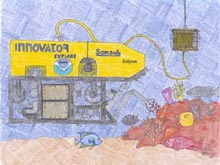
Chief Boatswain (pronounced "bosun") Bruce Cowden drew this graphical sketch of the Sonsub Inc. ROV Innovator collecting organisms on a reef. Click image for larger view.
Oases of Steel
September 16, 2003
Gary K. Wolfe
Marine and Environmental Education
Eau Gallie High School
Rollins College, Brevard, FL
I am writing this log entry with a porthole view of something I have never seen before. A few hundred yards away stands a steel oil-producing platform known as the BP Pompano oil platform. This platform brings crude oil from multiple wells some 1,300 ft below to the surface of the Gulf of Mexico. From within this city of steel begin the first stages of processing the oil. After the crude oil has undergone its first series of refinements on the platform, it is piped to an onshore facility to undergo further refining for a finished product.
Built in 1994, the B.P. Pompano oil platform has hosted thousands of men and women working round-the-clock. Not only does the platform become home to the workers, it is also prime real estate for many species of marine life that use its underwater jackets (legs) as habitat. Those of us who have spent any time at sea know that if suitable substrate is placed underwater, some form of marine life will opportunistically make it home. I wasn't prepared for what I saw in the underwater video footage, though. The jackets were teeming with marine life. The zonation in different types of organisms was amazing. Creatures that could withstand the force of the currents were on one side of the jackets, while those preferring lower currents inhabited the other side.
The soft bottom at the BP site makes it difficult for marine life to find suitable habitat, while the structures placed in the water by the oil and gas companies provide excellent habitat. When a structure is placed in an ecosystem, the process of recruitment onto those structures quickly begins. The first step in this process, known as primary succession, occurs when the initial life forms settle on the structures; these organisms are referred to as pioneer species. As the succession process continues, biodiversity increases, resulting in an ecosystem known as a climax system. These sites are popular with commercial and recreational fishermen due to the fish species that abound there.
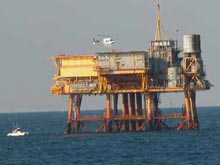
A helicopter leaves the BP platform as the Innovator ROV is launched. Imagine commuting to and from work by helicopter every day! Click image for larger view.
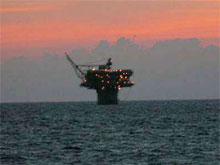
An oil rig at sunrise. When we woke up on Sept. 16, we found ourselves in a field of platforms similar to this one. Click image for larger view.
There has been a movement to designate decommissioned oil platforms as marine reserves due to the diverse communities that settle on them. At present, rigs must be removed after they are decommissioned, taking with them the benthic life forms that call the rigs home. These decommissioned rigs could provide ongoing habitat for many organisms that may prove beneficial in biomedical research. During today's ROV dives, we will be surveying the BP platform as well as an Apache platform. We hope to share new information with other scientists, government officials and especially the public about the marine organisms living on and around these oases of steel.
Sign up for the Ocean
Explorer E-mail Update List.


