


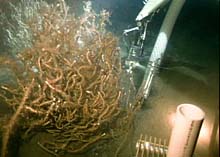
The larva of an unidentified polychaete worm collected from the plankton directly over a cold seep on the Louisiana slope. This worm larva may be from a seep animal on the bottom, but it may also be from a worm living in the sediment far away from any cold seeps. Click image for a larger view.
Leg 1 Summary: June 15-30, 2002
Chuck Fisher
Penn State University
During this leg of the mission, many different scientists were on board, and they had a variety of different objectives. We were able to accomplish most of our objectives for this first cruise, but bad weather and engine problems forced us to cancel many of our dives, including our last seven dives. Because this was our first cruise of the mission, our highest priority was to try out some new equipment built especially for the mission and to initiate experiments that we would complete on later missions (e.g., growth and larval settlement studies). Because we needed to conduct these experiments at places we already knew well, we did most of our early dives at two sites we knew very well and one nearby site that was more recently discovered, but had not yet been studied by biologists.
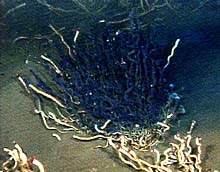
An entirely stained tubeworm bush. The whole bush stainer worked well and produced six bushes like this one. Click image for larger view.
We successfully used both of our new "toys" and were very happy with their performances. The first, "Big Sucker," is a powerful suction device designed to suck up the mud from around and under tubeworm bushes, which allowed us to see the extent of their roots and collect the bigger bushes with roots intact (something no one had ever done before). We collected two excellent samples of intact bushes with intact roots!
The second new toy was our “whole-bush-stainer,” which features a 100-gallon reservoir of stain mounted on top of the submersible. We used this stain to color an entire tubeworm bush. The stainer worked beautifully. We used it six times to start our growth studies of intact bushes of tubeworms. Now, every time we revisit these tubeworms, we will be able to see which animal has grown (and how much) by observing the new white tube that has grown past the blue-stained parts
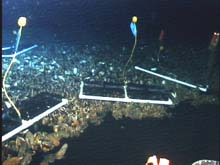
The larval settlement platforms deployed by the sub at the edge of the brine pool. These cages were filled with living mussels, mussel shells, or were empty. This was to test the settlement preferences of the seep mussel, Bathymodiolus childressi.Click image for larger view.
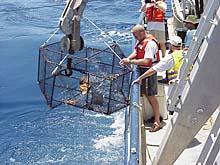
Recovery of one of the large traps placed on the seafloor away from seep sites. These traps caught many large scavenging animal. Click image for larger view.
We also were able to start an experiment to study settlement of mussels by placing a variety of larval settlement platforms at the Brine Pool. While we were initiating experiments and testing equipment, we also collected samples for the microbiologists on board. These included push cores of mud from bacterial mats and gas hydrates, samples of carbonate rock from all kinds of environments, and samples of mud from beneath and next to tubeworms.
Another major objective of the cruise was to collect non-seep animals and apply a special type of analyses of their tissues (called stable isotope analyses) to determine how much they feed on seep animals and bacteria. We collected some animals for these studies using the submersible, but we also deployed and recovered traps to collect animals not near the seep sites.
The final major objective of the cruise was to seek out and collect tubeworms (and whatever else we might discover) from seep locations on the Upper Louisiana Slope where we have not explored previously. We started at nearby sites and made the first-ever collections of tubeworm aggregations from two sites. We also stained some aggregations at these sites, where we plan to return on future missions to measure growth. We then set out to the west to explore and collect from new areas.
The first new site we explored was definitely a seep site. We spent more than an hour on the bottom cruising over clam shells and bacterial mats, but we only saw a single tubeworm and no bunches of tubeworms. Just as we were coming over a rise in the sea floor (with the neverending hope of seeing something new) we received a call from the ship. We had to surface immediately because the weather was getting bad and the seas were building. Unfortunately, that dive turned out to be our last of leg 1. We spent the next three days bobbing around and hoping for better weather. Then, on our second-to-last night at sea, the wind died, and the seas calmed. But an engine failed, forcing us back to port a day early.
Sign up for the Ocean Explorer E-mail Update List.


