


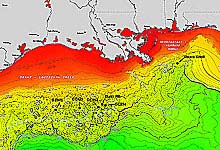
This map denotes dive sites from the first two missions in the Gulf of Mexico. (Image courtesy of NOAA, NGDC; Craig Young) Click image for a larger view.
Chemosynthetic Life in the Gulf of Mexico
Leg 1: June 15–30,
Leg 2: July 2-23,
Leg 3: October 6–19, 2002
The discoveries of chemosynthetic ecosystems, such as those at hydrothermal vents and cold methane seeps, have been hailed as some of the most important discoveries of the past century. The discovery of tube worms, ice worms and the array of associated fauna within these ecosystems has opened a new chapter in the discovery of life on Earth.
The Gulf of Mexico, home to extensive oil and gas lease tracts, has already been the site of numerous geologic studies and surveys. Due to this extensive background data, developed over five decades of geophysical surveys and piston coring, scientists have excellent information to use in planning new explorations.
A series of explorations took place this summer in order to discover and characterize new species at methane seep sites, explore unique outer shelf and slope habitats, discover new resources with pharmaceutical potential, and explore in the time domain by deploying time-lapse cameras and acoustically released seafloor experiments. Read a more detailed description in the Mission Plan.
Background information for this expedition can be found on the left side of the page. Daily updates are included below. More detailed logs and summaries of exploration activities are found on the right
Updates & Logs
Click images or links below for detailed mission logs.
 October 18 The expedition ends on a high note with the discovery of a deep-water reef off Mississippi. At 1,500 feet Johnson Sea-Link revealed a large expanse of coral thickets comprised of Lophelia coral.
 October 17 Johson Sea-Link uses acoustic moorings to find cages filled with mussels at the Brine Pool. Scientists are studying the mussels to understand seasonal reproduction in animals that don't experience and perceive seasonal changes.
 October 16 Chromosomes from tubeworm species are being used to learn more about their number, form and size in cold-seep organisms. Lab techniques for studying the tubeworm cells is quite a challenge on the moving, bouncing ship.
 October 15 Diving was too dangerous because of a cold front that brought 30 knot winds and 10 foot waves. The time was well spent in the lab examining mud samples for microscopic animals such as a harpacticoid copepod.
 October 13 The ancient skill of trapping and the modern technology of stable isotope analysis are used to determine if seep communities are included in the diets of deep-sea fauna such as giant isopods, large crabs and hake.
 October 12 Oxygen levels are usually below normal levels around cold seeps. A researcher tries to understand how one species, Orbiniid, adapts to the hypoxic environment.
 October 11 Scientists are trying to understand why mussels at the edge of the Brine Pool are so different from those on the outer edge of mussels beds. Three dives were devoted to deploying experiments on larval recruitment of Brine Pool mussels.
  October 10 Soon after tubeworms are brought to the surface they are dissected by scientists who skillfully "milk" eggs and sperm from adult tubeworms. After fertilization scientists observe embryonic growth to learn more about tubeworm biology.
 October 9 The "Bushmaster Junior" collection device captures more species than ever seen in a single collection. A tubeworm bush is collected that shows rare growth pattern.
 October 8 Either the bivalve clam, Acesta excavata, found only in the northeast Atlantic, or a close relative (possibly a new species) is discovered in the Gulf of Mexico. Learn about experiments being done to understand their feeding habits.
 October 7 The first two dives yielded important materials for scientific study but no chemosynthetic animals. The teacher on board reports his exciting experiences traveling to the seafloor aboard the Johnson Sea-Link submersible.
Sign up for the Ocean Explorer E-mail Update List.


