


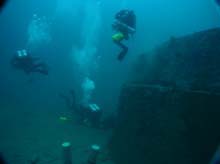
NOAA research divers explore the Monitor's turret. These free-swimming divers have good mobility and can hover or swim over the wreck. (Monitor Collection, NOAA) Click image for larger view.
March 25 - August 17, 2001
The USS Monitor, launched early in the American Civil War, has been called the U.S. Navy’s first modern warship. In 1975, her sunken and rusting hull became America’s first national marine sanctuary.
These pages chronicle a five month effort by Navy divers to recover the Monitor’s innovative steam engine and a section of her hull. The Navy employed a wide range of technologies in this effort, which was one of the largest archaeological recovery projects ever conducted. Monitor 2001 consisted of five expeditions to the Monitor National Marine Sanctuary, conducted in three phases. Each phase involved personnel from NOAA, the U.S. Navy, The Mariners’ Museum and other organizations.
Background information for this exploration can be found on the left side of the page. Weekly updates are included below. More detailed logs of exploration activities can be found on the right.
Updates & Logs
Click images or links below for detailed mission logs.
Aug 24 The 2001 mission has come to a successful conclusion.  Listen to Maritime historian Jeff Johnston of the USS Monitor National Marine Sanctuary discuss the mission objectives for the planned recovery of the ship's turret next year.
 Aug 17 The final dives on the Monitor are currently taking place. NOAA divers are using advanced technology to see what's buried within the silt filled turret. Read about these dives. Cmdr. Scholley has also provided her prespective on the Monitor mission.
  Aug 10 At long last the engine of the USS Monitor was presented by NOAA to the Mariners' Museum. John Broadwater greeted an ethusiastic crowd at the welcoming ceremony. Read John's log. Jeff Johnston has also provided his perspective on night diving.
 Aug 3 The Navy has completed diving this week and NOAA divers began their scientific survey of the wreck. Read more about the role that saturation diving played in the success of this year's mission.
 July 25 The engine arrived at the Newport News Shipbuilding on July 18, and now awaits a transfer to The Mariners’ Museum in Newport News, VA. After the engine arrives at the museum, it will undergo a lengthy conservation process. Read about the completion of Phase II.
 July 17 The lifting of the Monitor's engine was no simple task. It took years of planning and a coordinated recovery effort involving many project partners. This log entry explains in greater detail how the engine was recovered.
 July 16 The engine has been recovered! For the first time in 140 years, the 30-ton steam engine of the shipwrecked Civil War Ironclad, USS Monitor, broke the surface of the Atlantic Ocean. The NOAA team and scores of Navy divers worked around the clock for 28 days to free the engine from 240 ft below the surface of the ocean. The engine was placed on a barge and will be brought to The Mariners’ Museum where it will be placed in a 93,000 gallon steel tank so conservators can begin a 10-year process to preserve the historic engine. Read a first-hand account.
 July 6 Phase II is well underway. This week the dive team began attaching the main lifting slings to the Monitor engine. Amongst other artifacts, divers also retrieved a completely intact engine room thermometer. This precious artifact is currently in safe storage, happily reporting a temperature of 82 degrees! Due to poor weather conditions, the team anticipates that the engine should be ready for removal by mid-July. Read a status report.
Review the ABC clip.
July 6 Phase II is well underway. This week the dive team began attaching the main lifting slings to the Monitor engine. Amongst other artifacts, divers also retrieved a completely intact engine room thermometer. This precious artifact is currently in safe storage, happily reporting a temperature of 82 degrees! Due to poor weather conditions, the team anticipates that the engine should be ready for removal by mid-July. Read a status report.
Review the ABC clip.
 June 22 The barge arrived on site and 24-hour dive operations have begun. Navy divers have recovered many artifacts, and removed a keel plate that exposed the engine. The team is on schedule for an engine recovery operation in early July. Read the June 19 Status Report.
 June 15 After an intensive preparation and loading effort that began in mid-May, the salvage barge Wotan departed Houma, LA for a 2-week transit to the project site. Read about the special equipment it is carrying in the June 3 Log.
 May 15 With excellent sea conditions, Navy divers began the arduous task of installing heavy hydraulic rams, chains, and cables required for raising the Monitor’s engine. They came across an unexpected challenge. Read about it in the May 6 Log.
 April 30 The Navy team aboard the USS Grapple began deploying four large buoys to form a 1/4-mile square around the wreck. The four-point mooring system provides a diving platform for the June–July engine recovery expedition. Read an account of this leg.
 April 15 The NOAA research team has recovered data and artifacts from the wreck of the Monitor, including a bayonet handle and whale-oil chimneys. Read the Progress Report.
Sign up for the Ocean Explorer E-mail Update List.


